Showing posts with label Sociology. Show all posts

Saturday, April 12, 2025

Motonormativity 2

I wrote an LA Voter newsletter (for members of League of Women Voters in Los Angeles County) article about Motonormativity and the way that local, state and federal governments reinforce it with their laws and actions. 

Professor Ian Walker wrote in the 2023 paper, Motonormativity: how social norms hide a major public health hazard, “Decisions about motor transport, by individuals and policy-makers, show unconscious biases due to cultural assumptions about the role of private cars - a phenomenon we term motonormativity.” 

His results were replicated in in the US by Professor Tara Goddard in the 2024 paper, Windshield Bias, Car Brain, Motornormativity: Different Names, Same Obscured Public Health Hazard. 

Past WIG speaker and public health researcher Isabella Chu, MPH, also spoke about the hidden public health hazard that is the top killer of US children. Indirectly, through air pollution and involuntary inactivity by making active transportation (walking, cycling) dangerous, cars may be the top killer of people in the developed world of all ages. 

Transportation, mainly private automobile use, is the largest contributor of CO2 emissions in Los Angeles County and the largest source of PM2.5 pollution (except in the occasional years when particulates from wildfire smoke affects populated areas of LACO.) 

Yet, all this is invisible to most people and especially law and policy makers. In California, it is legal to kill with a car as long as you were not intoxicated, were not speeding, and stayed at the scene of the death. This applies even if a driver kills a cyclist in a crosswalk

ILO wrote a letter to Metro’s Board of Directors for omitting protected bike lanes on the Vermont Ave BRT (Bus Rapid Transit) project plans. The City of LA’s Mobility Plan 2035 (adopted in 2014) promised to address identified shortcomings by 2035 by implementing the plan as each section of the roadways had work done. The Mobility Plan showed Vermont Ave would receive both a protected bike lane and a bus priority lane. 

Vermont Ave is infamous as more people die on Vermont Ave due to traffic violence than in the entire state of Vermont every year. (This does not include deaths due to pollution and other indirect deaths.) The LA Times explained the situation in Lawsuit filed against L.A. over lack of bike lanes, claiming Measure HLA violations

Local actions are even more important as we can no longer count on the Feds to help us. Under the Reagan Administration, Federal transportation dollars were allocated in a rigid formula of 80% to highways and 20% to transit. 

The Secretary of the Department of Transportation is Reality TV and Fox Business personality, Sean Duffy. He made headlines recently when he rode the NYC subway with NYC mayor Eric Adams and subsequently told Laura Ingraham on Fox News that "even big men don't want to ride the subway." 


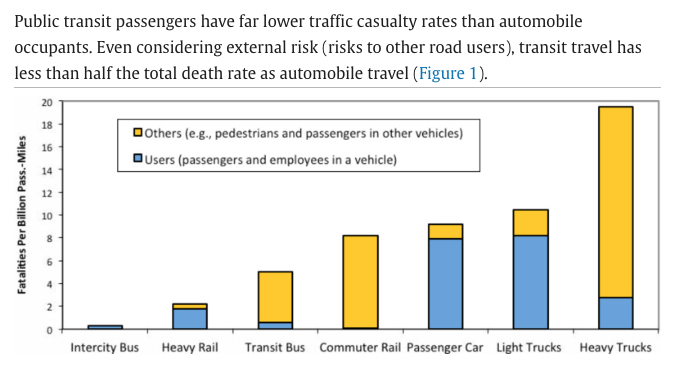
“Most transit trips include active transport (walking and/or cycling) links, and transit users tend to walk and bike more in total than motorists (Lachapelle et al. 2011). These modes have relatively high per-mile casualty rates, although this risk is largely offset by reduced risks to other travelers and improved public fitness and health, so per capita crashes tend to decline and overall health and longevity increase with more active travel in a community (Rojas-Rueda et al. 2011).” 
Transit is so safe that a 1% increase in transit mode share would result in a 2.75% reduction in road deaths. 

State lawmakers show similar characteristics of motonormativity. Until September 6, 2023, Californians could purchase EVs (electric cars) secure in the knowledge that they would receive guaranteed rebates of up to $7,500 for each EV, and that these would stack on top of Federal rebates of $7,500. The income cap was $200,000 for joint filers. California passed out over $1 Billion in EV rebates. 

Contrast that with the California eBike incentive, which has an income cap of $61,320 for a family of 2, and which exhausted the entire $10 Million allocated to eBikes within minutes. eBikes received only 1% as much money as EVs, despite global research showing that dual-mode households drove 19% less than before they obtained an eBike

 “Transportation is a climate and feminist issue. CA DMV data shows that women will spend twice as many years aged out of driving as men. Yet, our cities have not built infrastructure for people who don’t drive. 
… Car dependency is not just ruinously expensive, but it’s destroying the planet, and preventing nondrivers from fully participating in society. Women, as primary caregivers, are paying the time tax of chauffeuring people around. Protected bike lanes are mobility lanes, suitable for children on bicycles and seniors on mobility scooters alike.   
Local government decisions have kept us isolated and stressed.”

Wednesday, April 02, 2025

Motonormativity 1

 Sometimes, you need a name for something before you can see it. But, once you see it, you can't unsee it. 

I first heard of Motonormativity from this 2023 paper: Motonormativity: how social norms hide a major public health hazard

Lead author Professor Ian Walker recently gave a lunchtime talk to Streets For All and I highly recommend watching the video and reading the paper. 


There is a pervasive view that "everybody drives in LA", but that's just not true. About 1/3 of the population cannot drive because they don't have drivers licenses. They are too old, too young, too disabled, too poor, or just never bothered to get licenses for myriad reasons. Even if they do drive and own a car, they are burdened by high car ownership costs that can sometimes push them into homelessness. 

You have only to look at the different ways that the law treats people who kill with a car vs with another weapon. As long as you are not driving while impaired, were not speeding, and stayed at the scene, charges aren't even filed when a driver kills a pedestrian

Even when charges are filed, judges are very lenient. A driver who ran over a family in a crosswalk, killing the 4 year old and gravely injuring the father, was sentenced to 400 hours of community service

We also think nothing of speeding in school zones even though we wouldn't smoke around children. According to CDC statistics, cars are the leading killer of children in the US. Yet, we don't have any public health response to this crisis. 

Car culture is us, and we can change our culture and laws. 

Wales, where Prof Walker teaches, lowered their speed limit in urban areas to 20 mph. Collisions, injuries and deaths plunged. Because car insurance is based on loss claims, Welsh car insurance rates plummeted. Slowing down is good for everyone's safety and pocketbooks. 

Tuesday, June 06, 2023

We're unprepared for the Silver Tsunami

I was discussing Metro's Traffic Reduction Study for pricing roads (aka Congestion Pricing) to discourage driving. This very unambitious plan is targeting just three areas:
  1. DTLA (cordon area)
  2. I-10 between Santa Monica and DTLA (toll road)
  3. I-405 through the Sepulveda pass, including canyon roads (corridor pricing)
I wrote an analysis from a data-based and science (climate change, pollution) perspective, and encountered a lot of pushback. Everyone in the group is a driver, but I'm the only utility bicycle rider that rides in traffic. Others ride recreationally on the beach bike path or on low-traffic foothills roads. 

The reflexive response was, "What about the low-income (or moderate income) drivers?"

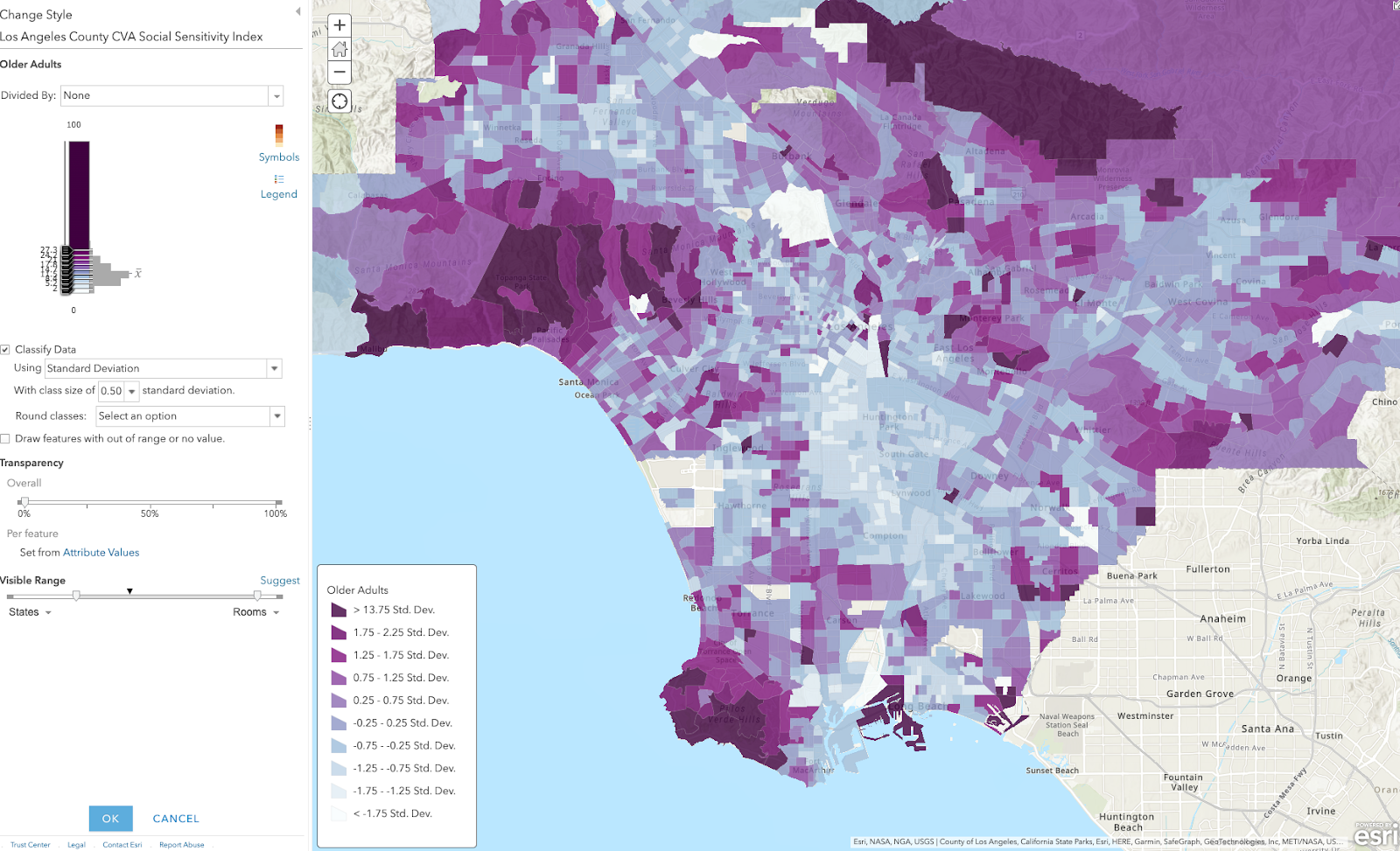
I was making maps using data from Los Angeles County CVA Social Sensitivity Index and was struck by how some areas of LA County are much older than others. That is, the coastal and hill sections have extremely high proportions of seniors.  It's especially dramatic if I map the census tracts by how many standard deviations they are from the mean. 


Darker magenta areas have more people over 65 years old than average. Bluer areas have fewer seniors. 

By implementation time for congestion pricing, today's 65 year olds will be > 73 yo. How long do you think they will be able to drive mountain roads? 

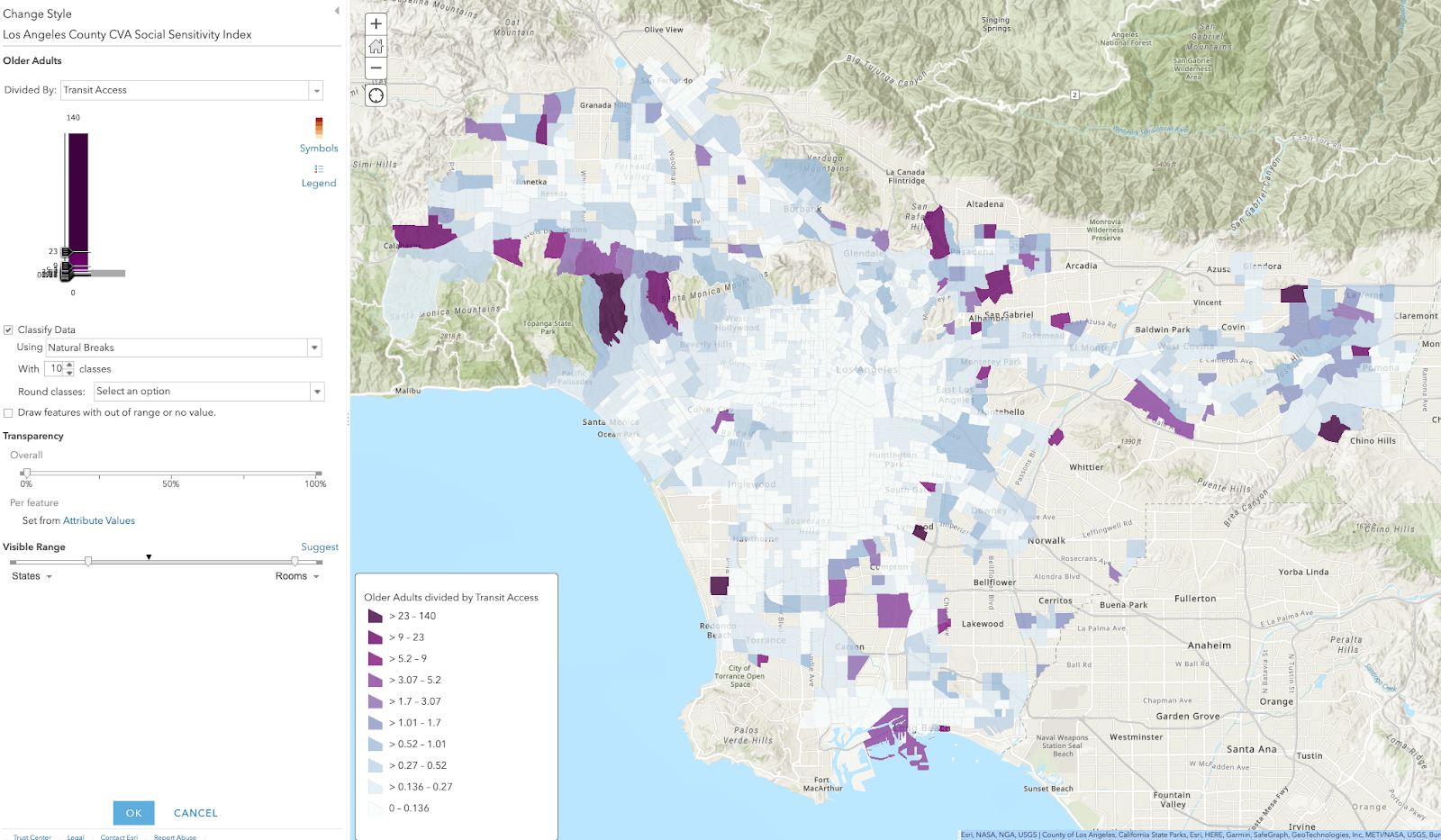
It gets more grim when I divided by transit access. These are high senior population percentage divided by standard deviations from mean transit access (which is already not great in LA County). 


Those are areas where we either need to improve transit and micro-mobility (for electric wheelchairs or sit-down scooters), or we need to move seniors out. Because people like to stay near their community, my preference is to coax them down from the canyons to multi-family housing where they are probably already driving for shopping, services, dining, recreation, or work. 

This leaves some voids in the flatter areas, which can be fixed by street space allocation, improved bus service, and some apartments near bike lanes & bus routes (hello, East Manhattan Beach). 

Anyway, congestion pricing is not going to harm seniors living in the canyons of Bel Air, Malibu, or Brentwood. They will soon age out of driving. It might cost them more to receive senior care in their homes if their caregivers have to pay to drive there. 

On the other hand, if it does improve traffic, then lower income workers will have more time for paid work and less unpaid time sitting in traffic. E.g. they can accept more clients per day because they will spend less time driving. This starts a virtue cycle where they won't have to pad their per visit charge as much, making senior care more affordable. 

You know what would create less traffic? If we let seniors live in congregate settings, where they each have their own small apartments, but caregivers are on site and can simply walk between clients. That would help alleviate traffic, the shortage of elder caregivers, and improve caregiver pay per hour. 

Instead of thinking about changes with fear, look critically at what is not working and how we might improve the status quo. 


Tuesday, March 22, 2022

World Water Day 2022: Groundwater

We've circled the sun one more time to another World Water Day. This year, the theme is Groundwater. 

I co-organize a monthly (Zoom) series for the League of Women Voters of Los Angeles County that grew out of a one-time water walking tour I led in the Beach Cities. We record and post all the Water and Infrastructure Group (WIG) lectures along with the slides. Occasionally, I add articles about what we learned or add further information on each month's subject. 


Mr. Matthew Hacker is a registered geologist in California and is currently a Senior Resource Specialist at the Metropolitan Water District of Southern California. He has more than 27 years of experience in water resources planning and local resource development in the areas of groundwater, stormwater, and water recycling. Currently, he is striving to create a more resilient water future for Southern California through innovative new projects such as Metropolitan’s groundbreaking Regional Recycled Water Program. 
His prepared talk is under an hour, half the video is Q and A. 

One fascinating thing I learned is that Metropolitan stores imported river water in the vast LA coastal aquifer. That water we pump out, treat, and deliver to our homes, may have originated in Northern California or Colorado. 

You can learn more about that by watching the Who Fills Your Taps? Video or reading the Who Fills Your Taps? Slide Deck. This is a marathon one that is better ingested in two bites. WIG co-organizer, Kathy Kunysz, is a scientist & planner who has had a long & varied career in water. She knows so much, it's an honor and an education to co-host this series with her. 

Monday, July 23, 2018

Thank-you Jonathan Gold and Linda Burum

I was saddened to read of Jonathan Gold's death over the weekend. Others wrote about his importance quite eloquently. Gustavo Arellano (Ask a Mexican) explained, "His strength lay in the fact that he wrote as someone thankful that the Los Angeles of today was not the Los Angeles of his youth."

Ruth Reichl, his friend and former editor wrote:
But Jonathan didn’t want us to go out to Monterey Park simply to eat Sichuan pickles. He didn’t lure us out to El Monte or the world’s best birria burritos for their mere deliciousness. He wrote enticing prose designed to take us out of our safe little territories to mingle with other people because he knew that restaurants aren’t really about food. They’re about people.

He gave us the keys to a hidden city, introduced us to folks we’d never have known. And the city changed. It is nothing like the city I found when I first came here in 1984.
If you want to understand LA, I highly recommend picking up a copy of Gold's classic, Counter Intelligence: Where to eat in the real Los Angeles.


Gold wrote a column for the Counter Intelligence column for the LA Weekly starting in the mid-1980s.  A collection of the columns was published as this book in 2000.

When we first moved to Los Angeles in the 1990s, A Guide to Ethnic Food in Los Angeles by Linda Burum (1992) was our LA food atlas.

We used to read the chapters (organized by ethnic food type) while looking at the AAA map of Metro Los Angeles (for the big picture) and the Thomas Guide for details. We planned outings to different areas of LA around food and walking around.

Until I moved to LA, I didn't understand it. It's still so vast and hard to describe. But food sociology is certainly a great way to start. Go out and explore. Eat. Look around. Listen. Talk to people.


I sat next to a food critic on a flight who knew Linda Burum. I asked why she didn't update her guide. He said that she moved to NY and was doing other stuff now. In the obituaries and tributes to the important work that Jonathan Gold and Anthony Bourdain have done in popularizing food sociology/anthropology, I see little mention of women.

I want to remind people not to overlook the women who were already there, doing the work in plain sight.  So many women have done the patient work of spending time in kitchens and explaining culture through food.   Culture has room for many heroes.

Monday, July 02, 2018

Sew Inspirational

Sew Becky Jo asked me to write up a post about five sewists that inspire me for the Sewcialists blog and I am happy to oblige.

I had to step back to think a little bit about what that means, or how I want to interpret this assignment. I'm exhausted from all the bad news lately, and have been reflecting deeply about how I can respond--push to make the world more in keeping with my values, while protecting my emotional core. Depending on how you see it, I am either a procrastinator or a researcher.

Several of the books I read in the last year dealt with how social media and technology is harnessed by authoritarians and liars for their own ends. Thus, I decided to focus on five sewists that are less active and "hot" (in the sense of popularity), but resonate with me. I'll also explain why.

Have you ever heard about the Weak Ties Theory? Changing Minds has a good synopsis. In short, social ties are either strong (between tight clusters of members connected mainly with others in the same group) or weak (bridges between strong networks.) 
The more weak ties we have, the more connected to the world we are and are more likely to receive important information about ideas, threats and opportunities in time to respond to them.
Strong ties are the echo/bubble chambers in which misinformation can ricochet without challenge.

Weak ties are the ways in which we expand our understanding about how others experience the world.

(If this interests you, read an academic paper by Mark Granovetter,  who first explained and gave a name to this effect.)

Sewing is a great way to add weak ties to your social media. We are all makers who encounter and solve similar problems. We can learn about sewing *and* about the greater world by following people who experience much different lived experiences than our own. In doing so, we can learn to empathize with people who don't look like us.


Blogger 1.

If I want to direct attention to less-known sewing bloggers, why am I starting my list with super-popular Carolyn of Diary of a Sewing Fanatic?  She's a super-star among bloggers for good reason.  She's been putting out quality content about her sewing journey since 2006, when the sewing blogger world was much smaller.  She's so generous with her time--showing what worked, what didn't, and analyzing why.

I've learned so much non-sewing information from her, too.

Through Carolyn, I've learned how challenging it is for plus-sized women to find professional and on-trend clothing, how much it means for African Americans that one of them was our president, and how personal BLM is when a mother has to send her son or grandson out in the world when so many see them only as a threat.

I read Carolyn to be a better sewist and a better person.

IG: @diaryofasewingfanatic


I'm intrigued by what sewists call Pattern Puzzles, novel ways to cut and shape garments.  Issey Miyake designs often fall in this category. So do the garments in the Pattern Magic series of books by Tomoko Nakamichi.

I follow many sewists that sew Pattern Puzzles and document their experiences to help others.  Some are less active on social media than they were in the past, but quality content is evergreen.


Blogger 2.

I first learned about Pattern Puzzles from Kathleen Fasanella of Fashion Incubator. She's blogged about Pattern Puzzles no fewer than 251 times!

Kathleen is less active in her open access blog than in the past. She runs a (paid) member forum for clothing manufacturers working in the US. I am not a member of that forum, but I hear it is a friendly and nurturing site full of people helping each other.

I have her book and it is an encyclopedia in one volume. Sometimes, I have to read it over several times because she can pack so much information in one paragraph and a few illustrations. Browse through her tutorials and use them. Your sewing will be so much better.

In 2015, she bought a factory--or rather, she built one in Albuquerque, New Mexico. You can follow her and her partners on IG @abqfi.

Another reason to follow Kathleen is to learn more about neurodiversity. She writes very movingly about how many of her life experiences made sense once she learned she is on the autism spectrum. The apparel manufacturing industry has traditionally been home to immigrants and people who think differently. This is it's strength.

 Like many people who are on the spectrum, Kathleen is a slayer of bullshit.

She compiled all her wisdom about The Myth of Vanity Sizing in one place. FYI, I went into this thinking vanity sizing is a thing. She completely convinced me I was wrong. Now I am smug because I know the right answer and there is no one more evangelical than the converted. ;-)

IG: @kathleenfasanella @abqfi

Blogger 3.

Lauriana of Petit Main Sauvage has sewn many pattern puzzles, though her recent makes lean more towards activewear. She works in a wedding dress salon and is generous with her knowledge.

I also enjoy her slice of life writing and photos of rock climbing, bicycle commuting and life in general in the Netherlands.  Plus, her organized, utilitarian and beautiful apartment (in the background of many of her photos) is a life goal.

If you like pattern pieces shaped like this, then this is a blog to read.  Start at the beginning and slowly work your way forwards in time.  I don't know if she is in IG.
Is this a bat or a sleeve?  Read and learn.

Blogger 3.5

Di of Clementine's Shoes took down all of her blog posts, so you can't see any of her Pattern Magic sewing experiments.  Some of the experiments worked.  Some failed.  They were real experiments.  It was inspirational just to watch someone who was up to try anything.

 I'm quite sad that she didn't leave her old posts up when she quit blogging.

Recently, she started posting on IG as @clementinesews. She also posts her work as an architect @dijonesarch. I hope she re-posts her old blog content, because it was really, really good. Oh, she knits and makes shoes, too.


The last two deal with disability or caring for the disabled along with sewing.

Blogger 4.

Many sewing bloggers order interfacing and other notions from Pam Erny of Fashion Sewing Supply. She is now my sole supplier of interfacing. No more bubbling from shrunken fusible interfacing!

Did you know that she also posts many helpful tutorials on her Off The Cuff Shirtmaking blog?

She doesn't write much about her personal life, but she's inspirational in that she is another math/physics person who created a second career for herself and her husband.

Don't you want to learn how to sew a placket like this?

Blogger 5.

Ms. Little Hunting Creek and I were frequent commenters on each others' blogs when we were both much more active bloggers.  We bonded over the fact that we both had the same Home Ec lesson in the 1970s in California.  We both earned BAs from UC Berkeley (Cal)--she in Classics, me in Mathematics.  We also both earned our livings in software despite not formally studying computer science in school.  Hey, if you can learn ancient Latin and Greek grammar, modern software languages are a piece of cake.

Berkeley's breadth with depth requirements for BAs meant that she had to take quite a few science classes (enough to earn a minor in Biology) and I had to take quite a few history classes.  This is probably the reason why Cal grads did not go on to found and run the tech companies that took down democracy around the world.

I suggest you read Sewing as Political Protest.

Her blogging slowed down due to health challenges that you can go over there to read about.  I find it inspirational that she could continue to work (but from home) and carve some time out to make stuff and blog about it.  Oh, she also wrote essays for the Toast.

From Wearing the Pants: A Brief Western History of Pants
According to Herodotus, when Greek soldiers met the Scythians in battle, they were amazed to see Scythian women on horseback fighting alongside the men, all wearing pants and decorated armor. When they went back to Greece they immortalized those Scythian women for posterity as the legendary Amazons in their poetry and art. Painting them looking both chic and fierce, their pictures of the Amazons are some of the earliest Western artworks showing women in pants. But even though pants came to the West from the Scythians and others (along with riding horses), in the West, wearing pants was associated with warfare and restricted to men only. Perhaps, remembering those Amazons, men feared what might happen to them if women were able to wear pants and get their hands on some weapons.
This is why I overcame my initial resistance to arming school teachers. If we armed the (mostly female) school teachers, perhaps they will enjoy the same high pay and cushy pensions as policemen. Amirite?


Each of these five bloggers have taught me things and even changed my mind by giving me new information or reframing it.  Let's keep on learning and making together.


Wednesday, December 13, 2017

Mturk and fauxtomation

Did you know that Expensify's “SmartScan” technology is actually people working for Amazon Mechanical Turk? Read more.
SmartScan is presumably a selling point for Expensify, since the receipts it handles can contain sensitive personal information, like names, purchase details, email addresses, and even bank routing numbers. So it was awkward when, last week, the company was caught posting receipts to an online marketplace for freelancers so that their contents could be transcribed not by SmartScan, but by humans.
No, I do not want Alexa or Google listening in on my conversations at home.

Wednesday, August 16, 2017

Beware of false moral equivalence

Speaking of recent bullshit, I am surprised by the lack of pushback in the media with respect to false moral equivalence. For instance, consider this article about the taking down of a confederate monument in Hollywood.  (I added the bold face.)
A spokeswoman for the Daughters of the Confederacy explained the group’s decision to remove the monument this way:

“I was afraid to leave it overnight,” said the spokeswoman, who asked that her name not be used for fear of reprisal. “We have had the cemetery remove it until we decide what to do.”

Those calling for the monument’s removal are “erasing history,” she said.

“I do not believe in slavery — no sane human would believe in that today,” she said. “But back then, they did.”

She condemned the violence in Virginia and expressed sorrow for those killed and injured.

“We weep for the people who are involved in all of the things that are going on in our country — on both sides. We find hatred among white supremacists, we find hatred among Black Lives Matter,” she said. “We should all come together and become one under the United States of America.”
On both sides?  ON BOTH SIDES?

Why didn't the LA Times reporters press this unnamed spokeswoman for the Daughters of the Confederacy to clarify what kind of hatred from the BLM movement she is referring to?

One side wants to celebrate the treasonous people who went to war for the right to enslave other people.  All BLM wants is for the police to stop killing them.

There is no both sides about this.  There is no moral equivalence.

There was a concerted social media effort to portray the BLM movement falsely.  A great deal of money was spent to smear BLM so that they would lose public support..  Zeynep Tufekci ably explained how this was done in Twitter and Tear Gas.  Read it!

[Addendum: ZT has posted a free pdf version of Twitter and Teargas but I hope you support her and buy a copy.]

Learn more about the Russian propaganda tool, 'whataboutism,' that is widely used by authoritarians, climate deniers and the right around the world.

I don't know what to call this

I am so effing tired that we have to even fight the dark forces that are threatening our country right now.  If you haven't already done so, I urge you to read Twitter and Teargas: The Power and Fragility of Networked Protest. Zeynep Tufekci has been studying the intersection of authoritarianism, technology and protest for decades and you really, really want to learn from her.

[Addendum: ZT has posted a free pdf version of Twitter and Teargas but I hope you support her and buy a copy.]

Meanwhile, I have an example of how adept the spinmeisters of satan are at manipulating technology and algorithms, I give you my search results yesterday for the "Southern Poverty Law Center Hate Map":

An ad or two appears before the search results, as is typical for Google searches. But look carefully. Notice that the top ad is for a website that exists solely to discredit the splc.org with completely fabricated lies? Who paid for that ad?  How do they act so fast?  There are literally armies of people working on spreading disinformation so that people give up and say that the fault lies with 'many sides.'  Don't be that dumbf*ck.

If you follow me on Twitter, you might have seen me tweet the screen capture to Google. Enough people must have done it because searches for the same phrase and SPLC in general are devoid of ads and go to the organization's site and map. BTW, this is the SPLC Hate Map tonight.

Less well-known, but deserves to be better known, is the Map of White Supremacy mob violence.


Don't miss @JuliusGoat's thread, 'Imagine if these people ever faced actual oppression.'

The white militia is here to demand your obedience with their guns.

AP photo via Mother Jones
Call me a feminazi, but I've never had to resort to carrying a gun to make you agree with me.


Thursday, August 03, 2017

Why are white people so afraid?

It turns out, white people who live among white people are at highest risk of being murdered or dying of illicit drugs.  Mike Males crunched the numbers in an LAT opinion piece.
I examined Centers for Disease Control statistics on murder, gun killings and illegal-drug overdoses among white Americans.
...
Rates of homicides, gun killings and illicit-drug fatalities are highest in counties where nine in 10 residents are white and where President Trump won.
...
Such counties are not limited to one geographical region. They include Boone County, W.V.; Washington County, Utah; Baxter County, Ark.; and Brown County, Ohio.
...
Overall, white Americans who live in predominantly white and Trump-voting counties are 50% more likely to die from murder, gun violence and drug overdoses than whites who live in the most diverse and Democratic-voting counties. The more white and Republican a county is, the greater the risk for white Americans.
...
Correspondingly, the white Americans who are safest from such deaths are those who live in racially diverse areas such as Los Angeles, New York and Chicago, where two-thirds of residents are nonwhite, where millions of immigrants live, and where voters favored Hillary Clinton in 2016. Nonwhites also are safer in these areas overall, though rates vary by location.
The last sentence is at the crux of the BLM movement. If you examine the evidence, white on black crime due to irrational fear, is the bigger crime problem in this country.  Trayvon Martin is not an isolated case.

Stand your ground laws make it impossible to convict someone of murder if they claim that they felt that their life is in danger.  If white people persist in irrationally believing that black people are dangerous, then they can legally get away with murder.  This is the new lynching.

It is the job of all of us to push back against irrational fear.  Don't let people like Trump get away with spouting lies without pushing back.  The lives of our fellow human beings depend on this.
Chawne Kimber's Self Study #4: the one for T

Tuesday, December 06, 2016

Colorado Gives 2016 Update

I already explained my misgivings about Colorado Gives and the inefficiency of philanthropy.

I found the Colorado Department of Revenue's Annual Report for 2015.

The dismal results of Colorado Gives 2015 proves my hunch is correct. A very, very small number of people (less than 63,690 Coloradans) gave a measly $28.5 Million (much of that in recurring gifts that would have occurred anyway.)

Census.gov estimates that Colorado has 4.2 million adults 18 and over.  This means about 1.5% of Coloradan adults gave something.

Colorado taxes are a regressive disgrace.  They manage to be even more regressive than the sad nationwide average.  See how your state stacks up.

 To file part-year taxes for Colorado and California, I first calculate my taxes as if I solely resided in CA or CO.  I would pay about 3% more of my gross income to live in CA over CO. But Californians enjoy more legal, environmental and economic protections as well as higher levels of service from government.  If Colorado just followed California's example, we wouldn't have to resort to begging.

During the presidential campaign, one candidate bragged that not paying taxes makes him smart, normalizes tax avoidance.  Furthermore, he also gave virtually nothing to charities.  This normalizes selfishness.  He didn't just normalize it, he celebrated selfishness.

Giving to charity is for chumps under the current system.  Charities (thousand points of light) fills holes in the societal needs dike while states enable wholesale avoidance of responsibility to society with regressive tax codes and low tax rates.

I'm sitting out Colorado Gives.  It's a band-aid as long as Colorado has TABOR (the so-called tax payor bill of rights.)

If you feel like giving, please donate to High Country News.  I like to buy an e-subscription and donate a hard copy to a classroom.

Tuesday, September 27, 2016

#sewphotohop Day 27: other interests

It's day 27 and I'm running out of steam for #sewphotohop.

One look at the word cloud in the column at right shows that I have a lot of interests.

When I started this blog, I had to be coy about my day job because I worked in a military lab, and the security officers really, really did not want their scientists to be out in public. It's not that I was doing anything to be ashamed of. In fact, I really enjoyed the work I did there. It's just not in the culture there to bring attention to oneself.

Since 2014, I've been providing data support for climate and weather research.  We are an open access data provider, funded by the National Science Foundation.  Both the data and the data tools are provided free thanks to governments around the world.  If you pay taxes (and I hope you do), then you help pay for this data infrastructure.

All this is an excuse to provide a list of data links.
I have a passion for making stuff.  I have a passion for data.  I have a passion for sharing my knowledge and skills.

*National Software Reference Library, a division of the National Institute of Standards and Technology (NIST).  I received my PhD at JILA, another part of NIST.

Pockets on my mind

I'm a big fan of pockets in my own clothing.  There was a time when I skipped them, or only inserted them in the side seams (totally unflattering and uncomfortable for my build), in the rush to be done with a sewing project.

Now, I sew to get exactly what I like.  If it takes longer to make it, then so be it.

Imagine my delight when I saw this slideshow of Marni's S/S 2017 collection:

Photo from NowFashion via NYT
An entire fashion collection devoted to exploring pockets!

BTW, I read the NPR fact-check transcript, but could not bear to watch the debate last night.

Did you read the Politics of Pockets?  There's all sorts of good historical stuff about suffragettes, rational dress, the "New Woman", and Hillary Clinton's pantsuits.

Read this story about Susanna, a custom clothier in Beverly Hills who makes some of HRC's pantsuits.  Fox and right-wing pundits tried to deflect criticism that Trump-branded clothing is all made abroad in low wage countries by suggesting that HRC's pantsuits are made in Bangladesh.  They lie.
Susanna Forest, of Susanna Beverly Hills, has been handcrafting women's suits in the United States since 1976. From design to manufacturing, every step of her process is carried out entirely from her atelier in Beverly Hills, California. Susanna Beverly Hills garments are the product of hundreds of hours of American labor, and women, including Hillary Clinton, can be proud to wear a garment that has been crafted with the absolute most care and skill here in the United States.
I have a small quibble.  The article says that this white suit she wore at the convention does not have pockets.  Click to embiggen the photo.  Do you see a faint outline of welt pockets on her jacket just below the waist?  Methinks her jacket has a pair of pockets, but they are so skillfully done, they are practically invisible.

Enlarge this to see the hip jacket welt pockets.
I'd like to make the jacket below for my S/S 2017 collection.

V8732 is sadly OOP.
But first, I need to make progress on F/W clothes from DD and myself.  I promised her 2-3 colorful tops.  I need to make a few for myself and clear a backlog of 3-4 sweaters patiently awaiting seaming and finishing touches.

Tuesday, September 20, 2016

Pushing back against Weapons of Math Destruction

I'm such a huge Cathy O'Neil fan, that I put Doing Data Science: Straight Talk from the Frontline on my very short list of recommended books for scientists and data scientists. I wrote:
The most hands-on of the meta books or the most meta of the hands-on books? Not many introductory books include a chapter on ethics but more should.
Weapons of Math Destruction is the book about data science ethics that I've been waiting for.


Listen to the interview with author Cathy O'Neil on All Things Considered.

I especially like this exchange:
MCEVERS: So it sounds like when you're saying, you know, we have these algorithms, but we don't know exactly what they are under the hood, there's this sense that they're inherently unbiased. But what you're saying is that there's all kinds of room for biases.

O'NEIL: Yeah, for example, like, if you imagine, you know, an engineering firm that decided to build a new hiring process for engineers and they say, OK, it's based on historical data that we have on what engineers we've hired in the past and how they've done and whether they've been successful, then you might imagine that the algorithm would exclude women, for example. And the algorithm might do the right thing by excluding women if it's only told just to do what we have done historically. The problem is that when people trust things blindly and when they just apply them blindly, they don't think about cause and effect.

They don't say, oh, I wonder why this algorithm is excluding women, which would go back to the question of, I wonder why women haven't been successful at our firm before? So in some sense, it's really not the algorithm's fault at all. It's, in a large way, the way we apply algorithms and the way we trust them that is the problem.
I hope you read or listen to the interview. Perhaps we can do a virtual book club and read it together?

In case you were not a reader of this blog in 2008, I wrote about my experiences using a proto credit-scoring algorithm while in high school student working part-time for Citicorp in the mid-1980s.  I did (with my boss' support) what I could to push back against arbitrary scoring algorithms when I felt they did not accurately capture an applicant's credit-worthiness.  It's also a time capsule for a time when we could assume that health insurance companies would eventually pay so that healthcare liabilities did not count against employed people.

What I didn't write in 2008 and should have, was that I applied to both Kelly and Kelly Technical Services. Kelly sent me to do the lower-skilled clerical work for slightly above minimum wage. Kelly Technical Services sent a male former classmate (who needed my help to debug one of his homework assignments) to work on implementing the software algorithm that eventually replaced the clerks like me. He got paid more. A lot more.

Bias was not created by algorithms.  We built the algorithms in our own image.


Tuesday, August 09, 2016

More statistical nonsense

I'm bereft that Serena lost today.

There's also the matter of a presidential candidate suggesting or joking that people assassinate his opponent and the judiciary.

Let's talk about something that makes me mad, but only mildly so.  This also gives me a chance to jump up and down on my soapbox about bad data crunching.

Exhibit A, this piece of click bait from the NY Times with a tone of schadenfreude toward engineering majors:
I clicked and read these counter-intuitive numbers.
This doesn't jibe with my personal experience. Physical scientists that I know are very, very civically engaged. How could we be such slackers when it comes to getting to the voting booth when I see "I voted" stickers on everyone in lab on election day?

Do I know a very atypical set of physical scientists?  I had a hunch that, perhaps, it is because (outside of school and student jobs) I have always worked in national labs that require US citizenship?

I did a little research.

First, I went to The National Study of Learning, Voting, and Engagement (NSLVE) website and read about the project. There appears to be a database accessible from that website. Because I'm not a participant in the research, I lack access to it.

There also appear to be some scholarly articles, which might have the summary data cited by the NY Times.  Again, I lack access to the articles.  (I'm not going to pay $41 for 24 hours of access to an article that may or may not have the data I seek.)

Search for "The National Study of Learning, Voting, and Engagement report". I was able to find several, including reports for Columbia and Long Beach Community College students.

In each report, I saw that the figures for % of eligible students voting by major was calculated using IPEDS and the same percentage was applied to all majors at a school, given the schools' overall demographics.
This is based on the percentage of non-resident aliens reported by your institution to the Integrated Postsecondary Education Data System (IPEDS), and is more reliable than the demographic data campuses provide to the Clearinghouse at this time.
Do you see the statistical flaw? The reports gave the numbers with this caveat at the top:
Your students broken down by field of study. Please note that we are not able to adjust these voting rates by removing non-resident aliens.
The NY Times' poorly-researched and reported listicle did not include any methodology or context.

OK, now let's read what the National Science Foundation has to say about Higher Ed in Science and Engineering.
  • About 60% of all foreign graduate students in the United States in 2010 were enrolled in S&E fields, compared with 32% at the undergraduate level.
  • Foreign students earned 57% of all engineering doctorates, 54% of all computer science degrees, and 51% of physics doctoral degrees. Their overall share of S&E degrees was one-third.
  • In 2009, temporary visa students earned 27% of S&E master's degrees, receiving 46% of those in computer sciences, 43% of those in engineering, and 36% of those in physics.
Moreover, physical science and math students are vastly outnumbered by business and other students; the US graduated 19 business majors for every math or statistics major in 2011.

Let's list what we know:
  • Statistics tying individual students majors and voting behavior are difficult to obtain for privacy reasons.
  • They had to make estimates based upon school-wide statistics.
  • Each school reported the % of their students that were not on temporary visas.
  • NSLVE then applied the same % to all majors, even though they know this is inaccurate. They reported that this is a source of error.
  • They also removed students that were younger than 18 and not eligible to vote.
  • The % of students studying STEM is quite low compared to other majors, particularly business.   That gives larger error bars to STEM voting numbers, even without the eligibility estimation.
  • STEM students as a whole make up ~20% of the total undergraduate (UG) population, but 30% of the foreign UG student population; their voting participation is underestimated by the NSLVE methodology.
  • This means non-STEM students are more likely to be US natives; their voting participation is overestimated by the NSLVE methodology.
  • Foreign-born permanent residents are a wild card.  They do not need a temporary visa.  Yet, they cannot vote.  They are also disproportionately likely to be studying STEM.
  • Foreign students make up a disproportionate share of STEM students at every level, but particularly so at the graduate level.  They dominate in many STEM fields.  Thus, their voting participation is VASTLY underestimated by the NSLVE methodology.  (That 40% of physical science students could very well be 90% of eligible students.)
I found all sorts of interesting information, especially at the National Center for Education Statistics:
Anyway, after examining the data, I think it is very, very likely that physical science students that are eligible to vote do so at higher rates than journalism students.  I'm sure The average physical science student is better with data than the average journalism student.  We might even be better than the average NY Times journalist.

Another piece of bullshit debunked.

Good-night.

Sunday, August 07, 2016

Harley Quinn sadness

Remember the Harley Quinn costume I made for my daughter?

And my ambivalence about the hyper-sexualization of females in comics?

Check out the slide show about Harley Quinn cosplay in the LA Times. Look at the difference in (un)dress between the male and female cosplayers.

Then check out this tweet from David Helder pointing out the sexism at #defcon, a computer security conference. Please note, this is happening in 2016.
Hacker Jeopardy. Category is "Dicks". Men play. Women give them beers. Why aren't there more women in security?
Click to see the questions on the screens. To play this game, you have to have encyclopedic knowledge about p@rn.

Scroll down to read the discussion.  This is the state of one corner of tech.  I am not sure other areas of tech are any better.

Wednesday, July 13, 2016

Studying while hungry

I read this study of food insecurity among University of California students with dismay.  It appears that rent is eating their food budgets so they are eating too little or cheap low-nutrition food, just to make ends meet.

I'd like to give a shout-out to the Berkeley Student Cooperative, where I lived for my last three years at Berkeley.  BSC was a key component of my Berkeley education and I am so grateful that I found it.
Home, sweet home.  Rooftop deck and study area at CZ.  Photo courtesy of Victory Garden.
During the great depression of the 1930s, many students suffered from malnutrition.  (I read a long time ago that professors reported students fainting in class from hunger.  If you have a link that substantiates that, can you leave it in the comments?)

Students in the BSC went to the Oakland Produce Market to buy food wholesale and in bulk.  Then other students took turns cooking and serving food (work shifts).  It was and remains a low-cost, and time-efficient way to obtain high-quality food near campus.

Plus, you learn skills.  I know how to operate a Hobart, an industrial dishwasher, how to dismantle and clean a commercial range, food safety laws...

The best part of BSC is the people I met.  I roomed with a black roommate one semester before I collected enough points to live in a single.  I can never walk in her shoes, but walking beside her was a crash course in US race relations.  That's one reason why I feel so strongly about #BlackLivesMatter.

Unlike the 1930s, the hunger experienced by 40% of today's UC students is caused by a strong economy.  Rising rents is literally eating the students' lunch.  It appears that the Oakland Produce Market is also at high risk due to rising rents.

I've come to realize that some basics--basic food, housing, healthcare, education and some types of data--are too important to leave to the free market.  Oops, writing that sentence took a long time because I kept thinking of things that needed to go on that list, such as environment, water, power...

As a society, we have work to do.  Let's push back with data and an open mind to problems and solutions.

Sunday, July 10, 2016

Twice as good

I'm too torn up to write about the events in Falcon Heights, Baton Rouge and Dallas.  There are others better positioned to write about that. It also speaks to the awfulness of today's internet why I and many of my friends opted to stay off the internet while people who know very little rant and pontificate anyways.

I'm going to switch gears and talk about how black people have to be twice as good to get half as much because I have a data point.

The data crunchers at the National Bureau of Economic Research determined that Rowan Pope is right; black people really do have to work twice as hard to be perceived as half as good.


I did follow the women's Wimbledon tournament, especially my fave tennis player, Queen Serena.  Now that she has won 22 Grand Slam tournaments, exceeding Chris Evert and Martina Navratilova (18), and tying Steffi Graf (22*), they've moved the goal posts so that Margaret Court (24**) can be the record holder.

Serena Williams photo courtesy of BET.
No and no.  Graf and Court do not belong in the same league as Serena Williams.

* Steffi Graf was an excellent tennis player that could beat an aging but still wonderful Navratilova, but she struggled against a teenager named Monica Seles.  Do you see how she her GS tally suddenly jumped between age 23 and 24?
Stats courtesy of USAToday.
In 1993, when Graf was 23 and Seles was 19, a Graf fan stabbed Monica Seles in the back while she was sitting on court.

He said that he did it to help Graf get her #1 ranking back.  He succeeded.  He never even went to jail for that, but that's another story.

With Seles out of the way and Navratilova retired, there was no one for Graf to compete against.

You know how baseball players have an asterisk * next to their names if there was a question of how they achieved their performance?  Well, I feel very strongly that Graf's 22 is actually a 22* and not really a record.

Rightly or wrongly, the press used to write about 22 as the number to beat.  Now that S. Williams has matched that, they moved the goal posts.  Now she has to match or beat Margaret Court's record of 24 Grand Slam Singles victories.

NOOOO!

** Court won 13 of her 24 Grand Slam events when they were amateur events.  We don't know how many Court would have won if professionals were allowed to play against her.  (Professional players were not allowed to enter the contests until 1968, the "open" era.)

There's a whole lotta class privilege surrounding who gets to be an amateur and who has to turn pro to support themselves or their families or even to raise enough money to enter and travel to the tournaments.

Court was a great athlete and competitor, but let's be real.  She won only 11 (not 24) Open Grand Slams against all comers.

Serena Williams beat her record 11 Grand Slams ago, doubling Court's record.  She's twice as good, not two behind.

Thou shalt not diss my queen, Serena.  She is the greatest of all time.  Full stop.

Friday, July 01, 2016

It's complicated

Remember It's a girl! Maybe and Pay no attention to the man behind the curtain?

The NY Times Magazine published an excellent long-form article by Ruth Padawar on The Humiliating Practice of Sex-Testing Female Athletes.

It's long AND worth your time.
Estimates of the number of intersex people vary widely, ranging from one in 5,000 to one in 60, because experts dispute which of the myriad conditions to include and how to tally them accurately.
I feel sad for the athletes caught in the gender bind. Then I read through a selection of the comments and that saddened me even further.

Friday, June 24, 2016

I got nothing

I'm heartbroken for the people in Britain who are about to live in a smaller world, and for the ideas of multi-culturalism and international cooperation.

I'm also worried about the future of the somewhat* United States.

Let's pause a minute to look at a pretty view.  Just don't breathe deeply because of the wildfire smoke.
The view on my bike commute.
Feel any better?

Me, neither.

Wildfire season is starting earlier and lasting longer due to climate change.  Dealing with climate change is expensive, disruptive, and requires global cooperation.

Denying that it is happening is not changing the fundamental truth.  The laws of physics (and chemistry and biology) don't give a damn whether you believe them.  They are inexorable.

I'm fed up with the fact that low information voters get the same vote weight as people who seriously study the issues.  I'm fed up with dismissal of the expert opinions of people who spend year--decades--studying issues.

I'm even more fed up with laws like Proposition 13 in CA and TABOR in CO that allow a no vote on taxes and government spending to count twice as much as a yes vote.

We have to vote on every damn infrastructure project.  The people who vote against them are mostly older and won't be impacted by crumbling infrastructure.  Yet, the younger people paying for their social security and medicare don't get a say in the services and money given to seniors because that's an untouchable "entitlement."

I'm sick of generational warfare and the old eating the young.

Did you notice that a major plank of the leave campaign on #Brexit was the completely fictitious story that they would have a huge amount of extra money to spend on their National Health Service (which is mainly utilized by the old)?  How do you fight against such lies?

What happened in Britain is happening here.  What are you going to do to push back?


* Copied from Sarah Vowell's book title.