Showing posts with label STEAM. Show all posts

Thursday, June 30, 2016

5 for 5

It's been a busy few weeks.  Today, we wrapped up the Weather Research and Forecast Model 2016 Users' Workshop.  I just want to share with you the last slide of the last presentation of the day and week.

How often in the world of tech and STEM do you see an all-female leadership team?  The leaders all five of the Developmental Testbed Center's Focus Areas are female.


The DTC was founded to "serve as a bridge between research and operations to facilitate the activities of both halves of the NWP (Numerical Weather Prediction) Community in pursuit of their own objectives."

Meanwhile, I have made a little progress on the #shirtdresssewalong.  I finally decided on these two fabrics: the floral with the check as an accent for the collar, pocket and cuffs.

I'll use the Ralph Lauren pattern for the bodice and the OdlR pattern for the skirt.  I had previously made the RL in rayon challis, and didn't like the rectangular shape of the skirt.  The OdlR skirt is more flared and has a curved pocket opening that I prefer over side-seam ones.

I had hoped to get at least the bodice done before the June 30 deadline for the sewalong giveaway.  But, deadlines and hobbies don't mix for me.

I'll work on it this weekend while I wait for my family to join me in Boulder.  July in the Rockies is heavenly.

Is anyone else going to the Cherry Creek Arts Festival?

How about the Women of Abstract Expressionism exhibition at the Denver Art Museum?

Tuesday, February 10, 2015

Technology Tuesday, Data Edition

I'm the only female data specialist in my department. I thought it was a statistical fluke--our group is small.

But, perhaps, it is a symptom of a bigger problem.

Did you read the Atlantic Monthly's article in which all the data scientists in the photos are men?

The analysis of data is too important to leave to only a thin and homogenous slice of our population. Actually, any job is too important to be left to a homogenous group.

Why?  Because people with different experiences and perspectives can see things that others might miss.  The contributions of a diverse team, testing the data in different ways, without the same assumptions, gives me more confidence in the results.

I read this last night to learn how other women got into data*.  All 15 of them come from the business intelligence or advertising realm.  Their advice range from mindless rah-rah (cheerleading) to the genuinely helpful.  It's short; it's free.

Download your own free copy of Women in Data here.

I work with many female graduate students, post-docs and assistant professors from around the world.  If you need data and data consulting for weather and climate research (that includes journalism and industry), we have a small but very able staff of data experts to help you.  Best of all, our services** are paid for through tax dollars via the NSF (National Science Foundation).

You may not need to pay expensive data scientists to answer your questions.  If you are willing to roll up your sleeves, you can learn to do it yourself.  No super-computer required on your end.

* I explained how I became interested in modeling and data analysis in the introductory chapter of my PhD thesis.  Although I wrote that half a lifetime ago, it still applies.

** There are exceptions for users who need very specialized data products tailored exclusively for them or data rescue services.

Thursday, January 23, 2014

In defense of Home Ec

I've made no progress on Capecho since 2007 because of an unfortunate meeting with the (then) new superintendent of our local school district. It was supposed to be a charm offensive but he made me so mad, I completely twisted up my Capecho and it's been sitting in a box ever since.


First off, why do EdD's go by Dr X when PhDs go by their first names?

He talked about the usual stuff like how he grew up nearby and he wanted to prepare our students for the twenty-first century economy.  He was aiming to send 100% of our high school students on to college.  As a scientist, my ears prick up at the mention of 100% anything.  What about the special ed kids?  Should we throw them under the bus (out of the district) lest they mess up our "metrics"?

To head off criticism, he clarified that his broad definition includes trade schools and vocational training at SCROC (Southern California Regional Occupational Center).  He suggested training at SCROC to be a medical assistant (average wage, $14/hr) as a viable career because of growing demand in the healthcare field.  He also proposed industrial shop as a good career due to the plethora of businesses of all sizes in the South Bay that make goods such as helicopters and satellites.  He praised the arts because of the contribution that it makes to our local economy*.  He finished up his spiel with a jokey, "In today's economy, Home Ec just isn't going to cut it."

Well, I just about choked right then, but I swallowed my anger and quietly knitted on.

There are so many things wrong with that statement.  Let me count the ways.

Why did he single out Home Ec as outdated?  It's hard .not. to see sexism in that statement.  Why train people to care for ever more patients sickened by lifestyle diseases if we could prevent the diseases in the first place?  What is wrong with teaching students how to cook healthily and economically at home instead?

Home Ec is the kind of cooperative, project-based, hands-on science training that educational pundits claim they are trying to bring into the classroom.  So why dump it?

I first learned microbiology from my Home Ec teacher when she explained how to safely store and cook food and why we needed to thoroughly wash our hands before and after food prep.

She had recently returned from a one-year exchange program in which she traded homes and jobs with another teacher in Wales.  She taught us a couple of Welch recipes and then sent us home to collect family recipes of our own. From those recipes, we compiled lists of common ingredients in different cuisines around the world.  (I grew up in a diverse suburb near San Francisco/Silicon Valley.)

The monotony of British and northern European recipes was an eye opener.  It made me so grateful for my heritage because my mom's recipes were so much more varied and tastier than those brought in by most of my classmates.

Then we investigated the geographic distribution of ingredients and the natural and human history of those ingredients.  In the process, we learned about weather and trade routes.  That was the first time I noticed how far north Ireland and Wales lie and how short their growing season is.  Most importantly, I learned about the Gulf Stream, that great conveyer belt of heat that makes life possible for such a large population at such a northerly latitude.

I learned way more science in Home Ec in the 1970s than my daughter learned in the parody that passes for science education today.  (California now requires all students to take science all three years of middle school.)  Today's watered-down science curriculum is so depressing, it deserves a separate post.

In homage to my 8th grade Home Ec teacher, who kindled and nurtured my interest in the natural world, I will post a couple of sea surface temperature analyses by NOAA/NCEP and the Navy/FNMOC.  Can you spot the Gulf Stream?

Or its Asian analog?  Or the inverse effect across the oceans?
I could bore you with the details of how the two different models and data assimilation systems differ or the difference between an operational analysis and a climatological reanalysis.  But, it involves lots and lots of physics and higher math--the kind they don't teach in Ed.D programs.

(It's late.  I've been running a fever for three days.  My crankiness is showing.)

Notice the subtle differences beyond the coarser 1/2 degree lat/lon resolution (~50 km square) of the NOAA model and the finer 1/12 degree (~10 km) resolution of the Navy one.  They both ingest the same remotely-sensed satellite data, but their in-situ datasets--provided by buoys and ships--differ slightly.

Which analysis do you expect to contain more in-situ data? Why? Can you track fleet movement and buoy drift by studying temporal changes in global analyses?

San Francisco weather is predictably dull.  Will tomorrow be cold and foggy, or foggy and cold?  But I first became interested in weather for the food.

Please leave your Home Ec stories here in the comments.  Include region, era and curriculum information.  I want to hear your stories!

* He never mentioned the value art for the its own sake.  I overheard some of the teachers discussing how the music program was saved only because musical training correlates with higher standardized test scores in math.  If true, that is beyond pathetic.  Why isn't making music/art for personal enjoyment, and sharing the fellowship of other artists/musicians, sufficiently valuable to preserve in schools?

I really should clarify that this happened at our first meeting in 2007.  He has earned my respect through the way he led our district through the lean budget years.  He cut administrative staff before classroom teachers.  He even took furlough days (and the accompanying pay cut) himself.  I still think it was wrong to single out Home Ec as unworthy of study and irrelevant today.

Sunday, May 19, 2013

Forget STEM, I'm on team STEAM

Project H Design wrote:
Integrating science, technology, engineering, arts, and math (STEAM) skills, Studio G projects build confidence, grit, and the belief that everything is possible in life and in the world.
That's exactly what I think has been missing in the entire STEM debate, an explicit recognition that creativity is an integral part of design and problem-solving in all fields.

This gives a whole new meaning to STEAMpunk.

High school students in Bertie County (NC) designed and built this farm stand.  Read more about the program and how the hostility from NC school officials has driven Project H out of NC to more friendly Berkeley, CA.

In other news, our local schools have just completed STAR testing.  How about your local districts?

I've been thinking about the point of STAR testing and how it has been perverted/subverted over the years.  I am so glad that this is the last year our state has to go through this farce.  But, I don't know how the common core will be implemented.

Friday, March 01, 2013

Grandma Got STEM

"So simple your grandmother can use it." drives me into a conniption.

Ha, many grandmothers know more nuts and bolts about how technology worked in their day than their grandchildren, because they could actually see the mechanical working parts.

Moreover, my generation (today's mothers) is more likely to know computer programming than our technology-consuming children.

Pennamite forwarded a linke to the Grandma GOT STEM blog.  From Why this blog?
Perhaps, like me, you are tired of hearing people say “how would you explain that to your grandmother?” when they probably mean something like “How would you explain the idea in a clear, compelling way so that people without a technical background can understand you?”

Here’s a similar saying you may have heard: “That’s so easy, my grandmother could understand it.”

I would like to counter the implication that grannies (gender + maternity + age) might not easily pick up on technical/theoretical ideas. As a start, I’m planning a public awareness / art project using grandmothers’ pictures+names+connections to STEM. This blog is where I’ll collect the info.

Please forward the call below (and answer it if you know/are a STEM granny!). So far I have had some really nice responses, including people who have said “I think my Mother/Grandmother did something with STEM, but I never really talked with her about it. I’ll get in touch with her and get back to you.” I’ve also heard from a number of enthusiastic grandmothers directly.
I hope you pass the link on.

I was particularly fascinated by the autobiography of grandmother Arlette Lambert Porter.  She managed to parlay a degree in pure mathematics into a wide-ranging career in computer programming in many industries.  She's 70 years old, still working, and a proud 3-time grandmother.
I have evolved with the technology and progressed from programmer to systems analyst to director of information systems for my branch of this world-wide company. The advent of the internet and web-based networking allow me to now sit at my desk and transfer data all around the world in a matter of seconds. I have evolved with the technology and progressed from programmer to systems analyst to director of information systems for my branch of this world-wide company. It is not at all unusual for me to communicate with people from Brazil, Scotland, China, Mexico and Canada, in addition to people throughout the US on any given day.

Tuesday, January 01, 2013

Free Range Kids 6

I never would have expected that Boulder would be less permissive than the Beach Cities when it comes to letting kids go Free Range.  But, life is full of surprises.

Recall that, in our area, kids 8-11 can be left alone in the library for up to two hours.  Kids 12 and older can stay alone as long as the library is open.  Only kids 8 and under need to be accompanied.  The Boulder Public Library just instituted new restrictive rules:
No person may leave children, age 11 and under, or dependent adults unattended.

First we would like to clarify for you that children of all ages are welcome in the Boulder Public Library, and, that children are not banned from the library. Library staff are happy to assist children with selecting and checking out library materials, and, providing reference and readers’ advisory service.  The reasoning behind instituting this new rule, which is consistent with many other public library systems across the nation, is, to address concerns about children being left alone in the youth area, or in the library in general, while parents or caregivers were either absent or in other sections of the building.

Our library staff values the safety and wellbeing of children, however, our resources do not make it possible for us to provide constant supervision and oversight of children, especially if they were to wander off inside or outside our buildings.

The libraries are public buildings, and, open to everyone.  Because the library is a public place, a child’s safety cannot be guaranteed.Children may encounter hazards such as stairs, elevators, doors, furniture, electrical equipment, or, other library patrons.  At the Main Boulder Public Library alone, almost one million patrons walk through the doors each year. The safety of our patrons, especially children and dependent adults, is our highest priority.
I don't expect my kid's safety to be absolutely guaranteed anywhere, including inside my messy home (lots of stairs, doors, furniture, electrical equipment and eccentric adults).  I just expect that reasonable precautions are taken after a rational risk-benefit analysis.  Why would the library be any different?

Libraries are libraries, not daycare centers.  Any reasonable parent knows that.  But I want to wander the stacks at the library and let my child wander on her own, too.  That's how kids discover things.

Can you imagine having to hover over your child at the library, and then drag them along with you to the adult stacks?  Library visits would take twice as long.  Since library visits tend to happen after school and before dinner, we are talking about a recipe for total child melt-down.

A British newspaper (I can't find the link found it and added the link) published a visual story showing the shrinkage of range for children over generations.  I also read an education study that looked at sex differences in mathematical and spatial reasoning.  While boys tended to have better spatial reasoning than girls, there was large variability within the sexes.  When they looked at what distinguished the high-performing girls from the rest, they discovered that spatial skills didn't correlate with sex; they correlate with roaming range. On average, boys are allowed twice the roaming range as girls of the same age.

[Addendum: I found many articles on the subject. You can try Spatial Ability and Home-Range Size: Examining the Relationship in Western Men and Women or Sex Differences in Spatial Competence: the ability of young children to map ‘primed’ unfamiliar environments.]

Correlation does not imply causation, and it was a small study. But, cognitive psychologists are investigating if the process of forming mental maps of one's surroundings while navigating through them improves overall spatial reasoning and processing speed.  Could helicopter parenting be a cause of the decline in STEM skills in American children?

I don't need another excuse to avoid driving my kid to school in the morning amid the crazy traffic around the school.  But, perhaps you are sitting on the fence and need a handy excuse.  ;-) Besides, Iris says that the walk is her time to think and clear her head.


Monday, April 23, 2012

CS 101 has started

Coursera's version of CS 101 went live today. Iris is viewing/practicing lecture 1 materials right now. We signed up for it months ago after watching this engaging video. But, there were many delays.

From what I've seen, the extra time was well spent. The browser-based API to perform the programming exercises works well. Iris was up and running (tweaking the sample programs provided) in minutes. In six weeks, the class will cover:
Syllabus
CS101 topics are covered with a mixture of video lecture and active lab work, all in the browser:
  • The nature of computers and code, what they can and cannot do
  • How computer hardware works: chips, cpu, memory, disk
  • Necessary jargon: bits, bytes, megabytes, gigabytes
  • How software works: what is a program, what is "running"
  • How digital images work
  • Computer code: loops and logic
  • Big ideas: abstraction, logic, bugs
  • How structured data works
  • How the internet works: ip address, routing, ethernet, wi-fi
  • Computer security: viruses, trojans, and passwords, oh my!
  • Analog vs. digital
  • Digital media, images, sounds, video, compression
The class is free. It's a great diversionary activity for kids who are suffering through standardized exams this season. In addition to having fun, they might just learn something useful.

Kids 13 and up can sign up with parental permission. The class is certainly appropriate for advanced kids younger than 13, but they can only do it with an adult. (Sorry, that's the law governing internet correspondence with minors, not Coursera's policy.) I signed up using my email address, log Iris in, and then take a hands off approach while she plays around.

Thank-you Coursera, Nick Parlante and Google for giving him time to work on this project.

What am I doing? I'm learning from data. This Caltech class is so much more challenging and rigorous than the AI class I took last Fall. Limits, functional analysis, proofs by mathematical induction, perceptron learning algorithms, error bounds and a heck of a lot of homework problems that can only be solved by writing your own code.

It's a time commitment, but I am enjoying the deep dive into rigor. I also like how you can view the lectures live and then ask questions, just like in a real class. Students type their questions in and the head TA reads them aloud to the professor during the Q&A session following each lecture.

Here's another computer/human hybrid teacher story:
At Virginia Tech, computers help solve a math class problem

Update:
She just finished the exercises for lesson 1 and proundly announced that she got an A+. Thank-you so much, Nick, for giving her something more useful to do on the computer than dress and groom ponies or Barbie!

Wednesday, January 25, 2012

Now I'm really insulted

The LA Times rarely gives the south bay region any coverage. And, when they do, they parachute out of the sky and botch it.

El Segundo was formerly known as an aerospace hub in the shadow of Los Angeles International Airport and a refinery town — its name derives from the 1911 selection of the spot by Standard Oil Co. of California for the company's second oil refinery.

But recently the city has begun to attract a variety of creative businesses that might once have looked down their noses at the humble burg of 17,000 residents.

I've written many times about my affection for my daytime hometown of El Segundo. But I take exception to the categorization that my work--and that of my colleagues--is not "creative".

I was so mad to read a LAT columnist describe ES as "lily-white", I didn't trust myself to blog about it at the time. Take a look at the school demographics. Take a look around at lunch-time. Not only is the town diverse, but the dining parties are diverse. That is, friendships form over shared interests beyond superficial ones of race.

The farmers' market is also fun. I wore a me-made linen skirt to the market last summer before dining at the Farmstand.

Friday, December 16, 2011

AI Finis!

Remember when Iris and I signed up for the online AI (Artificial Intelligence) class as a team?


I carried on alone.

But she wandered by while I was working with the (logic) Truth Tables for a final exam question and asked me to explain the notation.

Then she proceeded to rattle off the correct answers by inspection.

It't not cheating because I would have gotten the correct answers in the end. Truly.

Besides, we signed up as a team.

And, is it fair that a guy who competed in all of the DARPA Grand Challenges (and placed quite highly on some of them) and already has a PhD in robotics is also taking the class?

Yes, the percentage of people in the on-line version of the class that has gotten perfect marks on all the homework assignments and the midterm is double the percentage among the students actually taking the class at Stanford, but what if we disqualify all of the ringers like the one above? From the discussion forums, it appears that quite a few professors are taking the class to learn about e-learning rather than robotics.

Or is it sour grapes because I can do complicated Bayesian statistics calculations but can't subtract 14 from 100 correctly? (I was a math major. We don't use actual numbers after the first year.)

This class was a blast. It took the full 10 hours a week that the teachers estimated we needed to put into it. But, looking back over the homework and exams, I can see how much makes sense to me now. Before the class, I had no clue even how to read the gobbleygook notation.

Serendipitously, I embarked on a new project at work where I can apply some of what I learned. What fun! And I get paid for it.

A big thank-you to instructors Peter Norvig and Sebastian Thrun and all the IT staff that kept the servers (mostly) running during this record-breaking huge class.

Related Posts:

Monday, November 14, 2011

When the proxy becomes more important than reality

I am experiencing technical difficulties posting the podcast. While I sort that out, I am going to beat a dead horse shed light on another improper use of statistics.

Here's another quote from Why Science Majors Change Their Minds (It’s Just So Darn Hard):
The latest research also suggests that there could be more subtle problems at work, like the proliferation of grade inflation in the humanities and social sciences, which provides another incentive for students to leave STEM majors. It is no surprise that grades are lower in math and science, where the answers are clear-cut and there are no bonus points for flair.
[Aside: That's a totally unfair and ignorant comment about flair. Flair matters a lot in STEM. I've gotten some pretty nice approbation from professors (and peers) because of the atypical way I solved some homework and exam questions. Some even offered to write letters of recommendation for grad school, despite my mediocre overall grades.

In STEM, flair means solving problems with elegant and/or unconventional, but correct approaches. Remember the emails in climategate with praise like "slick trick"? That's praise for good work, not evidence of a cover-up.]

What is the point of giving grades? Is it to spur students to work harder? To distinguish the stronger students from the rest? To measure the amount learning or mastery of a subject? A progress report?

Did we really mean to turn GPA into a Hogwarts-like sorting hat?

Why do we fetishsize absolute GPAs? Why do employers give hard floors on GPAs when selecting students for interviews, regardless of differences in median GPAs and difficulty of fields of study? Why do scholarships--even the largest need-based scholarship at my alma mater--require a minimum GPA of 3.5 (higher than the average GPA of science majors at the school)?

In the article above, many possible solutions were suggested such as raising the average grades in science classes to match the easy grading in humanities, social sciences and business. However, the simplest thing to do is to just not attach such extreme importance to absolute GPA.

Science departments aren't wrong to grade toughly. Why should a department compress the dynamic range of grades? (If you don't know what a dynamic range is, then you weren't a STEM major.)

I found these two great visualizations from gradeinflation.com. It is well worthwhile to visit the site and read their research and methodology in full. I will wait.

There is about a 0.3 point difference in GPA between natural science and humanities. If you were a STEM major receiving a Berkeley Undergraduate Scholarship, the largest UCB program for need-based financial aid, and you were in the top 1/3 of your class, your GPA would still be too low to receive need-based financial aid.

Why punish the poor students for choosing hard majors? Don't we want all majors to be open to rich and poor students alike?
Read also, the 5 hardest and easiest college majors by GPA.
5 Lowest Grade Point Averages
  1. Chemistry 2.78 GPA
  2. Math 2.90 GPA
  3. Economics 2.95 GPA
  4. Psychology 2.98 GPA
  5. Biology 3.02 GPA
5 Highest Grade Point Averages
  1. Education 3.36 GPA
  2. Language 3.34 GPA
  3. English 3.33 GPA
  4. Music 3.30 GPA
  5. Religion 3.22 GPA
Is the average Chemistry major that much dumber than the average Education major?

Ironically, I was a Regents' and Chancellor's scholar while at CAL. It's the most selective academic scholarship for undergraduates:
The Regents’ and Chancellor’s Scholarship carries the highest honor awarded by the University of California, Berkeley to entering undergraduates.
Yet, the minimum GPA required is 3.0, lower than the need-based Berkeley Undergraduate Scholarship. I don't mean to pick on BUS, the California Alumni Association's leadership scholarship has an identical 3.5 GPA cutoff. I guess they think that STEM students lack leadership potential. (IMHO, I would like to see fewer elected officials who are trained as lawyers and more trained in STEM.)

While I was at Cal, I asked an administrator for the RCS program why their academic scholarship would have a lower GPA cutoff than the nonacademic ones. She replied, "Our students choose harder majors and we don't think they should be penalized for that." How refreshing!

Another way that the hard floors on GPA reinforce the gap between rich and poor is that you can buy a higher GPA simply by attending a private school.

Yup, you can buy a 0.4 point boost to your GPA, helping you land that job over the plebes at State U.

What can you do to help?
I called UC Berkeley to complain, but the nice folks at the University Relations office are all humanities majors and had no idea that STEM departments grade so much harder. They thought that a GPA of 3.5 should be a cakewalk.

I was getting nowhere with them so I decided to start a need-based financial aid program for STEM majors with no minimum GPA cutoff. Students need only be making adequate progress, and their academic departments get to decide what is adequate, based on the rigor of the department and how hard the student is working.

Thus, the bootstrap fund was born. It is not an endowment. Whatever money comes in is awarded that year to STEM majors at UC Berkeley that demonstrate financial need. In case you want to join me in this crusade, just send a check with a letter that looks something like this.

Your Name

Address
City, State Zip

Date

The Board of Trustees

The Regents of the University of California

c/o UC Berkeley, University Relations

2080 Addison St, #4200

Berkeley, CA 94720-4200

Dear Ladies and Gentlemen:

To help the University of California, Berkeley uphold its commitment to excellence and opportunity, and in consideration of the generosity of other alumni and friends of the campus, I wish to support the University in the following manner.

I hereby give to the University of California, Berkeley the sum of X Thousand Dollars ($X,000). Payment will be in the form of cash, marketable securities, or other property acceptable to the Regents.

Please use my gift to create a fund to be known as The Bootstrap Fund. The Bootstrap Fund shall be used at the discretion of Financial Aid to support students pursuing STEM (science, technology, engineering, mathematics) fields of study and who are in good academic standing and demonstrate financial need.

I understand that under campus policy the University will assess a one-time administrative fee of not more than 2 ½%.

Please indicate your acceptance of this gift by signing and returning to me a copy of this letter.

Sincerely,


Your Name


Related posts:
Aside:
Bad Dad and I have been accused of having a competitive marriage. I beg to differ. When I pointed out that his alma mater, MIT, beats Cal in grade inflation (see the links by specific schools at the bottom of the page), he protested.

It's notable that the growth in Cal student population, like the national trend, has been nearly entirely in fields with high GPAs and easier coursework. So, if you compare just the science departments against each other, the grade inflation might be even greater. But he insists that couldn't be the case.

Some men just can't win graciously.

Sunday, November 13, 2011

STEM is hard, but the headlines are wrong .again.

Don't miss Why Science Majors Change Their Minds (It’s Just So Darn Hard).

It makes some good points, but it also misses some, too. Journalism on a deadline will never capture the complete picture, so this blogger who has graduated with two STEM degrees from Berkeley will fill in some gaps.
Professor Chang says that rather than losing mainly students from disadvantaged backgrounds or with lackluster records, the attrition rate can be higher at the most selective schools, where he believes the competition overwhelms even well-qualified students.

“You’d like to think that since these institutions are getting the best students, the students who go there would have the best chances to succeed,” he says. “But if you take two students who have the same high school grade-point average and SAT scores, and you put one in a highly selective school like Berkeley and the other in a school with lower average scores like Cal State, that Berkeley student is at least 13 percent less likely than the one at Cal State to finish a STEM degree.”
You can't compare apples to oranges. For instance the mathematics curriculum for majors is at Cal State prepares graduates to teach mathematics at the K-12 level. Berkeley does not train math teachers, they train math researchers. It's not due to elitism; the California master plan for higher education defined the roles of the two campus systems. Cal State (CSU) educates for practical professions like teaching and nursing, and the UC system educates more broadly.

The STEM classes at Berkeley and Cal State are taught at a different level and with different texts. We routinely used the graduate texts in mathematics (GTM) series in undergraduate classes. We were taught the theoretical underpinnings to help us perform research, not to go out and teach math right away. To do that, we'd need to attend a Cal State for a teaching credential.

Berkeley math and science majors can complete the core required curricula in just three years and then spend their fourth year on individual studies. Math majors can select from clusters of classes with emphases in different math specialties or interdisciplinary studies in physics, biology, statistics and economics. (I chose mathematical physics.)

Berkeley chemistry majors can also select from specialties and interdisciplinary studies. (I chose physical chemistry and spectroscopy.) Many of my classes counted toward both majors so I could easily complete both majors in four years.

Had I not come from a strong suburban school, I could still have completed a STEM major (though not necessarily two) within four years. I had a friend who was a class valedictorian at an inner city school. She was not as well prepared as I was, but she took advantage of the resources available to her. She took remedial STEM classes her first year and really worked hard. She went to office hours and the professors and teaching assistants helped her. Her grades went from very low to very respectable. She took a semester or two longer to graduate than I did, but she graduated. The last time I talked to her, she was headed for med school.

By the end of our second year, we are told to start looking around for our undergraduate research topics. Some people start on research in their junior year; others wait until their senior year. I started one as a junior, found it was a bad fit, and started on a different project in a different lab the summer between my junior and senior years.

One of my chemistry professors told me that 1/3 of the college of chemistry undergraduates went to med school, 1/3 went to PhD programs in chemistry, and the rest were roughly evenly split between industry and graduate programs in related fields such as epidemiology and public health/public policy.

The undergraduate programs at Berkeley have to be harder than the ones at CSU because they are preparing students for different futures. While one can obtain a Bachelor of Science degree at either university system, the experiences will be very different. Telling a poor kid that they should attend CSU over Berkeley because they are more likely to graduate is selling that student short. Ask them about their goals. If they are unsure, encourage them to aim high, but have a back up plan.

I also want to point out .again. that Berkeley leads the nation in producing female students that go on to earn PhDs in STEM--in absolute numbers and per capita. It's hard, but you are not alone. And, if you manage to survive, you'll belong to an elite sorority that will help you for life.

Addendum:
UC Berkeley also differs from other state flagship universities such as Michigan and Illinois. Those schools offer mathematics tracks for future K-12 math teachers as well as tracks for students heading for PhD programs in math and related fields. You can't compare graduation rates without looking more deeply in the curriculum of the different schools and programs.

Thursday, October 27, 2011

Insomniac's delight

In case you are awake at 2:48 AM (or want to set your alarm clock), the viewing conditions from the Los Angeles region should be just about perfect. From Spaceflight Now's NPP mission status page:
The Launch Readiness Review occurred today to verify the NPP spacecraft and Delta 2 rocket are standing in perfect shape for blastoff at precisely 2:48:01 a.m. local (5:48:01 a.m. EDT; 0948:01 GMT) from Vandenberg Air Force Base.

Friday's launch opportunity extends 9 minutes and 10 seconds to ensure NPP reaches the desired orbit. The window closes at 2:57:11 a.m. local (5:57:11 a.m. EDT; 0957:11 GMT)
NPP is a meteorological satellite that will fly a sun-synchronous polar orbit in the 13:30 (early afternoon) local time plane. It will be launched southward from Vandenberg Air Force Base (VAFB) slightly less than 12 hours from the desired local time plane so that it will go northbound across the equator at the named local time (aka local time of right ascension).

Sun-synchronous satellites fly over each region twice a day, once at the named local time plane, and again ~12 hours offset--one dayside, one nightside. Relative to the sun, they orbit in a stationary plane (other than circling about the sun along w/ the earth) and the earth rotates under them, through the orbit plane. If this is unclear, catch me at the next school or soccer event and ask; I can demonstrate with a piece of fruit.

Anyway, NPP is fairly large as met satellites go, so it will need to go up on a relatively large Delta 2 rocket. That, coupled with the night-time launch and 0% predicted cloud cover, mean that the rocket should be visible for a long distance. It should be easily viewable from the beaches south of VAFB. (VAFB is slightly north of Santa Barbara.)

Read A really big firecracker for a smaller Minotaur rocket launch. It was very bright and visible when viewed from the Redondo Beach harbor area. This one will be even more so.

Sign up for Spaceflight Now's twitter feed. Head down to the beach or the hills--anywhere you have a good view over the ocean--and watch the show. A very bright moving object, the rocket, will appear over Malibu about a minute after launch from VAFB. You can watch it move southbound across the sky for a couple of minutes.

Rouse your kids from bed to watch from the beach. They can sleep later in school. ;-)

Friday, September 16, 2011

Mommy and me AI

I am not sure if this is a violation of the rules. But Iris and I signed up to take an online AI (Artificial Intelligence) class together, but using my email account only.

We are going to listen to the lectures and discuss the problem sets together. I will be responsible for writing up and emailing our homework sets. I don't know in advance whether she has a long enough attention span for this. Or whether either of us really have the time to do this in between her school and my work commitments.

We signed up for the advanced class, which requires us to do all the homework and take all the exams. If we fall behind in our homework, we can always change to the basic (audit) version of the class.

We are really excited about this. I have had a long-time interest in Markov models. Are there any other people doing this with their kids? Is this considered cheating or collaborative learning? After all, she's 10 years old--too young to sign up on her own.

Thursday, July 28, 2011

The problem with data...

...is that it is so darn hard to use!
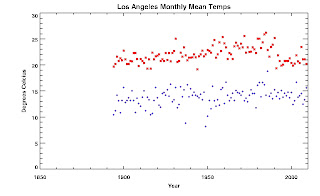
This looks very easy, right? But it was a PITA to get from the data I downloaded from the Guardian website to the plots shown here.

I write notes to myself about data workups, both the statistical/science decisions and the software tricks. I thought I would show you how unnecessarily hard this is.

[I used to be embarrassed about how much time I spent on opening data files and getting different data files to play nice with each other--a process called data fusion. But, then I heard a bigwig at USGS state at a conference that her staff devote 85% of their time troubleshooting data reading issues and only 15% on the science stuff. I am so grateful for her openness. How else would I know that I hit par?]

So here are my data reading notes.
First, if you use your browser to go their link, All the US weather stations (CSV)
and then save it as plain text using Firefox (my browser of choice but YMMV), you get one file with all of the data written on one line!
I like to work up data on my Macbook Pro using X11 and the Mac flavor of Unix.
prompt> wc us.csv
1 21678 967827 us.csv
Yup, that's one line, 21678 words and 96827 characters.

To break it up into multiple lines that I (and my machine) can read,
I used vi and ex
prompt> vi us.csv
then type this easy to parse line (ctr-V means press ctr and v at the same time)
:g/ctr-V ctr-M/s//ctr-M/g
That turned the ^M characters that read as tabs on my computer
to Unix carriage returns.

Then I tried to use grep to find files tagged with
CA
and
CALIFORNIA
but discovered that the structure of the data for each station was slightly different.
Some were marked in the second field, after station name,
CALIFORNIA
CALIFORNI
CALIFORN
CA
and LOS ANGELES just omitted the state field altogether.

In all, I found 6 climate stations in California
(if you find more, please leave a comment!).
From North to South:
Eureka
Sacramento
San Francisco
Fresno
Los Angeles
San Diego

[If I were smart, I would have wrote a script to grep for every CA station in the Worldwide WMO station list by WMO identifier against the us.csv climate file. Consider this your homework assignment and send me the stations that I missed.]

I used unix again.
prompt> grep FRESNO us.csv > fre.csv
and so forth for each of the 6 stations to put them in a separate file.

Then I had to get rid of the extra column of CA variants in 5 of the 6 fields. I used MS Excel to open up each station's csv file, delete the column, and save again in csv.

There should be a way to do it using sed or awk, but I forgot how to do it. When I looked it up, the simple
prompt> awk < fre.csv '{print $1, $2, $3}'
showed that I had real problems.
prompt> awk < fre.csv '{print $1}'
gives FRESNO, as you would expect, but
prompt> awk < fre.csv '{print $2}'
gives
CALIFORNIA,723890,36.8,119.7,2009,8.8,11,13.4,16.8,24.1,24.3,29.4,27.7,26.5,17.6,,
because awk is expecting spaces as delimiters and there are no spaces after
CALIFORNIA FRESNO, CALIFORNIA,723890,36.8,119.7,1887,,,,,,,,,23.7,19.9,13.2,7.7

What to do?
prompt> awk < fre.csv '{FS = ","; print $1,$3,$4,$5,$6,$7,$8,$9,$10,$11,$12,$13,$14,$15,$16,$17}'
does the trick, but, by the time I remembered the awk syntax, I had already used MS Excel to do it for me.

I tried to make plots with Excel, but found it too limiting. So I resorted to my favorite programming language for parsing data, Interactive Data Language, IDL. If you want to be a meteorologist, you need to learn it. If you are at a university, chances are very good that your school has a site license for it.

If you have IDL version 7.1 and later, there is a handy-dandy built-in procedure that reads csv files called "read_csv.pro" !
IDL> eur = read_csv("eur.csv")
IDL> sac = read_csv("sac.csv")
IDL> sfo = read_csv("sfo.csv")
IDL> fre = read_csv("fre.csv")
IDL> lax = read_csv("lax.csv")
IDL> san = read_csv("san.csv")

Type help to find out what is in your data structure.
IDL> help, fre, /structure
** Structure <18d5208>, 18 tags, length=18704, data length=18696, refs=1:
FIELD01 STRING Array[123]
.
.
.
FIELD18 DOUBLE Array[123]

If you cleaned up your fields, then
field01 = station
field02 = wmo_id
field03 = latitude
field04 = longitude
field05 = year
field06 = Jan mean temperature in Celcius
field12 = Jul
field18 = Dec

I reversed the default plot and background colors
IDL> !p.background=255
IDL> !p.color=0
and used color table 39, rainbow + white
IDL> loadct,39

IDL> plot, lax.field05, lax.field06, xrange=[1850,2010], yrange=[0,30], min_value = 1., psym = 1, $
IDL> title = 'Los Angeles Monthly Mean Temps', xtitle = 'Year', ytitle = 'Degrees Celcius'
IDL> oplot, lax.field05, lax.field06, min_value = 1., psym = 1, color = 50
IDL> oplot, lax.field05, lax.field12, min_value = 1., psym = 2, color = 250
IDL> saveimage,'LAX_JanJul_Climate.jpg',/jpeg,quality=100

If you haven't already downloaded and installed Liam Gumley's saveimage.pro, what are you waiting for? You can find it here. Save it to somewhere early in your IDL path.

If you want to get fancy, you can plot all six CA stations on one page.
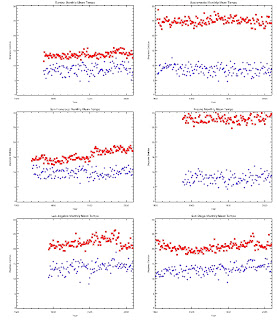
I want to discuss the features that I see in these graphs, but at a later date. Iris has a TKD party right now.

Sunday, June 12, 2011

Speaking of keeping notes

UMBC eBiquity managed to combine two things near and dear to my heart, robots and construction notes! Moreover, the robots crawled under the Great Pyramids of Giza to discover the red writing, which were later deciphered to be builders' measurement notes. Add in the great pyramids and a mystery solved, it's really a trifecta.

Robot discovers construction notes.

Saturday, June 04, 2011

Correlation does not imply causality: the algebra version

We've come a long way since the controversial "Math class is tough!" Barbie.

I have repeatedly mentioned that our school district places ~20% of the 6th graders in a math class that compacts the CA 6th grade and 7th grade math curriculum into one year. Those kids are then able to take algebra in the 7th grade, putting them on track to complete calculus by 11th grade. That's the de facto honors math track.

Nationally, it is quite rare. Even within California, only 6.7% of all 7th graders do so--mainly in well-to-do and high-tech areas. That 18.5% of the kids at my daughter's Title 1 school (40% of the kids are poor and/or have parents who did not complete high school) did so last year is a source of pride for our community. (Even though kids of highly educated parents are more likely to be on that track, a significant number of at-risk kids take the class alongside them and do fine.)

I was chatting with my daughter's pre-algebra teacher at open house, when I lamented that the 7th graders wouldn't be segregated from the 8th graders in algebra. I had hoped my daughter could continue in a fast-paced math class. She has often told me how much she liked that class and the teacher. I was worried that the 8th graders would slow the 7th graders down.

If you look at the CST Algebra 1 test scores for the entire state of California (below), you will see that 7th grade algebra students score much, much higher (430 vs 350 ) than 8th graders. 9th graders fare worse and 10th and 11th graders do even more poorly.

Then the teacher said what appeared to be a non-sequitur. She said that we could sign her up for gender-based algebra.

When my daughter asked us to fill out a gender-based algebra form, stating our preference that she be placed in an algebra class of all girls, we reluctantly signed it. It was her preference, not ours. My husband and I had assumed that the class would be filled with girls who were NOT math-confident.

The teacher elaborated that the school district superintendent was a big proponent of gender-based algebra and that education scholars were following the results in our district with great interest. I said the results are not statistically valid because of selection bias. At this point, I was still clueless, assuming that the girls' scores would be lower than the boys'. But I couldn't understand why the superintendent would so strongly support this program because he struck me as a data-driven guy.

Then the teacher said that the parents of the boys complained because the girls' algebra class had become the de facto honors math class because only the girls very serious about math signed up for it. The boys were relegated to algebra classes with a higher percentage of kids who had difficulty with math. To be fair to the boys, she would also teach a boys only algebra class next year.

Her point was that gender-based algebra test scores look really good because of selection bias.

I would like to point out that 7th graders test higher than 8th graders in the same math class because of selection bias, too. In a perfect world, kids take algebra when they are prepared for it. The kids that are ready at a younger age are more likely to excel than the kids that take it at a later time. But, you can't take the same kid and throw them in a higher level class and expect them to do better. (With the exception of bored and under-achieving kids.) Sorry, putting Kindergardeners in algebra is not going to make CA stack up against Singapore. ;-)

Correlation does not imply causality is my statistical pet peeve.

Just the same, I went to the assistant principal in charge of curriculum to explain that my daughter really, really wants to take gender-based algebra next year and could he check to make sure it doesn't conflict with her preferred electives?
We've come a long way, baby. Even MIT has matriculated more girls than boys in recent years.

CST Algebra I (California overall)
Result Type 7 8 9 10 11 EOC
Students Tested 31,492 274,508 269,800 118,412 56,830 751,042
% of Enrollment 6.7 % 57.3 % 52.3 % 23.8 % 12.1 %
Students with Scores 31,480 274,182 268,975 117,798 56,451 748,886
Mean Scale Score 430.9 350.3 307.9 290.1 282.3 323.9
% Advanced 50 % 16 % 3 % 1 % 1 % 9 %
% Proficient 35 % 30 % 19 % 11 % 8 % 22 %
% Basic 11 % 24 % 26 % 23 % 19 % 24 %
% Below Basic 4 % 22 % 36 % 42 % 45 % 31 %
% Far Below Basic 1 % 7 % 16 % 23 % 27 % 14 %

Tuesday, May 17, 2011

It gets better, the gifted version

Bad Dad and I were wondering if it is time for a It Gets Better campaign for gifted kids.

I was talking with a reporter about my finding that super-high-test score districts are less likely than average to advance their kids in math. He wondered how I stumbled upon that finding. Why had I bothered to look at the data in that way?

The short answer is that it is because I care. But I care for a reason that was not immediately obvious to him. I better spell it out really clearly.

It's not about bragging rights about whose child is more advanced.

It's about the child who is sitting in math class, thinking she just might not be cut out for math because she will tear her hair out if she has to sit through another fracking demonstration of long division.

It's about the child who gets sent to the principal's office for reading a book in math class (and being told to go back to the classroom to apologize).

It's about the child who quickly turns over her 100% test grade so that the other kids don't see it--lest she get beat up in the school yard over that.

It's about the child that got beaten up in the school yard anyway, while the other kids watched, and then took turns kicking her once she was pulled down to the ground.

It's about the kid who looked to the teacher across the school yard for a rescue, and watched the teacher walk away instead.

It's about me.

I'm here today to tell you that, if they ever let you go beyond long division and fractions, it gets better.

You'll learn that rational numbers are a field under addition, negation and multiplication but integers are not. Integers are merely a ring because they lack the inverse under multiplication. And every system of algebra opens up a different universe of possibilities.

And the special algebra of infinite-dimensional Hilbert spaces will open up the world of quantum mechanics to you. And, once you gain entree into that world, you will see how the quantum world manifests itself in the macro world all around you.

Who knows? You might even learn about general relativity and make relativistic corrections for satellite-to-satellite communications.

You might even work at a place alongside 850 other PhD-holding rocket scientists, marry one of them, raise a family and take fantastic trips (with the MIT alumni travel program).

Monday, May 02, 2011

More thoughts on STAR testing

As we enter week two of STAR (standardized) testing in California, I have a few more thoughts. Actually, Pennamite and I came up with these ideas together.

First, listen to Diane Ravitch's interview on Fresh Air. She spoke about the intent of standardized testing--to collect data--and the results of standardized testing--to punish schools. It was never her intention that standardized tests would be used as a blunt instrument and that they would become a tool for those who aim to privatize the US public school system.

After my What the STAR tests really tell us post, Pennamite suggested that schools (and school districts) that are known for their ultra high test scores become prisoners of their past results. They must get ever higher scores--or at least stay flat--or risk the wrath or displeasure of the parents.

It takes a bit of massaging to maintain such steady upward progress in the face of statistical noise and educational policy and demographic changes. Remember, people's jobs (and pensions) depend on the pleasure of the parents. Take a look at the math classes taken by 8th graders in California, Redondo Beach and Manhattan Beach.
Former Governor Schwartzenegger wanted to have ALL California 8th graders to take Algebra or beyond. All is a tall order, but most districts are trying to comply.

Statewide, 57.3% of 8th graders are taking Algebra 1 and another 4.8% (have already taken it and) are taking Geometry. 62% are meeting the new goal.

In RBUSD, it's 57.3% and 18.9% respectively. 78% are meeting the new goal. RB parents are wealthier and better educated than the statewide average (but not by much), so these numbers are not that surprising.

In MBUSD, it's 35.0% and 9.2% respectively. 44% meet the new goal. Despite having some of the wealthiest and best-educated parents in the state, the students are taking lower level math classes than the state-wide average. They are a full grade level behind comparable schools with similar demographics.

This is even more alarming because MBUSD used to exert strong pressure on parents to hold kids born after April back a year. See Implications of academic redshirting.

It wasn't always this way. Look at the data from prior years. The rest of the state leapt to accelerate students in math while MBUSD moved more slowly. They are where the rest of the state used to be.

Pennamite pointed out that the ultimate losers in this game are the kids. They are being held back until the school is sure that they will perform very well on the standardized tests. The default is to not challenge/stress the students. Otherwise, the kids might not score so highly and the schools will face some angry parents.

There is some grumbling on the soccer fields about the lack of challenge in math curriculum in MBUSD. One MB mom who has her kids on permit in RB has cited that as the main driver for leaving their school district. She works in the education field. I wonder how long it will take for the rest of the parents to become aware of how fixation with test scores is shortchanging their kids?

A (IMHO) good use of standardized test scores:
The RBUSD superintendent and the administrators of RBUHS are concerned that the middle schools are pushing the kids too far and too fast into higher level math. When 9th graders take Algebra 2, some of them do very poorly in the class. Would they have done better with an extra year of maturity? Did the system set them up for failure?

The standardized test scores support that view. The average test scores of the kids in the accelerated math track in RBUSD are slightly above the statewide average for kids of the same age, and they are twice as likely to be on an accelerated math track. But they are far behind the kids in MBUSD, which takes a much more selective approach. Are higher test scores (which I hope means mastery of the subject) a consequence of the extra year of arithmetic and pre-pre-Algebra? That's a subject worth further study.

The district and the HS want to try a more selective approach. Giving only kids that we are confident will succeed a chance to succeed will certainly result in higher test scores. But is that a laudable goal? As I explained in Math class is tough!, my bias is to put kids in the most challenging math class they can handle. That might mean putting some kids on the edge to see if they surprise us--and themselves. I've triumphed over difficult math classes and it has changed me profoundly for the better.

RBUSD MS math teachers suggest that they intervene with struggling students earlier, before students start to fail. They already use benchmark tests several times a year to discover what the students do and do not fully comprehend. (The STAR test results come out during the summer so they are useless for individualized course correction.) Why don't the schools use the data they already have to call in students who have lapses in their math skills?

The teacher said that my conjecture in What the STAR tests really tell us was wrong. They do cover the entire Algebra 1 book before STAR testing in early May. The problem is that the pace may be slightly too fast for some of the kids. Math is a cumulative subject. Because Geometry is so orthogonal to Algebra, those gaps do not necessarily impair performance in Geometry. But missing some key concepts in Algebra 1 could really impair understanding in Algebra 2.

Teachers can use quiz and benchmark tests to identify struggling students and set up appointments at lunch and after school to help them. The teachers are already available at lunch and for one hour after school each day for tutoring. (The teachers cooperatively work out a schedule so that one teacher for each subject will be available each day.) But the students in most need of help may not be the ones savvy or confident enough to ask for help.

So they only thing they want to do differently is to reach out to those students rather than wait for them to come in on their own. It can be done at no extra cost--the teachers at this school work off the clock so much anyway. Only after exhausting all these options, would they recommend that the kids take a step back in math.

I think that's worth a try.

UPDATE:  STAR test scores and external influences