Showing posts with label Wardrobe Refashion. Show all posts

Tuesday, March 12, 2019

Pajama-a-Palooza

Has it already been 3 years since Nightgown-a-Palooza*? The teen has since declared that she is over nightgowns and wants pajamas.  When we were in Joann's, she fell in love with this Star Wars themed Porg flannel.  We both find porgs adorable so we purchased 2.5 yards, just as the pattern recommended.

Flannel shrinks more than other 100% cotton fabrics due to its loose weave.  I was courting danger by not buying extra to compensate.  Sure enough, the legs of the pajama pants are just a bit short and I added knit cuffs to extend the length and keep out drafts.

Butterick 4483 and porg flannel
I'm going to spare you the sight of the droopy crotch of the PJ pants in OOP Butterick 4483.  It looks indecisive.  Are they MC Hammer pants?  I put them in the out box, but then pulled them out.  I might make the PJ top at a later date.

In looking at the oddly shaped scraps after cutting out the pants, I wondered if I could piece them together into two pieces large enough to cut the torso of a loose T-top like Kwik Sew 3262.  I could.

When people see that I sew with old clothing, they give me bags of old clothing.  (My mother once gave me a bin of 26 T-shirts.)  A mom cleaning out her adult sons' rooms found half a dozen T-shirts for their old baseball league.  They had some rips or stains, but I was able to cut sleeves around the flaws.

I added the same rib knit I used in the PJ pants, purchased at SAS Fabrics in Hawthorne.

Roomy top 
In one item, I used:
  • post-consumer waste (T-shirt, porg scraps)
  • pre-consumer waste (knit ribbing with a few flaws purchased by the pound at an odd-jobber)
It's like I made something out of trash.  Oh, I did.

The complete set also contains new fabric specifically milled for the home sewing market so it spans the whole gamut of material options.  Sewing with old clothes can be disappointing if the worn fabric wears out too quickly. By mixing old and new materials, I can make something that lasts, but minimize the amount of new stuff we consume.  (It's even better if my new material is a flawed mill waste (rib knit) or overstock/deadstock fabric.)

We are consuming several planets worth of stuff.  It is definitely not sustainable or equitable. 

DD wears her clothes for years, until they fall apart.  I sew her sturdy clothes with a mix of new and used materials.  If we all did this, maybe the planet won't burn up.

Anyway, she loved the porg pajama set so much, it was difficult to get it off of her to do laundry.  I had a light purple pair of knit PJ pants that I wasn't wearing.  I wanted to make another flannel top to go with it.

After making a bunch of flannel bathrobes for everyone in my family, I had used up all my flannel.  I stopped by SAS Fabrics and found this overstock/deadstock fabric. The top pattern suggests 2 yards of 60" wide knit fabric.  I though that I could squeak by with 1 yard of 44" wide flannel if I pieced the back and mixed the crosswise and lengthwise grain.  (I preshrank the fabric in a hot wash and dry cycle to reduce puckering from differential shrinkage.)  There was even enough left over to make a pocket for her cell phone or cold hands.

Second sleep set with new top and my underutilized knit pants made years ago.
She liked the pocket so much, she asked me to retrofit the first set with pockets. There were no porg flannel scraps left. I cut up one T-shirt sleeve and then re-seamed it so that the hems fall along the side openings and then topstitched it on the top. It looks really cool.

Improved first set with pocket
* In reading Nightgown-a-Palooza, I realized that there is was one more nightgown that I failed to blog.  I rather like the way that I made do with short yardage for that one so I will post it shortly.

Tuesday, July 25, 2017

Shirtdress shortcut

The black and white shirtdress was so successful, I decided to make another one. Time has been short this summer, so I started with a men's shirt from Goodwill and went searching through my supplies for the perfect match for the skirt portion.

I knew that I wanted to use the skirt from Vogue 1916 again. This time, I made the pockets 1" wider and 1.5" deeper to securely hold my cell phone.


I auditioned many skirt fabrics.  This was my second choice.  I had 4.5 yards of my first choice and decided to save it to a dress at a later time.  I was worried that this light-medium denim was too heavy and stiff for this style.

I needn't have worried.  The denim is soft and drapey.  In fact, it was so soft that the waistline stretched out and I had to insert back darts to draw it in.

The denim was purchased cheaply by the pound near LA because it has some minor flaws and fading. I buy most of my fabric (by yardage but not by $) from odd jobbers like that, and cut around flaws. This time, there was no avoiding all the flaws, but they are relatively minor. Also, denim is supposed to develop a patina and this has a head start.

I also used one of my husband's shirts that had been retired after a sad encounter with soy sauce.  The contrast kick pleat flashes nicely when the skirt moves.

The piece left over after I cut the kick pleat insert had a pleasing curved hem.  I rotated it a quarter turn to make a wonky second shirt pocket.  I added the buttonhole, but decided to omit the button in the end.


I used the sleeves of the shirt to line the skirt pockets.  If you look carefully, you can see some stains from droplets of soy sauce.

It's not easy to refashion a dress shirt from long to short sleeves due to the sleeves' taper.  I cut some bias bands to hem the sleeves so that they lay evenly.  I wish I made the bands twice as wide for more visual oomph.  Next time.

I measured the black/white dress bodice length and then added a smidgen when trimming the thrifted shirt. I shouldn't have added the length. It looked so sad. After a date with my seam ripper on Saturday night, I put in two back waist skirt darts, readjusted the shirt pleats, and reattached the two parts. It looks and feels great now.


This is a water post because of the embedded water I reclaimed by using all second hand or irregular fabrics that might have gone to waste.

Read more about the reclaiming the energy/water/value of textiles:


Friday, July 14, 2017

That bamboo rayon may not be so green

More bad news about clothing choices came to light recently.

First, remember how I wrote that polyester shirts were greener than cotton shirts when the full use cycle is considered? Well, it turns out that polyester clothing can shed fibers in the wash, which may end up in the oceans and rivers and, eventually, in wildlife.

Rayon has been hailed as a miracle fiber.  It's silky like silk and polyester, breathes like cotton and linen, takes dye readily,  and is washable.  It used to be made from wood chips that are mill waste from making lumber out of trees.

Now that rayon has grown in popularity and the price of paper has shot up, there aren't enough trees.  Fast-growing bamboo to the rescue!  It's a grass so it grows fast.  It's renewable, natural and sustainable!

Not so fast.

When I was a chemistry undergrad at Berkeley in the 1980s, I came across a thick textbook at Moe's Books about rayon manufacturing.  The number of steps and caustic chemicals needed to turn break down wood chips into cellulose fibers and then to reconstruct them into rayon fibers is staggering.

The good news is some mills, notably in Europe and Australia, have invested in equipment to make rayon using closed-loop processes in which 99% of the chemicals are recovered and reused.  You can find them labeled with trade names such as Tencel and Lyocell.

The bad news is that most rayons on the market are dirty in the sense that they are made with great harm to the environment and workers.  Paul David Blanc wrote about this in Fake Silk: The Lethal History of Viscose Rayon.  Also read H&M, Zara and Marks & Spencer linked to polluting viscose factories in Asia.

Wastewater outfall near Sateri Fiber and Jiujiang Jinyuan Chemical Fiber viscose plants in Jiangxi, China Photograph: Changing Markets Foundation via Guardian
Just as I haven't given up eating meat entirely.  I haven't given up rayon, cotton or synthetic fibers.  I use everything in moderation and try to buy from responsible manufacturers.  I also often reuse/repurpose old textiles.

Related:


Wednesday, March 01, 2017

Ice dye experiment 2

I've been ice dyeing again.

Incredible visual texture
First, I soaked the shirts in a solution of 1/4 cup soda ash for each gallon of hot water.  Then I wrung them out by hand (but not too much) so that they were thoroughly soaked, but only slightly drippy.  Then I
  1. Arranged t-shirts on the bottom of each plastic bin
  2. Placed a cookie cooling rack above them
  3. Put a white dress shirt on top of the rack
  4. Mounded ice cubes to completely cover the shirts (2+ inches deep)
  5. Sprinkled dye powder on top
  6. Went to bed

Ice dye, low immersion scrunch dye, tie-dye in baggies.
In the morning, I
  1. Spun out the shirts in my spin dryer
  2. Washed them twice in *hot* water with synthrapol dyer's detergent
  3. Rinsed them twice in cool water
  4. Spun them in between each wash and rinse to extract as much dye as possible 
  5. Spinning minimizes the number of washes and rinses you have to do

That's no plunger; it's a Breathing Washer.
Drying
Front of my favorite shirt
Back of my favorite shirt
Look at that detail!
A friend treats a lot of kids with head injuries.  The kids are in pain.  The parents are freaked out.  He's intimidatingly big at 6'3".  He likes to wear goofy things to lighten up the mood.  I think these will break the tension.  What do you think?

Two shirts going to a friend.
I mailed them off this morning, tucking in one of the blue/green tie dye shirts you saw on the drying rack.

Detail of the pocket
Ice dye shirt underneath the dress shirt caught the drips.
Two of the shirts were claimed by friends who came over for dinner while they were still drying.  Two more were claimed by friends who came over for dinner a few nights later.  She selected this one

This shirt caught the drips under my fave dress shirt.
and he selected this one.  (I know the title says ice dye, but this scrunch dye came out pretty cool.)  It looks kinda like space--perfect for a physics professor.
Spacey scrunch dye

The back view that the students will see in the lecture hall.
Another shirt went home to DD via DH, who flew into Boulder for a quick business meeting.

In total, I dyed 4 dress shirts and 7 t-shirts.  All of them were post-consumer waste given to me; the only new things I purchased were the dyeing supplies.

I gave away 3 dress shirts and 5 t-shirts.  This made a sizable dent in my refashioning supplies.

A coworker had a baby boy recently, so I need to tie-dye some baby onesies.  Click that link to see adorable baby onesies I've made in the past.  Explore all my Dyeing posts for dye recipes, tutorials and the results.

I've been sewing.  I've been working hard at my day job.  I have some science posts planned, but don't know when I will find time to write them.  There may be some short, quick posts to highlight interesting things I found before then.

Sunday, June 26, 2016

Simplicity 2938 Take 7

I've tried Instagram and Twitter. They fill their niche.

But blogging is not dead, at least for me. I like to read blogs that share deep knowledge about subjects and give a peek into the lives of their writers.

It takes me more than 140 characters or a picture and a quick sentence to express some of my ideas. I also like that my ideas from 2005-present are all collected right here.  Some 2003-2006 ideas can also be found at my sister's blog.

ASIDE: When my sister watched me knit in December 2002, she asked me if I was interested in posting on her fiber arts blog.  I asked, "What's a blog?"

When I increasingly went off-topic (not about fiber arts), she told me I would be happier with my own blog and suggested Wordpress or Blogger.  I found the Blogger interface easier to learn (YMMV) and here we are in 2016.

META: I'm going to keep writing about whatever interests me and I think should be more broadly known.  That means, it's not all knitting and sewing.  I read environmental science news and journal articles and I'm going to write about how that translates into real life for people who aren't scientists.  Occasionally, I'll multi-task by connecting science, sociology and making stuff.

When I see bullshit, I'm just going to write about that, breathe, and then let the anger go.  I don't know if exposing bullshit does any good when so many people appear to be unswayed by facts or reason, but, pushing back makes me feel better.

Some sewing happened

Simplicity 2938

Pattern by Karen Z and endorsed by ASG (always good signs.)
When I searched for Simplicity 2938 on this blog and on my pattern spreadsheet, I discovered that this is the 7th version of this top that I have sewn.

Four versions, all sewn with recycled shirts.
I really like this pattern because the pattern pieces fit inside the usable bits of Bad Dad's shirts that are frayed at the collars, cuffs or seams, yet have perfectly good fabric in the interior.

Perfect for recycling shirts that are frayed at the collar/cuffs.
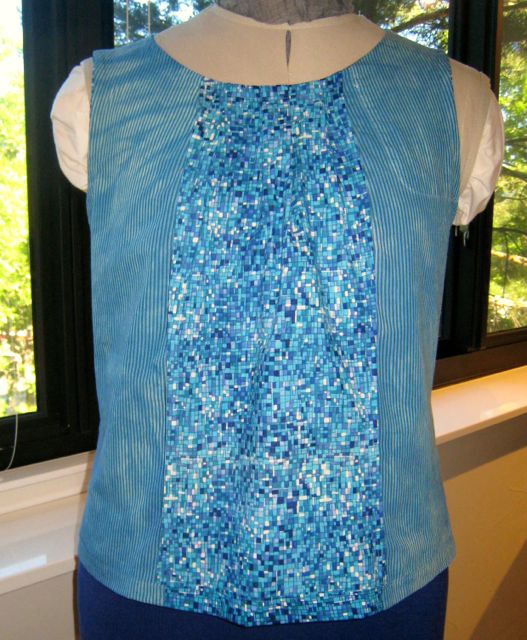
When I need a top, I pull a shirt from my refashioning bin and look for a coordinating center panel fabric from my scraps bin.  Rather than use facings, I piece bias strips from the sleeve of the shirt (if it has long sleeves) or from scrap fabric.  I omit the zipper as it pulls on over my head easily without it.

The only knit version.
I've only sewn one version that did not begin life as another shirt.  But, I bought this < 1yard remnant from SAS, which receives/sells truckloads of scraps from clothing manufacturers around SoCal.  I made the two-piece outfit below for a friend's daughter (as a going off to college present) from stuff that used to go to a landfill.  I paid SAS ~$6 for the two pieces and spent a day sewing it up.
The only one not sewn from a recycled shirt.  But the remnant was purchased by the pound from an odd jobber.
Textiles are not environmentally benign.  It takes huge amounts of water and pesticides to grow and process cotton.  Organic cotton is not the answer as seeds that are genetically modified to use less water can not earn the organic designation.

Natural dyes are also not the answer.  It takes about 13 acres to grow enough natural dyes to dye 1 acre of cotton.

Those rayon pants?  I used every last scrap of that remnant.  I can't bear to see rayon wasted after I chanced across a textbook on rayon manufacturing at Moe's used bookstore in Berkeley.  It was written for chemical engineers in industry and cost $200 *used* and in the 1980s.  However, it was 800 pages thick.  I managed to skim-read much of it on repeated visits to Moe's because I can't afford the $ or shelf space for that book.

I love the feel of rayon, but not the environmental impact of the irresponsibly made ones.  If the rayon was made in Germany, or has the Tencel trademark, it was made with an environmentally-friendly closed-loop process.  Enviro-guilt free.

Back to this top.

I over-dyed a green/white striped pinpoint oxford shirt with (cobalt? ultramarine?) blue Procion fiber reactive dye from Dharma Trading the same day I tried the snow-dye experiment.  You can see the shirt in the plastic shoebox in those photos.  The color is made up of different dye components, and they can separate, as they did here on the lower back.

Color separation happens.
When working with dyes that contain fuchsia, 'bursts' of fuchsia can happen unless you filter the dye through cheesecloth first. I don't bother and live with the results.

Star bursts of dye happen, if you don't filter your dye for undissolved dye particles.
I use very little water, scrunch the fabric, and let unevenness happen.  Just for fun, I put the bias binding on the outside instead of the inside.

I employed Grandma Sewing techniques, so the top can be worn inside out.  The contrast between the quilting cotton and the shirt is more muted on the reverse side.

The shoulder is a bit strange, because I attempted (and failed at) a square-shoulder adjustment.  I should have left it alone because the other 6 tops hang much better.
I bought some heather cotton jersey from The Fabric Store that pick up many the colors in the top.  I'm going to make an unstructured, open cardigan to match.


Monday, May 02, 2016

Kwik Sew 2452

Or what we wore during Me Made May 2016 Day 1.

I gave a glimpse of a new dress in the ensemble picture (and also on IG).

When I pulled out that black/ecru printed cotton/lycra jersey, I recalled that I purchased it at the time to make a t-shirt dress.  Which pattern should I use?  I have tons of t-shirt patterns to select from.

Associations are funny.

I was making the top and skirt for a petite friend.  In 1995 or 1996, I made a mint green cotton interlock dress from Kwik Sew 2452.  I got the pattern and fabric from Denver Fabrics, which is now called Colorado Fabrics.  (The online Denver Fabrics retailer is actually in St Louis and has nothing to do with the original Denver Fabrics except that they bought the name.)

I made the longer version of the dress.  When my petite friend went on a trip to Saudi Arabia, she borrowed the mint dress, which was a maxi on her.

I bought he black/ecru dress fabric at Colorado Fabrics.  Thinking of the store and the friend, I searched for the dress pattern and found it in my most excellent pattern drawers, designed for me by the son of the manager of Simplicity's pattern printing plant.

Can you think of a more perfect dress to wear for the first day of Me Made May 2016?
DH got many compliments on his snow-dyed shirt at the TCM Classic Movies Festival 2016 today.  Because he feels a little guilty about the cost of his festival pass, he asked me to buy myself something.  OK, twist my arm.
I stopped by The Fabric Store on my way home from viewing the Robert Mapplethorpe and Reigning Men exhibits at LACMA.  Reigning Men was sensory overload for a textile geek, especially after I had spent so much time at the Mapplethorpe show.

We have until August 21, 2016 to examine the details on Reigning Men.  I'll be back.

Sunday, May 01, 2016

MMMay16 Day 1 or Simplicity 1199

When I showed my LA sewing space, I wrote about how I make clothes from a combo of pre and post-consumer waste and new fabric.

I explained in Laziness or SWAP, how I organize my planned sewing projects by serger thread color.  Then I tackle them in semi-assembly line order.

Let me show you a bit of the process.

First, I pull fabric and candidates for refashioning from my supplies.  I lay them out and look at them, adding and subtracting to the set and moving them around, until I have a vision of what they want to be.

When I was looking for something else, I came across the black/tan marl fabric.  When I bought it at SAS Fabrics, I reckoned it was black/gray.  Outside, in natural daylight, I realized I had reckoned wrongly.  But, 1.2 yards of cotton jersey for $2 is a steal and I thought I could make baby clothes for LA County foster children with the piece.

That didn't happen.  When I came across this piece again, I knew what it wanted to be and who would wear it.  I pulled some coordinating fabrics and refashioning candidates and laid them out on the dining table.  Over several days, I added and subtracted candidates and pulled patterns.

Eventually, I settled upon a black cotton/poly pique remnant from a something I made DD years ago along with some new fabric I bought at Colorado Fabrics last year.  I cut out the pieces one (snowy) weekend afternoon.

Then I sewed them up in batch fashion (like chain piecing when quilting) over two dreary snowy evenings.

The top came out better than I imagined.  The last two times that I sewed Simplicity 1199, I selected the size by the measurement chart, making the S for DD and the M for myself.  They were huge.  I wanted to test the fit of a S at the shoulders and M at the hips.

As you can see, it fits the dress form that approximates my measurements.  I took 2" out above the waist and shortened the back another 1" to fit a petite friend.

I bound the neckline with the technique I learned from Kwik Sew 2555 (which I have used 30+ times) instead of the method found in Simplicity 1199.  The cotton/lycra printed jersey had enough body and recovery to make a satisfyingly hefty neckband.
Aside from the length, the top fits exactly to my liking.  I'll be making more for myself this summer.

While the serger was dressed in black thread, it was a good time give the thrifted black t-shirt I wear to the gym a curved hem.

Oops, this post got so long, I'm going to reveal the outfit I wore for MMM16 Day 1 on the next post.

Thursday, April 21, 2016

Snow Dyeing Experiment

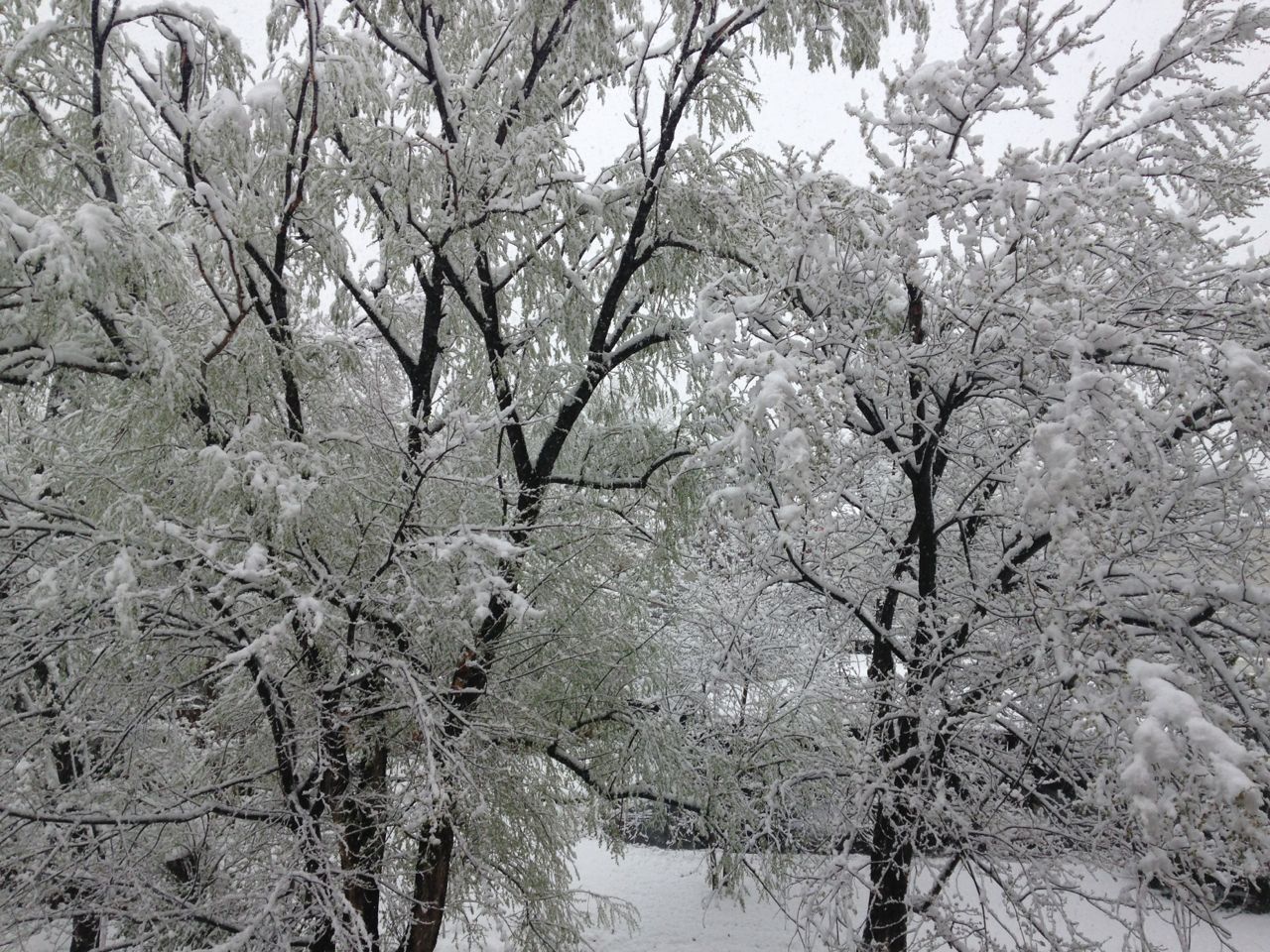
First, you need to harvest some snow.  The NWS predicted rain Friday night turning overnight to snow.

When I woke up Saturday morning, the snow was still melting immediately when it reached the warm ground. When the snow began to stick, I set my IKEA Torkis baskets outside to harvest some snow.  I put them on a bench, so they would equilibrate to the air temperature instead of the ground temperature.

Then I went back inside to mix a cup of soda ash with 5 gallons of hot water. I soaked the four items I wanted to dye in the soda ash solution.

Meanwhile, outside, the air temperature remained stubbornly right above freezing.  My snow yield was disappointingly low compared to the dead leaf yield.  I moved the Torkis to a more open area on the grass.

Back inside, I put the scrunched up the damp clothing in plastic bins, mixed some Procion fiber-reactive dyes with water, and splashed the dye in.

For the snow dye experiment, I decided to supplement with ice from the ice-maker in the kitchen.  (Isn't it ironic that we run ice-makers in the winter?)
Note that I did not put the shirt on a rack to suspend it above the dye as it drips through.  I wanted a more solid look.

My total snow harvest was pretty pathetic. I consolidated all four baskets of slush and barely had enough to cover the shirt.


I sprinkled one teaspoon each of midnight blue and strong navy Procion dye powder on the slush/ice/shirt tostada.

Waiting inside, catching up with my mending pile.

Waiting on the other side of the condo, enjoying the quiet beauty of a snowstorm.

Silence in the heart of the city.

Sunday morning, I rinsed out the clothes until the water ran clear.  In LA, I use the spin cycle of my washer to extract the moisture (with the excess dye).  That cuts the time and water required for rinsing by a huge amount.

In Boulder, I use a Nina Soft Spin Dryer, which is a centrifuge for fabric/clothing.

Wow.

I am a total snow dye convert now.

The NWS nailed the forecast.  We got an astonishing amount of snow for April.  But, most of it fell Saturday night/Sunday morning--too late for my snow dye experiment.

I think I will have to learn how to make artificial snow with ice in my blender...and see what happens when I suspend the fabric on a cookie rack.

Links to stuff I used*

* I have no financial relationship with Dharma Trading except that I've been buying from them for nearly 30 years and have *never* had an unsatisfactory experience with them.