Showing posts with label Travel. Show all posts

Wednesday, June 04, 2025

The horror of catenary


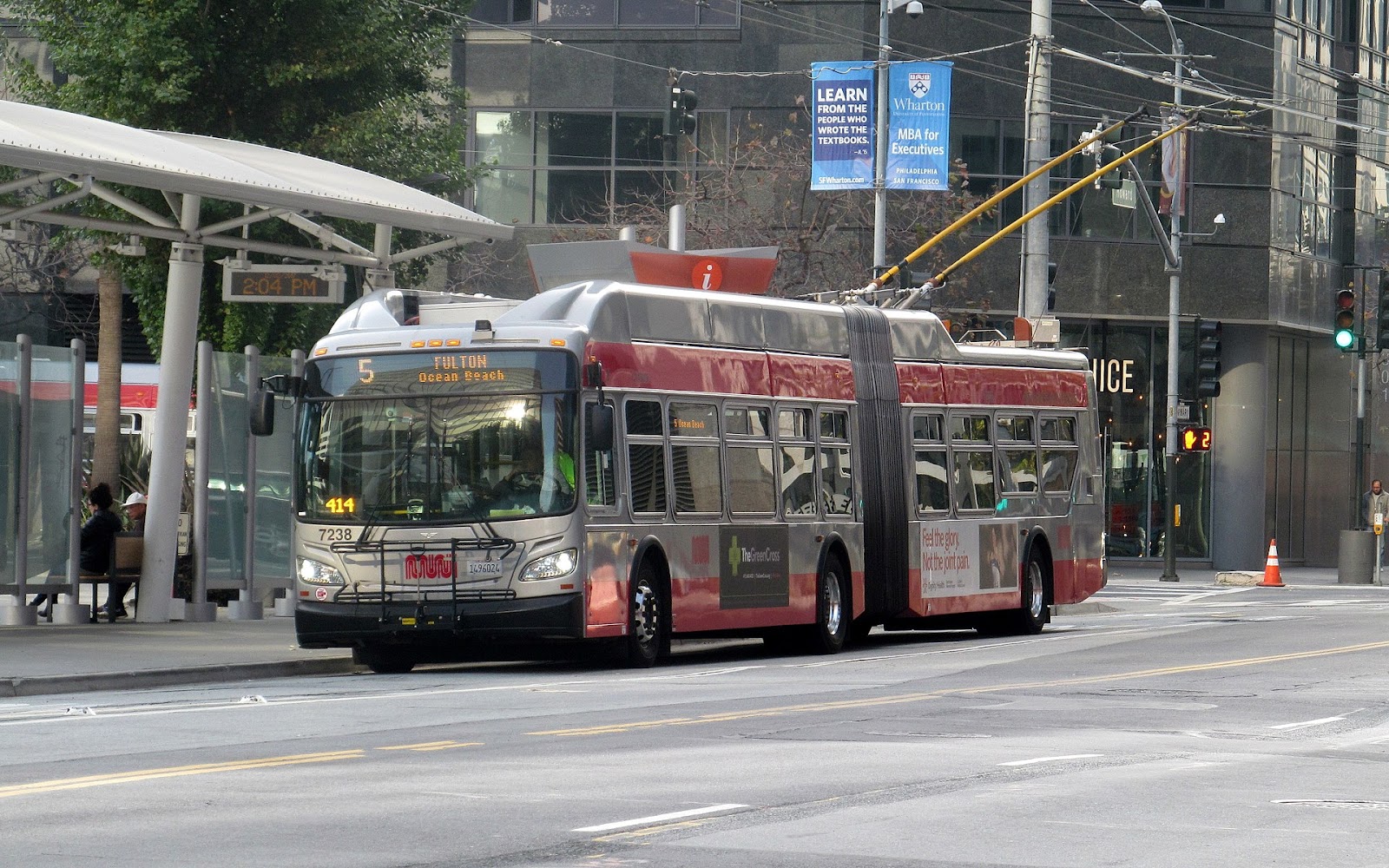
San Francisco Trolley Bus powered by overhead catenary lines.
Photo courtesy of By Pi.1415926535 - Own work, CC BY-SA 3.0, https://commons.wikimedia.org/w/index.php?curid=64552498

I am not a fan of Battery Electric Buses (BEBs) due to their expense and operational difficulties. We need to stop burning stuff that produces greenhouse gases, but we also need to provide the most bus service for the most riders possible. 

Buy American mandates for US transit agencies have them in a bind with too few American BEB manufacturers, all of them in and and out of bankruptcy, and difficulty getting repair parts. In fact, many BEBs have been mothballed despite billions spent on them and specialized charging infrastructure. 

I had always wondered why we didn't utilize the century-old technology of electric trolley buses powered by electricity from overhead lines (called Catenary). In California, only SF Muni still operates them in 2025. 

What is stopping other California agencies like LA Metro from using Trolley Buses? They are cheaper to buy, maintain, power and store. You need fewer of them compared to BEBs, which need to be taken out of service during the day to recharge. Trolley Buses can even be driven off-catenary using small (compared to fully BEBs) on-board batteries. 

CEQA happened. In 1970, then governor Ronald Reagan signed the California Environmental Quality Act into law. 

CEQA requires that any project needs to be evaluated against the status quo. Criteria include Visual Impact Assessment. Since a landscape with overhead wires always scores lower than the same landscape without overhead wires, you can't install them anywhere that doesn't have them. San Francisco still had overhead wires, so they were able to maintain and upgrade their overhead wires without running into CEQA veto points. Los Angeles once had catenary, but had already removed them by 1970s. 

There was no going back--until AB 2503 passed in 2024. Now, electric wires/catenary for buses and trains can be built without running the gauntlet of decades (yes, decades) of CEQA lawsuits. 

In May, 2025, we visited Berlin and took articulated electric buses, some that can run hybrid on and off catenary wires. They ran in dedicated bus lanes, often next to wide bike lanes. It was so easy to get around by bus in Berlin. We loved it. 


Look at the size of that bike lane!

We rode both German and Polish-built buses, which run on different lines. 


Narrower bike lane this time, but that's because road width is tight on a bridge. 

I was so impressed with the Solaris hybrid articulated buses. They can run up to 1/3 of the time off-catenary, can recharge while on catenary, and they never need charging during the day. They can move up to 100 people all day without interruptions of service. This means fewer buses serve more people. So cost-effective and clean. 

Oh, the 100-passenger bus needs only a 700 kWh battery. Compare that to the Tesla Y's 60-80 kWh to move 1 person around. Saves on material costs, too. 

Anyway, they accelerate/deaccelerate smoothly with just a quiet whirr. We really enjoyed sightseeing from inside the buses. I also rode my first double decker bus!

More on Berlin and our April-May Germany trip later. I still need to post pictures of our bicycle cruise on the Mekong Delta in February. My husband jokes that we save carbon by not driving (in Los Angeles!) and avoiding beef, and then blow our carbon budget on international travel. Fair enough. 


Friday, February 02, 2024

Vacation at Home

 First Costco wrote about how some of their customers shop by cargo bike


Then AAA (the American Automobile Association!!!) wrote about 8 car and taxi-free days in Paris


And I'm even quoted in the LA Times about getting glasses at Costco by eBike. Well, they didn't mention that I biked there. But I biked home from the Torrance Costco during peak evening traffic and I kept catching up with the same SUVs at each red light for the first 5 miles. 

The media is finally catching on that getting around by cars can be a PITA and bicycling for transportation can be fun, efficient, and healthy. It can be normal, if only we reallocate space for it. We shouldn't have to fly to Paris to experience a city with great food by bike. I mean, Paris is great, if you like French food, but the food in Torrance is way more exciting (I am saying this unironically). 

South Bay weather is nicer than Paris'. 

We have the beach, we have mountains (or the hills of Palos Verdes Peninsula). 

We could be paradise. And we don't have to go on vacation to experience it. We can stay right here at home, and live our best lives just by going about our normal business. It would also be cheaper, for both our personal pocketbooks and for society's. 

Monday, April 20, 2020

Can flying ever go green?

Define green.

Today I learned that United Airlines uses biofuels from municipal sewage for a portion of their jet fuel for flights out of LAX.  In 2016, they contracted to purchase up to 15 Million gallons of biofuel over 3 years.  At the end of the contract, they signed up to purchase up to 10 M gal/year, doubling their use.

In 2016, WaPost wrote that the biofuel would be blended in a mixture of 30 percent biofuel and 70 percent traditional fuel.
But the use of biofuels is one possibility for existing machines to cut down on their emissions without having to upgrade their engines or other aspects of their design or engineering. “Drop-in” fuels are renewable fuels that are designed to work safely with existing engines, although as in the case of the United flights, they sometimes require mixing with traditional fuels.
This is analogous to cars in California using a blend of 15% bioethanol and 85% gasoline. If the ethanol comes from grains like corn, then the carbon savings is minimal.  If the bioethanol and biomethane comes from food waste, then the payoff is bigger.

Putting it in perspective.  United Airlines used 4292 Million gallons of fuel in 2019, of which 5 M gal was biofuel.  Even if they were to double that to 10 M gal/year, that would be 0.2% of their fuel use.


So, biofuels in airplanes is better than diesel.  But it's even better if we cut down on our flying overall.  It doesn't have to be much.  Cut down on one round trip long haul flight per year and it's as much carbon savings as if you traded in your gasoline-powered car for an electric car.

I copied the figure from Quantifying the potential for climate change mitigation of consumption options, which I also wrote about in New Paper on Global Data-Driven Climate Actions.

We cut back on personal flights so that we make one long-haul trip every few years.  I was supposed to fly home from Germany yesterday-today.  Bad Dad was going to represent his family at the commemoration of the liberation of Bergen Belsen 75 years ago.  The ceremony will be postponed.

We don't fly long distances for short trips.  We make fewer, longer trips.  We had planned to spend 3 weeks, visiting Berlin, Munich and some smaller towns in between.  I even planned to show him the small town where I had been an exchange student in high school (German Gymnasium.)  It will have to wait.

Thursday, April 16, 2020

New Paper on Global Data-Driven Climate Actions

Local experience is not always generalizable. But, you sum up research on a bunch of places, and then patterns emerge. In Data-Driven Climate Action (for Los Angeles) I said:
In summary, decarbonizing transportation has the highest potential for stopping Climate Change, but it requires collective action. We can’t choose to bike along a street that doesn’t create a safe space for us or take a bus to an evening concert if the buses don’t operate at night. An urban area is precisely where these two modes can excel, if we let them. We don’t need a solution that works in Iowa or New Hampshire or even Fresno. We have the existing density and the weather to do this right here, right now. Let’s paint those streets Green (bike lane) & Red (bus lane).
A recent meta-analysis by Diana Ivanova, John Barrett, Dominik Wiedenhofer, Biljana Macura, Max W Callaghan and Felix Creutzig, examined
6,990 records in the Web of Science Core Collections and Scopus. Searches were restricted to 1) reviews of lifecycle assessment studies and 2) multiregional input-output studies of household consumption, published after 2011 in English. We selected against pre-determined eligibility criteria and quantitatively synthesized findings from 53 studies in a meta-review. We identified 771 original options, which we summarized and presented in 61 consumption options with a positive mitigation potential.
They really did their homework on a global scale.  Climate mitigation measures were broadly separated into transportation, food, housing and other.  The combined findings are plotted together on a single box and whiskers chart.
The findings for each study are plotted with circles.  The extreme values are marked with "whiskers" at the end of the bars showing the full range of values. The 25th and 75th percentiles bound the "box". The average value is marked with a large X. The median is marked with a vertical line. 

For context, we need to reduce global CO2 productions by 55% to limit climate change to a global average of 1.5℃ (We've already warmed up 0.8℃ and 1.0℃ is already baked in due to past emissions alone.)  That means each person on earth can contribute 2.1 tCO2eq/cap (metric tons of CO2 or equivalent of emissions  per capita per year.) Americans and Australians contribute 16.7 and 16.2 tCO2eq/cap of emissions.

Note that some of the mitigation strategies can cause negative reductions or increases in CO2 emissions. The authors call that rebound--when the cure is worse than the disease.

The biggest difference that we can make, with the least cost and risk, is to live car-free. I get a lot of eye-rolling, mainly from older people in the US, when I mention this. We are apparently so exceptional in the US that physics and logic could simply not apply to us.

We know how this worked out for COVID-19. Ignore scientists and the results are apparent in a few weeks.

We have been telling you to get out of your car to save the planet for decades, and the result is so slow-moving, that we've been ignored or told we are crazy.

Physics and viruses don't care. They do what they are going to do.

Here's a closer look at just the transportation sector. See the range of values for "Live car-free?" The extreme high value is for ditching an SUV, which also happens to be the most popular car style in America. Losing the family SUV is a huge savings of about 3.6 metric tons of CO2 per capita per year.


I can already hear the, "Yes, but" crowd pointing to the Battery Electric Vehicles (BEV).  Don't they offer almost as much CO2 reduction?

The answer is maybe.  Notice that a significant chunk of the data points for BEV fall in the pink, rebound area, where they cause a net INCREASE in CO2 emissions.  E.g. the BEV is charged with fossil fuel-generated electricity or other externalities that cause other emissions to go up.  Los Angeles falls in the pink area for the reasons I explained in Data-Driven Climate Action (for Los Angeles).

Notice Fuel Cell Vehicles (FCVs) at the bottom?  Hydrogen fuel cells get a lot of hype, but don't save CO2 emissions and they run a huge rebound risk.

I've been accused of confirmation bias because I keep pointing to cars as the culprit for so many ills.  Look at the data.  The biggest bang for the buck is to reduce the distances that you travel, and then travel in the most environmentally-light way.  Walk, bike,  eBike, eScooter, transit, carpool, drive a fuel-efficient car (small and/or hybrid, or BEV.)

Our family made the calculation that, a BEV would be a fine SECOND car, but not our ONLY car.  We drive to SF visit family and have seen the waits to use the fast chargers on Interstate 5.  We also like to take family car trips to remote places with no BEV chargers.

I have seen the South Bay CCOG statistics of car ownership.  I've seen the Vehicle Miles Traveled (VMT) data for Los Angeles county.  In the relatively affluent South Bay, there is about one car per licensed driver.  We have 1 car for 3 drivers. We've essentially taken 2 cars off the road compared to our neighbors.

By having only one car, and making it a fuel-efficient hybrid, our entire family has had to learn how go about our daily routines without a car.  This leads to non-linear savings.  If you always have a car available to you, you use it.  If you can't count on having a car available, then you learn to make most of your trips without a car.

Learning to live "car-light" saves us money, reduces air & water pollution, mitigates climate change, reduces competition for parking spaces in our neighborhood and forces us to get more exercise.  Those are all very positive outcomes and does not require us to wait for a build-out of BEV charging infrastructure.

Ivanova et al strikes an optimistic note.  If you just do the top 10 changes, we make substantial global progress.
The top consumption options (by medians) include substantial changes in car travel (living car-free, shifting to electric vehicles and public transport), air travel reductions, use of renewable electricity and more sustainable heating (renewable-based heating and heat pump), refurbishment and renovation, a shift to a plant-based diet and improved cooking equipment. The top 10 consumption options together (accounting for the overlap of car travel alternatives) yield an average annual mitigation potential of 9.2 tCO2eq/cap. While crudely estimated, this indicates a substantial mitigation potential of already available low-carbon consumption options towards achieving the 1.5-2°C target.
Make the changes that you can, given the society that we live in. Then organize to create a society where more of us can make choices that are better for the planet. We collectively built the auto-centric landscape in the past 70 years. We can collectively rebuild it.

Monday, January 06, 2020

South Bay Insiders' Bus Guide to LAX

Taxi drivers are on strike at LAX airport today*.

Did you know that there is a relatively painless way to get from LAX to most parts of the South Bay that doesn't involve multiple transfers and shuttles?  This only works if you can walk 5 minutes with your luggage.

I would probably pick up my elderly or disabled houseguests, or those with a lot of luggage.  But, I would make the rest of my houseguest take public transport away from the airport and part way to my guest room.  Because, a condition of being offered my guest room is that you are the type of person that uses private cars and taxis only as a last resort.

Look at the map of the eastern end of the LAX airport.  I circled the bus stop at the SW corner of Sepulveda and Century Boulevards in red.

This bus stop is the first stop after the southbound buses leave the LAX bus transit center. 

Metro 232 and Torrance 8 shared bus stop circled in red. Paths from Terminal 1 (Southwest) and Terminal 7-8 (United) are also marked in red.  Walking paths drawn in blue.
Both the Metro Los Angeles 232 and the Torrance 8 buses stop here, even though it is not marked on the schedules.  It's the stop used by southbound airport and airline personnel.  It is one stop south of the LAX bus transit center. Not having to take a shuttle bus to the transit center and then find and board your bus (in a line of 20 buses) is a big time and hassle saver at the cost of a few minutes walking.

Not causing another car to come into the congested LAX area is a big environment saver as well.  If you have light luggage and can comfortably walk half a kilometer, this is the way to go. 

From Terminal 1 (Southwest), walk past the LAX-it lot and cross Century at Sepulveda.  LA Times timed the walk from T1 to LAX-it at 3 minutes; the bus stop is just a bit further and may take about 5 minutes. 

From Terminals 7 & 8 (United), walk on the sidewalk around the parking structure and through the iconic "LAX Gateway Pylons" light sculpture.  (This is really cool at night.)  Then walk half a block north to the bus stop.  It took me 7 minutes the last time I walked it, and I stopped to take pictures of the light sculpture lit up at night.

There is a bench but no bus shelter at this stop.

Both buses leave the airport every 30-60 minutes.  The bus maps and schedules show the LAX bus transit center, but not this roadside stop.  I drew circles on the maps below and linked to the bus schedules.

Metro Los Angeles' 232 travels along the Pacific Coast Highway (aka PCH aka Sepulveda Blvd) all the way to Long Beach. It takes a long time to get to Long Beach. But, you can get to many places in the Beach Cities, including all the hotels that line PCH, relatively quickly.  It's a bargain at $1.75 cash or TAP card**.

The bus stop is circled in red on the inset map.  The bus then continues south along Pacific Coast Highway (aka Sepulveda Blvd) all the way to Long Beach.
Torrance 8 goes to the El Segundo Employment Center, including LA Air Force Base and all the Aerospace companies near it. Then it continues to the South Bay Transit Center at the Galleria Mall and the Del Amo Mall in Torrance (and all the hotels near Del Amo) before continuing to the base of the Palos Verdes Peninsula. It also drops you off 0.2 miles from my house. $1 cash or TAP card**.


The bus stop is circled in red.  Hawthorne Blvd is a major boulevard, immortalized by Quentin Tarantino in Kill Bill.  Take the tour for $1 (or $0.25 seniors, $0.50 students.)
Catch the bus that takes you closest to your final destination and then walk or Taxi/Uber/Lyft from there.  (I would likely meet houseguests at the bus stop and walk or drive them home.) On weekends or late at night, the buses only run hourly.  In that case, take the next bus and take a slightly longer Taxi ride.  PCH and Aviation Blvd are only 1 mile apart.  PCH and Hawthorne are 2 miles apart. 

If the wait for any bus is too long, walk slightly further to the Hyatt Regency on the NE corner of Sepulveda and Century. Taxis ordinarily line up there as well.

* They have a valid beef IMHO.  Uber/Lyft have totally screwed up the LAX circular road and Taxis shouldn't have to be punished for the bad behavior of others.

** TAP cards are reusable stored value cards accepted by 25 transit agencies in the area.  LAX airport does NOT have a TAP card vending machine in the terminal area.  The closest vending machines are at the Green Line light rail stations.  Bus drivers do not sell TAP cards.  Save your TAP cards between trips and make sure to keep them loaded with enough fare to get out of the airport.  As a good hostess, I would snail mail you a preloaded TAP card upon request.

Wednesday, July 19, 2017

Prepare to get wet

Are you ready to get wet? I hope so because I'm starting (restarting) a series about water*.

Yesterday, my daughter and I participated in a fascinating Northern Water tour to the headwaters of the Colorado River (CR) to learn how water is diverted across the Continental Divide (under Rocky Mountain National Park!)

I also recently read Where the Water Goes, a book that follows the CR from the headwaters I visited yesterday all the way to Mexico.  Read the New Yorker article by David Owen that he expanded into this fascinating book.


While I do not live in the natural Colorado River basin, the CR provides a portion of the water I use whether I am at home in Los Angeles County or Boulder.

Bad Dad bought me a signed copy of the book when David Owen visited {pages}.  He wondered if I would learn anything new because I'm such a water geek and I also work in environmental science.

The answer is an unequivocal, "Yes!"

Water is complex.  Although I already knew most of the environmental science, the history and rationale for past decisions were mostly news and fascinating.  The NPR story gives a hint of some of the things you can learn in the book.

Your homework is to read the New Yorker article and my past water posts.  If you like the NY article, then read the book.  (Even though I own a physical copy, I checked an ebook out from the library so I could read it on the go on my phone.)

Then we will dive into water issues.  It will be a highly idiosyncratic tour with stops where I think the issues need better explanation.

Your tour guide will be me, a lifelong outdoors woman who grew up in the American west, earned a BS in chemistry, a PhD in physics and works as a weather and climate data specialist.  I also hang out with a lot of people who are as interested in water as I am and have lots of tidbits to share.

Rain gear and waterproof shoes are optional.

* Have I written only 34 past posts about water? I thought I wrote more often about it. I might not have tagged all pertinent blog posts and will go back and rectify that when I have more time.

Monday, July 25, 2016

Cultural Tourism

My two talks last week came and went.   People came up to talk to me all week about some of the points I brought up, so I guess not everyone snoozed.

DD is at sleepaway camp.  DH is at a meeting in Boston this week.  We decided to spend some vacation time together on the east coast before heading back west.

I've been enviously reading other sewists' blogs about their visits to
I really, really wanted to explore the permanent collection at the Philadelphia Museum of Art and to see the Barnes Foundation's collection again. Philly is bursting at the seams hosting DNC this week. But, this is the week I am on the east coast.

Here's my schedule for the rest of the week in case you want to join me for cultural bingeing, shopping or eating:
M: Boston
T: AM Amtrak to Philly. PM museums
W: Museums, strolling Philly
Th: AM Amtrak to NYC (Chelsea), PM strolling, shopping Manhattan
F: Museums, shopping, strolling
Sa: Brooklyn (any recommendations?)
Su: Museums, bookstores, strolling
M: AM strolling, PM fly home

I'm interested in seeing these other exhibits if time permits

And I'm all about the food.

If this sounds interesting to you, leave a comment with your contact info and day(s) available. Thanks.

Sunday, June 12, 2016

I left my heart in LA

I've written before about my melancholy when I leave LA to return to Boulder. The last trip was extended because of a family crisis. In between care-taking and medical appointments, Bad Dad and I managed to sneak in cultural breaks. 

For us, LA is all about the food, the culture and the beach. (I don't mean to discount rocket science even though that's what brought us to LA initially, but we're talking about the things that we love outside of work.)

It's nice to read that even the NY Times agrees with us:
No city in the country is more exciting than Los Angeles right now. Despite pop culture portrayals of Los Angeles as either comically superficial or darkly dystopian, the nation’s second largest metropolis is a vivid, soulful, eclectic city. It’s home to year-round blooms and captivating street murals, musical innovation and outsider art, deeply rooted communities and world-class food cooked by chefs from around the globe. The greatest challenge for visitors is not what to do, but which version of this vast city to embrace.

We went to LACMA to see Reigning Men and the Robert Mapplethorpe retrospective.
Look at that metallic embroidery.

Those short britches may require a bit of calf enhancement.
Cultural institutions of LA collaborate. For instance, LACMA and the Getty share a huge body of photography. The Getty Center is also showing Robert Mapplethorpe photographs as well as the work of some of his contemporaries and the collection of his first major collector/patron.

Getty Center hallway.
Meanwhile, the Japanese American National Museum is showing Making Waves: Japanese American Photographs 1920-1940. That show is incredible and not to be missed. Although most of the photographs made by these artists were lost or destroyed, what remains shows that, had they not been incarcerated (and racism), they would have been as famous as Ansel Adams and Edward Weston.


LACMA extends the argument further, with their own exhibition of Japanese Prints and Photographs: Paths Through Modernity.

I cannot stress this enough.  When you visit LA, skip the Tourist Traps and theme parks and head to the cultural institutions and the ethnic enclaves.  You will be met with friendly courtesy, fantastic food and insight into how diverse people and cultures live peacefully and cooperatively side by side.
Fried chicken, waffles and collard greens in Inglewood.
Downtown LA (DTLA) is hopping these days.  Stores are open (and busy!) on weekends.
The detailing on the old buildings is amazing.

Clifton's Cafeteria is open after their extensive remodel.  Prices and food quality are up.
The LA food scene uses traditional techniques with new ingredients and ideas.  For instance, dim sum places offer more and more vegetarian options.  Ocean Seafood will serve you seafood that looks back at you.  (Baby octopuses, anyone?)  But, even vegetarians can be challenged with tofu (stuffed with tofu instead of the traditional pork) that dares you to eat it.
Even the tofu dim sum at Ocean Seafood is served with faces intact.
When you come visit, pack for our mild and foggy summers.  You don't need a down jacket (that's San Francisco), but bring a light jacket for cool mornings and evenings.
June gloom extended all the way to the San Gabriel Mountains the day I left.


Wednesday, December 30, 2015

White Christmas...in LA

November through December is a busy time of year for professional and personal reasons.

AGU's Fall Meeting is a professional highlight and capstone to each year, but preparing for it is stressful. I don't know why I thought it was a good idea to present my work to both the Geoinformatics and Education communities in different sessions.
With nearly 24,000 attendees, AGU Fall Meeting is the largest Earth and space science meeting in the world.
With 24,000 attendees, it's necessary to get over FOMO (fear of missing out). There is too much going on and you will always hear about some great talk or poster session after it has happened.

The large number of attendees meant that it was a great time to hold multi-agency meetings and get sh*t done.

I had some fruitful discussions with colleagues from NOAA, NASA and the Air Force lab I used to work at. This resulted in some much-needed ego-stroking ("I really like/respect what you are doing.") and even more work ("But could you also do this/that?").

This Spring, I will be giving an internal WIP (work in progress) talk, teaching "Data thinking before data crunching" at a Big Data workshop for graduate students, and helping to design/write a "Best practices for data stewardship" framework/document for data professionals.

This is in addition to my normal job duties.

After AGU, Bad Dad and DD usually drive from LA to SF for a weekend in SF and a few days with my mom.  This year, we had the added excitement of a hit and run driver hitting our Prius just after Bad Dad dropped DD and their luggage off at the hotel in downtown SF.

Fortunately, no one was hurt besides our car (damage 80% of resale value of our car).  Through the help of insurance and the amount we received for selling the car for scrap, we have a 2016 Prius V (station wagon).  Yes, we bought a car while we were on vacation so we could drive home.

My mom needed/wanted a new computer and phone.  So we added helping her purchase and set up a MB Air and iPhone to our to do list.  I'm so impressed with how quickly she was comfortable with the iPhone.

She said it was familiar because she took an iPad class when she bought one years ago and read the iPad for Seniors book the teacher recommended.  I'm going to look for a similar book for the iPhone and Mac OS X.

This is a long explanation for why I haven't sent out year end/xmas cards yet.  If I send something out between the Jewish and Lunar New Year, our holiday cards are on time.

A friend mentioned experiencing a 64 F Christmas day in Boston.  It may have been balmy in the northeast, but Los Angeles had a white Christmas.  Proof.

Snow seen on the southbound "Grapevine" section of I-5 between the central valley and Los Angeles.
A few times in the last 20 years, we have woken up in our Redondo Beach home to see the snow-capped San Gabriel mountains from our north-facing windows.  We drove home after the rain/snow.  But there was enough snow on "the Grapevine", the pass between the central valley and Santa Clarita valley (in LA county) to suggest we missed that pretty sight.

We saw plenty of snow on the north-facing slopes, even inside the Los Angeles county line.
The view right after passing the "County of Los Angeles" sign.

A colleague who studies waves said that mid-latitude quasi-stationary waves have a wave length that often result in anti-correlation between the east and west coasts of the US. That is, when one coast is hot, the other is cold, and vice versa. The hot/cold anomalies will see-saw between the coasts.

With climate change due to a melting arctic ice cap, this kind of behavior is expected to be more stationary. That is, the waves will see-saw less often and set up semi-permanently a la "the ridiculously resilient ridge". Scary food for thought.

Saturday, July 18, 2015

Past and present

I'm in LA after 5 days at the Asilomar conference center. No, we rarely saw blue skies last week. The fog broke for about 15 minutes on two days, but it was gray the rest of the time. I took this screen shot from the Asilomar website.
The dining hall hostess steered us to the right or left sides of the room according to the conference we were attending.  To the right, my current work with The Federation of Earth Science Information Partners Summer 2015 Meeting. To the left, my PhD research field, Dynamics of Molecular Collisions XXV.

I crossed the line to say hello to old colleagues.  I stood in the lunch line near the professor that taught me graduate Quantum Mechanics and for whom I served as a teaching assistant for undergraduate Quantum Mechanics.  It looks like both meetings were fruitful.


Tuesday, July 14, 2015

Monday, June 22, 2015

Fathers' Day Hike

I'm told that restaurants are busy on Mothers' Day and trailhead parking lots are jammed on Fathers' Day.  We discovered that the truism is--true.

We started relatively early, but still encountered a full parking lot at the top.  Add the 1.0 miles we needed to walk from parking to the trailhead to the mileage to Upper Copeland Falls.

Thursday, December 25, 2014

Merry Christmas

After a whirlwind week at AGU's Fall Meeting, I am spending a week with family in San Francisco.

San Francisco's civic center was lit up for Christmas.


Rather than do the same old tourist stuff, our family opted to visit San Francisco's water supply.

It's a great way to catch up and get some exercise, too.

I highly recommend this trail!

Yes, this sits on the famous San Andreas Fault.

Sunday, December 07, 2014

Meetup in San Francisco?

I'm going to American Geophysical Unions Fall Meeting in San Francisco.  I fly in mid-day on Saturday, December 13.  The meeting starts on Monday, December 15.  That means I have 1.5 days to play in San Francisco.

Any one want to meet up for retail therapy?  Museum going?  Dining?  I'm up for almost anything reachable by public transit (or if you can drive).  I'm a returning SFBA native.  So, if you are also visiting for AGU, I can guide you to some of my favorite SF haunts.

I'm saving the weekend after the meeting for visiting with my family.  I'm bringing an extra-large suitcase to hold a poster tube and for treasures that have to come home with me.

Wednesday, October 01, 2014

High-country fall colors

Bad Dad and Iris flew out to Colorado to visit me for a long weekend during Rosh Hashanah.  Bad Dad went hiking on Thursday while I worked and Iris did her homework in a conference room near my office.  Friday, we drove up Boulder canyon and along Peak to Peak highway to Estes Park, stopping for a short hike at Wild Basin.
Near Estes Park, Colorado

Near Allenspark

Trailside between the Wild Basin Trailhead in RMNP towards Calypso Cascades.
Happy New Year.

I have to do a little bit of mommy blogging/bragging.  I heard that Iris' math teacher needed to miss a day of class.  He left detailed notes for the substitute teacher, but the sub didn't know math well enough to understand them.  Iris read the notes and taught the class how to graph piecewise functions and determine left and right limits.

I congratulated her on understanding continuity well enough to teach it, but she informed me that continuity had nothing to do with it.  Fellow math majors will know why that is funny.

Tuesday, August 12, 2014

3 Days

Chunghua Road-style potstickers near San Francisco.
Sunset in Manhattan Beach (with coast guard helicopter) on dusk patrol.
Farewell to Mork in Boulder.
It's been a crazy-busy week dealing with family stuff and I am happy to be back at (paid) work.

Iris and I went through her wardrobe and threw out worn-out clothing (some from 2009!)  We also went through some of my old clothes; she received one dress, three skirts and a pair of sandals from my closet.  I bought her two dresses from Goodwill last Spring.  She and her BF bought one graphic-T each in a BOGO sale this summer.

A friend invited me to accompany her to an art fair in Boulder specifically to support one of her former students.  I purchased a graphic-T at a Boulder art fair from his booth.  My friend and I selected the same shirt design for our respective teenagers and didn't realize it until we went to pay.

Two of the hand-me-down skirts needed to be taken in a bit.  One of the thrifted dresses required a quick gaposis fix.   Another mom-made pair of shorts needed a minor repair.

Iris asked for three items to complete her back to school wardrobe:
  1. another olive skirt
  2. another black skirt
  3. a neutral or cool-toned pair of shorts
Would you believe I already possess all the necessary fabrics in my collection?

If I cut or sew a little bit each night, I should have them done before my next trip to CA.

Friday, August 08, 2014

Sunday

Sunday was more relaxing and slower-paced, if you count hiking near the Continental Divide slow-paced. My ankles and I are healing, so I wasn't up for the full 3 mile uphill trek from the Buckingham campground and trailhead to Arapaho Pass. We went about half way--enough to enjoy fields of wildflowers and this waterfall.  View the video if you want to watch Bad Dad negotiate the wet rocks.


Enjoy the gratuitous wildflower photos.


Ho-hum.  Just another Colorado scene.

We didn't quite make it up above tree-line. Hopefully, next summer, my ankles and I will be stronger.

On the way back to Boulder, we stopped in one of my favorite stores, Nature's Own in Nederland, for some singing magnets.  I also bought a Tanzanite pendant for myself (way cheaper than in Tanzania---go figure).

Not sure about Ironman traffic*, we drove directly to some friends' home for dinner. Their daughter is about to leave for college.  IMHO no dorm room is complete without singing magnets.  I don't know about you, but I'm fidgety when I study. However, keep those magnets away from your phone and computer!

* The participants we saw near the finish line looked grim and determined, but not like they were having fun.

Tuesday, July 08, 2014

Summit

I'm up in Summit County, Colorado, for a meeting. Yesterday, I arrived later than I had hoped and only had time for a short 30 minute ride. This evening, I was free to bike from Copper Mountain to Vail Pass. It's only 6 miles, but quite steep in places.

I'm a sucker for wild irises, hence my daughter's name.
A colleague told me to be on the lookout for a beaver dam. I wonder if that is how Beaver Creek got its name?
I wasn't sure if this was the summit.
But it turns out there was a higher spot.
A commemorative plaque explaining how Vail pass got its name.
I went beyond the pass because I heard there was a pretty lake on the other side.
A Colorado native told me that she left and returned because Colorado is for sky people. Los Angeles has its charms, but big skies is not one of them.