Skills are usually passed down from parent to child. But, what happens when a skill is lost and your parents don't know how to use a clothesline? Then people turn to search engines or the media.
Today, the NY Times ran an article entitled,
to fight global warming, some use a clothesline. Unfortunately, the pictures show her using it wrong. The LA Times ran a similar article a few weeks ago in which the pictures also showed the writer using the clothesline wrong.
If you hang your shirts up right side up and clip them at the shoulders, you will have funny-looking peaks at your shoulders. Is that really what you want?
- Hang your t-shirts up-side down so that the clip marks are in a less noticeable location. You wouldn't want to have to iron your shirts to get those marks out. Irons draw a huge amount of wattage, negating some of your energy savings from using the clothesline in the first place.
- Smooth out your clothes while you hang them up to minimize ironing.
- Fold the top of your towels and sheets over the line slightly. That will make them more secure and less likely to blow off the line. Use more than 2 clothespins for heavy items.
- Hang your clothes in the shade. Sun fades dyes. Our grandmothers knew to hang their clothes in a covered or partly covered area so that their clothes did not fade. It also gave them more time to get the clothes inside in case it started to rain.
- Keep an eye on pollen count. If someone in your household is allergic to pollen that is flying at the time, hang your clothes inside or use your dryer. I give you permission. In our household, we dry all bedclothes and sheets inside because of our allergies.
- Wipe down your clothesline before each use. Pollution, pollen and dust cling to them.
- Indoor clotheslines make a great deal of sense in areas with afternoon thunderstorms. In fact, I knew two families in the Boulder foothills who hung their laundry indoors as a way to save energy and to humidify their homes. Who cares if you have laundry in your living room if you are at work or school?
The NY Times article was written by a woman who evidently lives less than 10 miles away from me. Her electricity bill hit $1,120 in a single month last summer. In contrast, mine is
$50-60 $35-$45 per month. I've written plenty about
lifestyle choices in energy use and I won't belabor the point here. (Amended to reflect lower bills after we zapped energy vampires around the house.)
She also complained about how the wooden clothespins she initially bought fell apart quickly. I took a picture of clothespins you will find in my house. The one on the left, with the pom poms glued to it, is the style you will find most frequently in the stores. They are made in China and extremely cheap. The other two are made in the American Midwest and harder to find. They cost twice as much as the ones from China.
I have used the one on the extreme right since 1990. I bought the one in the middle about two years ago. The American-made ones come from
McGuckin Hardware in Boulder; they don't even bother to stock the cheap imported ones.
Compare the gauge of the metal used in the spring that holds the clip together. The cheap imported ones are used in my household for Iris' art projects, hence the pom poms. We would never entrust our wet and heavy laundry to the cheap clothespins. (We learned this the hard way.)
Anyway, our local Home Depot only stocks the cheap ones that you don't want to use. In case you do not live near McGuckin Hardware, you can go to your independent hardware store. Our local owner stocks only the cheap Chinese-made ones but will special order the American-made ones for you. It takes a few days, but it is worth the wait. Maybe if enough people insist on the better American-made ones, the default item stocked in stores will be the American ones.
The writer of the article also bemoaned the 7 minutes it took her to hang up her laundry. Perhaps she is one of those people who drives to the gym to lift weights. Think of it as an upper body workout.
She should also not worry about her neighborhood clothesline police. Since the California electricity crisis of summers of 1999 and 2000, the state legislature has passed a law preventing homeowner's associations from punishing clothesline users.
It is interesting that she wrote,
“It looks beautiful,” she said when we stepped back. “It looks like we care about the earth.”
I do find hanging laundry beautiful. But we should do it because it makes sense, not to signal our environmental convictions.
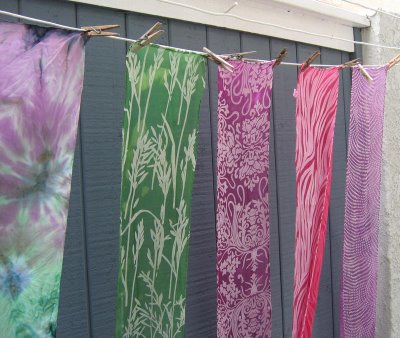 Addendum (8 Nov 2009)
I learned that Penley, the maker of my old sturdy wooden clothespins, has discontinued domestic production. They now make their clothespins in China. I have no idea if the quality is the same. McGuckins hardware sells both the Penley wooden ones made in China, and a plastic variety. Has anyone used them? Do they hold wet, heavy laundry?
I have no use for the high-style ones mentioned in
this story:
Nowadays plastic clothespins are available in endless variations, including a new one that has gone into widespread production, Zebra’s “sweet clip,” made with both hard and soft plastics, using a dual-injection manufacturing process. The hard plastic is in the long handles, while two softer cushions sit where the pin grips the clothes. Zebra developed a dual-plastic toothbrush 15 years ago, applied the principle to clothespins in Europe in the late 1990s, obtained a worldwide patent, and captured 8 percent of the global clothespin market. The pin is sold in North America under the name Urbana.
“We love to target stupid products,” says Xavier Gibert of Zebra. “When you walk into a megastore, most of the time you see stupid products, boring products. You buy them because you need them. We target basic products to make them come alive, able to talk to people.” And what does the Urbana clothespin say? Something along the lines of “I’ll be gentle.”
“The key of this peg is not to be able to hold very heavy clothes,” says Gibert. “It’s much more dedicated to sensitive clothes.” Response to the pin has been enthusiastic. “People were attracted by the design. They said, ‘Wow, we love the shape.’”
If we want to save carbon and achieve energy independence, we will need a clothespin that can securely hold heavy and wet laundry.
More about clotheslines:
- Clotheslines Again shows how I hang my laundry.
- Clothespin Extinction discusses the end of clothespin production in the US. A reader offers her own favorite clothespins and source.
- The comments for this post offer many tips.