Showing posts with label Technology. Show all posts

Saturday, September 07, 2024

Cool Roof 2: Cool Roof, Cool City

 Los Angeles is in the middle of a record-setting (again!) heat wave. NWS reposts that LAX airport, along the coast, recorded a high of 102 F (old record of 99 F in 2020) while Downtown LA hit 112 F. 

Several people asked about our Cool Roof and Heat Pump. I wrote about replacing our asphalt shingle roof with a composite shingle "Cool Roof" back in 2012. Our roof went from reflecting 30% of solar heat (absorbing 70% of the heat) to reflecting over 70% and absorbing less than 30%. If you look closely at the shingles, they incorporate bits of recycled glass, tumbled to a frosted gray, green or blue. From a distance, it looks like a light-medium gray. You wouldn't even know it was a cool roof unless I brag about it. 

When you install a cool roof, you mitigate the Urban Heat Island (UHI) impact of urbanization. "Georgescu et al. (2012, 2013) reported that summertime statewide warming due to projected urban expansion for Arizona could be reduced by about 50% with the complete integration of highly reflective cool roofs." SoCal would likely be similar. 

So, which should you pick, a cool roof, a green roof, or a photovoltaic (PV) solar roof? The answer turns out to be dependent on local climate and geography. Materials change the radiative impact of buildings. They can reduce the amount of heating during the day, but they can also disrupt the amount of cooling at night. They can heat the air above the city, strengthening the urban heat dome. There are so many variables, it takes a radiative full-physics model and a supercomputer to track them all. 

Take the case of Phoenix and Tucson, studied by Salamanca et al: Citywide Impacts of Cool Roof and Rooftop Solar Photovoltaic Deployment on Near-Surface Air Temperature and Cooling Energy Demand. "In Arizona, cool roofs reduced daily citywide cooling energy demand by 13–14%, while rooftop solar photovoltaic panels reduced them by 8–11% (without considering the additional savings derived from their electricity production)."

But, if you were in London, Brousse et all found that cool roofs would be most effective in reducing extreme heat. Nonintuitively, green roofs wouldn't make much difference overall (but help during the day). Vegetation makes a minimal difference on a city-wide scale. Rooftop solar might have an overall heating effect, as would running AC. But, if the rooftop solar energy was used to run AC, and people could take shelter from the heat indoors, they could be a net benefit. 


Governments can encourage behaviors good for society and suppress behaviors that are detrimental with subsidies/fines. If you were running the government, you would like to find out the cost-effectiveness of different interventions (eg subsidies) and fund what gives you the most bang for the buck. If you had even more money, then fund the slightly less effective but still helpful stuff. 

COOL ROOFS reduce heat experienced inside the buildings and in the urban environment. Require them in new construction. Replace dark roofing materials with cool roofs first. If you have money left over install rooftop solar. 

In 2012, I got a 10% tax credit on the cool shingles we used, but that is only a small amount compared to total cost of installation.  The shingles cost the same as the darker colors in the same product line that absorbed more heat and didn't qualify for the tax credit. I didn't need a nudge of a few hundred bucks to do what I knew would make my house cooler. 

Adding rooftop solar was not on my radar back in 2012 because I figured that the prices were still high and technology was still changing. A few people in our neighborhood installed them, but they were much bigger energy consumers than we are. We hadn't installed a heat pump yet. 

BTW, Lawrence Berkeley Laboratory puts out an annual pricing survey called Tracking the Sun, with useful data on actual installed prices of solar systems. 


DIGRESSION:

When we got our heat pump back in 2020 (or maybe 2019?), people asked why we didn't get solar panels as well. I dragged my feet because the rooftop solar salesmen (and they are always bros) were so sleazy, and I also didn't want to buy anything made with forced labor. I was waiting for the solar supply chain to clean up. I am also waiting until I replace my roof again. The timing just wasn't right. 

Besides, I know that California has an excess of solar power during the day. It used to be worse, but utility-scale batteries have been soaking up the excess solar power so that we need to shut down feed in (curtail) solar farms less than in prior years. For the last month, we have been curtailing solar farms during all the hours rooftop solar would have produced at my location. 


Even during the heat wave this week, we had to curtail cheap solar farm power. 


Yes, even during the hottest day ever (so far) in LA. 


There just wasn't much value-add for society if I add solar panels to our cool roof. 


Tuesday, March 22, 2022

World Water Day 2022: Groundwater

We've circled the sun one more time to another World Water Day. This year, the theme is Groundwater. 

I co-organize a monthly (Zoom) series for the League of Women Voters of Los Angeles County that grew out of a one-time water walking tour I led in the Beach Cities. We record and post all the Water and Infrastructure Group (WIG) lectures along with the slides. Occasionally, I add articles about what we learned or add further information on each month's subject. 


Mr. Matthew Hacker is a registered geologist in California and is currently a Senior Resource Specialist at the Metropolitan Water District of Southern California. He has more than 27 years of experience in water resources planning and local resource development in the areas of groundwater, stormwater, and water recycling. Currently, he is striving to create a more resilient water future for Southern California through innovative new projects such as Metropolitan’s groundbreaking Regional Recycled Water Program. 
His prepared talk is under an hour, half the video is Q and A. 

One fascinating thing I learned is that Metropolitan stores imported river water in the vast LA coastal aquifer. That water we pump out, treat, and deliver to our homes, may have originated in Northern California or Colorado. 

You can learn more about that by watching the Who Fills Your Taps? Video or reading the Who Fills Your Taps? Slide Deck. This is a marathon one that is better ingested in two bites. WIG co-organizer, Kathy Kunysz, is a scientist & planner who has had a long & varied career in water. She knows so much, it's an honor and an education to co-host this series with her. 

Monday, January 03, 2022

Dark Money Greenwash Wokewash

If you consider yourself an environmentalist and live in California, odds are high that your inbox has been bombarded with misinformation from a certain group that purports to speak for small solar rooftop owners combatting climate change. 

They call themselves The Something Rights Alliance.  Notice their rhetoric focuses on Individual Rights vs Collective Responsibilities.  This Libertarian framing is then wokewashed with faux concern for the poor to argue for policies that actively harm the poor. 

This Dark Money group is so effective at Flooding the Zone with Misinformation that I'm not going to name them for fear of their web sniffers and the mobs they unleash. But pay attention to the loaded, emotional language that they use in order to short-circuit critical thinking. 

I've been taking a lot of heat from this group and was going to lie low. But, this morning, I read Skeptics Say, ‘Do Your Own Research.’ It’s Not That Simple. written by Nathan Ballantyne and David Dunning (yes, that Dunning) and decided that I have to speak out against armchair environmentalists and the Dark Money manipulators weaponizing them.

It's bad enough that we are dealing with Covid & Climate Change deniers, but now we have to worry about Regulatory Capture by Big Solar as well? 

Let's start with Dark Money.

“Dark money” refers to spending meant to influence political outcomes where the source of the money is not disclosed. Here’s how dark money makes its way into elections: 
Politically active nonprofits such as 501(c)(4)s are generally under no legal obligation to disclose their donors even if they spend to influence elections. When they choose not to reveal their sources of funding, they are considered dark money groups.

I looked up this group in Charity Navigator to find out more about them. They are unscored because they won't disclose information. Hmmm. Then I looked up their 990s on the IRS website. They reported ZERO income in 2017, the last year 501(c)(4)s were required to disclose their donors in a supplement. New grassroots organizations may start with no money and a bunch of volunteers, then grow slowly (both members and $), but this organization's funds grew overnight and then stayed flat. 
IRS 990 for 2018, showed they went from $0 income to $215,017 income, but did not file a (now purely optional) supplement to show who gave them the money. Meanwhile, the board shuffled a bit, but kept the same executive director. He earns his keep by being very active on the bird app and always in your inbox stoking outrage for Straw Man claims that no one is seriously proposing or considering.
In 2019, they report $215,027 in income and their board changes slightly again with the addition of more minorities to bolster their wokewash credentials.
 

Enough about the Dark Money, let's talk about the lies. I wrote an entire fact sheet debunking the wild things they say in their mass emails. It all sounds so physically plausible, until you pick up a physics textbook and calculator. 

The kerfuffle is over Net Metering, the methodology where we credit rooftop solar owners at retail rates for excess electricity that they export onto the shared grid. It made sense when the goal is to nurture a nascent industry, but it becomes a problem when the industry is mature, per panel costs have come down over 90%, and a lot of homeowners are trying to do the same thing. 

When CA passed the first Net Metering law back in the 1990s, lawmakers were worried about the day when residential rooftop solar would be ubiquitous enough that Net Metering would cause a cost-shift from solar owners to non solar owners.  They wrote in the legislation that they would periodically examine the cost-shift and readjust incentives as necessary. This Dark Money group wants to subvert the law. 

This is further exacerbated by the fact that (with few exceptions) you have to own your home and have enough home equity to swing a loan to install solar panels on the home. Guess who has the money?  It's generally older, wealthier and whiter people than the general population.  Over half of Californians are renters. Add in the people who live in condos/townhomes, whose smaller roof area per resident constrain their ability to generate excess electricity to export. 

According to the vast majority of energy experts in academia, national labs and industry; that cost-shift is happening, costs CA electricity customers without solar over $3 Billion per year (and rapidly climbing), and is a very inefficient way ($ and materials) to decarbonize California's grid.  I'm not going to belabor the points, it's already covered in my Fact Sheet. The main point is that people who have  larger systems, and fewer residents/users, export the most electricity to the grid and benefit the most under the status quo NEM 2.0. 

This Dark Money organization tried to stop the regulatory reform process by claiming it was rigged.  When that failed, they turned to organizing a mob to lobby Governor Newsom to either veto the proposed decision or to appoint new California Public Utilities Commissioners that are friendlier to them. This might work because the CPUC was led by an environmental justice rock star, Martha Guzman Aceves, who has been tapped by the Biden administration to head up the EPA for Region 9, which includes California. 

There will be two openings on the CPUC, so this is where they might actually succeed. The vote is scheduled for January 27, 2022 and there might be new commissioners, or the vote can take place without two stalwart defenders of poorer Californians. This is why I'm writing about it here. I'm hoping you will learn more, and then help vaccinate the population against the lunacy.  They are going to flood the governor and the CPUC with their talking points. So I want to get mine out as well. 

I want to talk about the Straw Man claims vs the actual California Public Utilities Proposed Decision. The Dark Money group is using wildly inflated numbers for the Grid Participation Charge. The math doesn't even work out right on their claims.  If you don't want to read the 204 pages of the Proposed Decision (PD), then at least read the CPUC NEM Fact Sheet: Modernizing California’s Net Energy Metering Program to Meet Our Clean Energy Goals Proposed Decision for Proceeding R.20-08-020. 

Simply put, the Grid is a support system that binds all of us together.  We depend on our neighbors and they depend on us. That is the rationale for the Grid Participation Charge, GPC. 

The Grid is a complex and expensive system to build and maintain.  It's also extremely creaky, with many system components from the Rural Electrification Act era, over 80 years ago. If we are not going to burn coal or fossil gas, for which we already have plants close to the users, then we need to build out a twenty-first century national grid to move renewable energy around from source regions to use regions. 

Transmission losses are inversely proportional to voltage; high-voltage interstate transmission lines that bring New Mexico evening wind energy to Los Angeles can lose as little electricity to transmission loss as from a neighborhood substation to a home in the suburbs (a few % each).  That's all taken into account in the Avoided Costs Calculator that NEM 3.0 uses. 

People without solar pay for the grid through volumetric rates ($ per kWh) and a very daily fee.  Rooftop owners push/export electricity to the grid during midday and then pull/import from after sunset.  They are heavy users of the grid, but their volumetric bill can be effectively zero. So they are not financially supporting the grid even though they are heavily reliant on the grid.

In order to encourage conservation, we set volumetric rates so that, the more you use, the more you pay.  That makes intuitive sense, as long as everyone is paying into it.  But, suppose all the heavy users, who also happen to be the wealthiest, install privatized systems--rooftop solar. With volumetric rates, they buy a lot less electricity, which means the (~9/10) non solar customers have to pick up the slack to support the grid.  

The fewer people paying for the Grid through volumetric rates, they higher the volumetric rate (cost per kilowatt hour) needs to be to pay for the Grid.  Under the current Net Energy Metering 2.0 program, rooftop solar owners get paid the retail rate for electricity they export, which is about 5 times as much as the avoided cost (generally wholesale cost of utility-scale solar plus transmission & reserve capacity).

This retail rates have to go up to cover this overpayment, which then generates even higher payments to the rooftop solar owners.  This is a positive feedback mechanism, also known as a runaway train.

Net Metering Reform is about countering this runaway train effect. 

It's long, it's complex, the ruling (proposed decision) is 204 pages for a reason. But I want to counter two BIG LIES. 

The first is that the Grid Participation Charge will hurt low-income solar owners (or which there are very few).  Nothing could be further from the truth. 

Remember earlier when I explained that the Grid is a social contract?  Well, we acknowledge some people have more needs and less resources than others.  We subsidize the vulnerable.  Low income and disabled people (their entire households) will be exempt from the GPC.  The GPC will phase in slowly over 5 years, with a Market Transition Credit to soften the landing. Low income households will also get the MTC so they will get a negative GPC. 


In contrast, NEM 2.0 is paying low income homeowners with solar LOWER prices than for much wealthier solar owners.  Why? Because low income people pay 18-35% lower retail electricity rates.  So, the wealthier you are, the more you are earning under NEM 2.0. 

The second lie is that the CPUC is doing the bidding of the utility companies and designing NEM reform to kill their competitor, roof top solar.  Utility companies are regulated monopolies. They can wish for the sky, but the CPUC tells makes the rules. 

The CPUC has an obligation to keep the Grid in good working order (capacity and maintenance); ensure a safe, reliable and affordable electricity supply for all users; decarbonize the Grid in a cost-effective way as fast as possible, using roof top solar as one of their many tools; and to sustainably promote roof top solar.  It's a tough balance, which is why they studied the issue for so long, listened to many arguments, examined a lot of data. 

The CPUC isn't trying to kill off an industry they are tasked to support.  They are just trying to do it within the constraints of the other things they must also ensure--like affordable rates and a robust grid for everyone.

The second lie is related to the resilience argument.  Currently, the CPUC and the public who pays for NEM 2.0 has no say in where new rooftop solar is installed and subsidized.  Adoption is much broader in wealthy communities. That leaves a lot of poor communities vulnerable to rolling blackouts and Public Safety Power Shutoffs.  Rooftop solar + batteries/storage help insulate people from power outages. If your community has a lot of solar power, and it is set up to run in island/micro-grid mode, then you may be able to access some intermittent power off the micro-grid. But it's not reliable.

Under NEM 2.0, the resiliency benefits of rooftop solar accrue to the owners, and a little bit to their neighbors.  If you are so worried about access to reliable electricity for the medically fragile in the era of frequent Public Safety Power Shutoffs, why not just give solar systems with batteries for the disabled?  Or build Community Resilience Centers in poor neighborhoods where people can come for air conditioning, electricity, wi-fi, hot showers, etc?

That's the beauty of proposed NEM 3.0.  It would raise and disburse $150 Million each year to fund solar installations with storage (batteries) for those in highest need.  We would swap a horribly inefficient subsidy system, NEM 2.0, for a new subsidy that identifies those in highest need and directs the largest subsides to help them. Disabled people who are on SSI (and their households), regardless of income, will be exempt from the GPCs. 

It's about efficiency with our dollars. It's about directing help to those in need instead of waiting for trickle-down solar to work. It's about helping renters and multi-family residents instead of single family home owners (who have a larger rooftop/person ratio).

Please, please, please, don't feed the outrage machine.  Read the Proposed Decision yourself (the conclusions of law starts on page 175 and the order starts on page 179), or at least the CPUC NEM Fact Sheet


Friday, April 02, 2021

Batteries don't grow on trees

This video came across my Twitter timeline and I retweeted it. Rice geophysics professor Cin-Ty Lee explains why nickel and cobalt laterites are found in the areas where biodiversity is greatest. It's pretty heartbreaking.


I knew that batteries were very toxic, and that the Cobalt used in them came from DRC*, often using slave or child labor, but I had believed the stories that alternate sources of Cobalt had been found and that would be a nonissue as soon as the alternate sources came online. 

Professor Lee's video made me realize that the most economically viable Cobalt deposits are all in the tropics: Congo, Papua New Guinea and Queensland, Australia.  You reach the deposits either by strip mining in tropical highlands, or mining the oceans.


If you are in the "green-industrial complex" and need to calculate your client's carbon footprint, you end up having to sum the carbon from battery production with the savings that the battery enables.  If battery production includes the carbon released from strip mining tropical rainforests to mine the ore, the potential carbon savings plummets.

I found an open access journal about the Life cycle assessment of cobalt extraction process that gave a picture of the tradeoffs.  Eutrophication means adding nitrogen and silt to waterways from the strip mining.

Highlights

  • The life cycle assessment of the cobalt extraction route is carried out.
  • Blasting and electricity consumption in cobalt mining is damaging to the environment.
  • Eutrophication and global warming are the most affected impact categories.
  • Carbon dioxide and nitrogen dioxide emission are highest from cobalt mining.
  • Alternative energy sources for electricity generation would enhance sustainability.
One way to avoid destroying tropical rainforests to mine ore is to source your ore from the ocean floor.  I found other articles such as, Deep-ocean polymetallic nodules as a resource for critical materials, that show the potential of deep ocean mining metals used in batteries.  You may not release carbon by cutting down tropical rainforests, but you will make the fishing and tourism industries and coral reef ecologists very angry.  You'll also destroy ocean ecology.  Pesky tradeoffs!

Right now, we're in the battery build up phase.  Eventually, we'll have enough that we can keep recycling them, much as we do for lead-acid batteries.  This will end the destruction caused by mining, but cause other problems.

I did a little research to wrap my head around how much we are talking about.

Lithium-metal batteries are about 10-20% cobalt chemistry, but that includes water, so it's about 1-2% Cobalt by weight.

Teslas have 1060-1200 pounds of batteries or about 55-85 kWh (kiloWatt hours)
The new eHummer has 200 kWh
My Ebike has 0.5 kWh
My Escooter has 0.3 kWh**

Electric cars have 100-500x the batteries and toxicity of Ebikes/Etrikes/Escooters. They are also very very spatially inefficient with road space and urban space (parking).  For rural areas where space is not a problem and distances are large, they make sense.  For the 90+% of Californians and Angelenos living in urban spaces, they are a last solution, not a first solution.

I Ebike about 50 miles on the charge used to move a Tesla X just 1 mile.  Do we really need to move a 4000# car with an additional 1000# of batteries to move one person plus groceries?  I can carry 5 days worth of groceries for 3 on my Ebike without a backpack.  I could probably carry 7 days worth with a backpack, but why bother?

This is why I don't support strongly support electric cars, trucks and buses alone.

We have to get out of single occupancy cars as much as possible, especially in the urbanized areas.

We need to decarbonize transportation using every tool, starting with right-sizing the vehicles for the task.  

We need to use road space more efficiently, which means remodeling our urban environments to make better use of transit and active modes (walking/cycling). 

There is no time to waste.  

We need to do it all at once.

Further reading:


* Just because you rebrand a county from Congo to the Democratic Republic of Congo, doesn't automatically make it so. I refuse to use the Newspeak name.


** A research paper showed the CO2 per passenger-mile for a bunch of different transport modes and the statistic that caught all the media editors' clickbait attention was that shared electric scooters are inefficient.  They are inefficient due to their short lifespans (people trash them) and miles driven in cars by the people who hunt them down, recharge them and restock them.  


A subsequent study showed that privately-owned Escooters are almost as efficient as Ebikes, which are almost as efficient as regular bikes-the most efficient mode of travel ever invented.


Wednesday, October 30, 2019

Organic =/= Sustainable

I cringe every time I read someone call organic cotton sustainable.  It uses so much more land and water.  Natural dyes can double the amount of land required to produce fabric.

I know that I can never convert the die-hard purists, but they are probably not reading this blog anyway.

Technology Review (MIT's Alumni magazine) sums up the current state of our knowledge, Sorry—organic farming is actually worse for climate change.
Organic practices can reduce climate pollution produced directly from farming – which would be fantastic if they didn’t also require more land to produce the same amount of food.

Clearing additional grasslands or forests to grow enough food to make up for that difference would release far more greenhouse gas than the practices initially reduce, a new study in Nature Communications finds.
I've written ad nauseum about how organic cotton uses more water, which is scarce in many of the arid regions where the highest quality cotton is grown, like in my home region of the US Southwest.  Irrigation with groundwater has left the soil so salty that crops can not grow. 

(Alfalfa is grown in the desert because it will tolerate salty soil and water.)

Genetically modified cotton grows with half the water as organic cotton, and it can tolerate salty soil.  You can use the organic practices of crop rotation, cover crops and compost/manure and combine it with technology in a responsible way. 

For instance, GMO Bt cotton manufactures its own protection against cotton borers and bollworms.  In fact, the higher the salt content of the soil, the more pesticides the plant produces.  Bt cotton is sold with and without resistance to Round-up.  Most of the seeds are sold with resistance to both, but that doesn't mean farmers are spraying Round-up willy nilly.

Most farmers are smart enough not to spray chemicals that they don't need.  If weeds are not a problem in that field in that year, then they won't spray.

Small-scale organic farm are laboratories where farmers can test novel ways to grow crops.  Scientists in labs can also develop and test new crops. Then we can combine the best of both approaches.

I read that only 1% of US-grown cotton is organic, while 15-16% (and climbing) are grown from GMO seeds and unsprayed.  It's sometimes sold as "clean cotton" or "better cotton" and purchased by IKEA and Uniqlo.

I read laments by younger sewists on blogs and Instagram that they are sorry they can't afford to sew with organic fabrics.  That saddens me.  We don't have enough planets for everyone to go fully organic.  But we can blend the best of organic practices with technology for a sustainable future for everyone--not just the rich.

Tuesday, April 09, 2019

Towards a better wardrobe

Kate at the Time to Sew blog (@timetosew on IG) asked me what I think about the arguments presented by Nina Marenzi on the Wardrobe Crisis podcast.  I listened to the entire 36 minute podcast just so I can hear a few minutes of scientific tidbits.

(Why are podcasts so popular?  Are we being gas-lit about the popularity of podcasts the same way FB lied about the popularity of video news?  Don't busy people want more info in less time?)

Nina Marenzi made some good points, but, there wasn't an opportunity for her to address the issues deeply in 36 minutes (!) while establishing rapport (talking about childhood pets) and establishing culture cred (music), etc.

Anyhoo...

In short, she said that we have a crisis of topsoil.  We are in danger of using up all of the world's topsoil in 60 years unless we change the way we do things.  You get no argument from me on that one.

Then we hit an uh-oh, when she segued into organic agriculture and biodynamic farming.  We use labels as cognitive shorthand; organic is supposed to represent a sustainable way of farming.  It's true that, on average, organic farmer tends to be kinder to the environment than conventional agriculture.  But, if you have been reading my blog, you know that organic is no panacea.

One problem is that organic farming does not necessarily preserve topsoil.  The opening chapters of Michael Pollan's book, The Omnivore’s Dilemma: A Natural History of Four Meals, deal with how organic lettuce at Whole Foods is grown in northern California.

 The land is tilled, watered and weeds  are allowed to grow. Then they plow the weeds under and repeat the process. Fewer weeds should sprout the second time.  After plowing the weeds under a second time, they actually grow the lettuce.

They follow this wasteful practice in lieu of hand weeding because they simply do not have enough labor to hand weed the enormous acreage required to feed our demand for organic lettuce.

The damage wrought by that organic lettuce is enormous. They lost topsoil with each tilling. They pumped groundwater from a critically overdrafted aquifer to grow two crops of weeds and one crop of lettuce. Along the way, they used up 57 calories of fossil fuels to produce 1 calorie of arugula.

(That is not counting the energy for you to go shop for the arugula and get it home.  I sound like a broken record, but the biggest change you can make is how you (and your stuff) get around.  An electric car sitting in traffic is still another car in traffic.  Get out of your car already.)

Read Organic Pesticides: Not An Oxymoron for an idea of what I am talking about. The problem with EWG's Dirty Dozen is that they only test for synthetic pesticides (the ones not used in organic farming.)  No one is routinely testing for pesticides used in organic farming that can be hazardous to the environment, farm workers, and consumers.

Why You Shouldn't Buy Organic Based on the "Dirty Dozen" List [Updated for 2019]
The “Dirty Dozen” list, which aims to rank the fruits with the most pesticide residue, comes from the Environmental Working Group, and they publish their methodology on the report’s website. They basically download the test results from the USDA’s Pesticide Data Program, which samples produce for pesticide residues, and come up with a ranking score for each fruit or vegetable based on six criteria relating to the number of different pesticide residues seen on produce of that type, the percentage of samples with pesticide residues, and the total amount of pesticide detected.

There’s a problem here. Some pesticides are drastically more toxic than others, but the EWG’s scoring system considers all pesticides to be equal, and they don’t relate the pesticide amounts to known safety standards. Two food scientists did a reality check on the EWG’s numbers from their 2010 list (which uses the same methodology as this year’s). Their analysis was published in the Journal of Toxicology.

They compared the amount of pesticides on each of the Dirty Dozen foods to the chronic reference dose, which is the maximum amount that it’s okay to have if you are eating that food every day of your life. This level, just to be safe, is one hundred times less than the amount that experimental animals were able to consume with no effects. It’s a pretty big safety margin. So how many of the Dirty Dozen exceeded this extremely conservative chronic reference dose? None:
You should read the entire well-researched article.  Author Beth Skwarecki echoes the points chemist and farmer friends have made to me.  It's preferable to buy from a farmer that sprays glyphosate once than from a farmer that sprays organic pesticides repeatedly.  Insects can develop resistance to any pesticide, organic or synthetic.  It's the repeated spraying that breeds pesticide resistance--superbugs and superweeds.

A friend says that he sprays glyphosate once per growing season.  It makes a big difference in his farm's yield and water use.  His orchard is too big to weed manually.  But the glyphosate plus manual weeding of stragglers is working for him, even though he can't sell his fruit as organic.

Did you know that in some parts of India, the chickpea borer has become such a big problem, that farmers cannot grow one of their primary sources of protein?  The best hope for these farmers is to grow BT chickpeas, which are resistant to the borer.  I'm not going to tell a farmer that they are better off starving than using GM technology.

That flexible approach to production that uses technology to improve efficiency while being safer for the environment, the people working in agriculture, and the consumers.

Let's get back to the podcast.  Marenzi made solid points about how we should expand our market basket of fibers beyond cotton and polyester.

She said that polyester makes up 70% of the fiber in global clothing production.  Cotton makes up ~23% and all other fibers make up about 7%.

She said that we should use more linen and hemp, which grow readily with little chemical input and can grow on more marginal land.  One of the big problems with cotton is that it uses up topsoil and water at alarming rates.  It also requires good quality land and fresh water.  GMO cotton can be engineered to grow in soils and with water that contains more salts than organic cotton can tolerate.  In a world with 7 billion people (and growing), we need fiber crops that don't compete with food crops for land and water.

They talked about fiber shedding in laundering and the amount of fibers that end up in the oceans and waterways.  Acrylic sheds the most fibers of all.  I expected cotton and natural fibers to also shed and find their way into the water.  But I did not expect them to persist.  After all, they are biodegradable.  I thought wrong.  The oceans are full of small fibers, natural and synthetic.

This makes me glad that I live in Los Angeles, where our waste water is screened, treated and micro-filtered at a minimum.  Some are even nano-filtered or undergo reverse osmosis and UV treatment to make them potable again.

She mentioned the grave and irreversible damage done by cashmere production that I chronicled in The planetary cost of cashmere.

They discussed problems with viscose/rayon production.  Marenzi noted that viscose/rayon isn't the problem so much as the production process.  You have to soak the cellulosic fibers in strong chemicals to break up the fibers and then use more chemicals to get them to reform into fibers suitable for spinning into yarn.  Wikipedia on rayon has a good summary of the processes.

They mentioned the water use in viscose/rayon production, but didn't mention that the water footprint of viscose/rayon is based on the assumption that the water used in production is released into waterways and diluted to safe levels of toxicity.  That's not what really happens.  No one has uses that much water to dilute the effluent.  Many producers just release it into waterways and let downstream users deal with the pollution.  That happens often in countries with little oversight and laws.

More responsible manufacturers recycle the chemicals and water (with high-tech equipment and applying lots of energy) in a closed loop process.  Manufacturers that use closed loop processes label sell their products under the Lyocell, Tencel or Ecovero labels.  Ambiance Bemberg rayon also uses a closed loop process.  Please support these manufacturers as I do.  They cost a little more for the consumer because they are not foisting the environmental costs to others.

Marenzi also said that 80% of organic cotton grown today is rain-fed.  This is a positive development, but it's too late for the Aral Sea region or the Murray Darling River.
The Aral Sea in 2000 on the left and 2014 on the right. Photograph: Atlas Photo Archive/NASA
She also said that organic cotton is a cash crop grown in rotation with food crops by subsistence farmers in many parts of the world.  I wish the higher yields and lower water requirements of GMO cleaner cotton were available to the subsistence farmers.  This could happen if we made GMO seeds less costly and if we as consumers were willing to pay more for cleaner cotton.  (Farmers in poor countries are only being paid more for organic cotton but we can change that.)

I'm encouraged that the Gates Foundation is investing in GMO research so that farmers in poor countries will be able to take advantage of GMO's advantages without having to pay exorbitant and unfair Monsanto prices.

Anyway, I thought the podcast was a long slog and made some good points but it was a poor investment of my time.  For most people, reading is the fastest way to ingest information.

Thank-you for reading and I hope I didn't take up 36 minutes of your life.

Tuesday, January 29, 2019

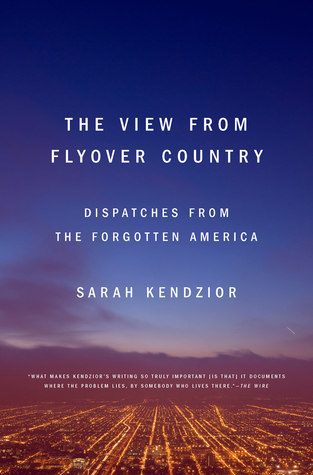
The View from Flyover Country

This is a review that I posted to Goodreads* in 2018.

I've been telling so many people to read this book, follow Sarah Kendzior on Twitter @sarahkendzior and to listen to her podcast (with Andrea Chalupa,) Gaslit Nation.

This is a compilation of her essays, originally published in newspapers between 2012-2014, organized roughly by theme. This can appear repetitive on the surface, but pay close attention to the dates and the world events she cites.

You can pick up and start reading anywhere.

I highly recommend "The Political Consequences of Academic Paywalls" on pages 136-141. Dr Kendzior received her PhD studying authoritarian regimes in Central Asia. The for-profit journal business model is an inconvenience for physical scientists like myself. But having access to her published research, "Inventing Akromiya: The Role of Uzbek Propagandists in the Andijon Massacre," meant life and death for Uzbeks applying for political asylum.

Russian-backed propagandists honed their skills in Uzbekistan, and then trained their sights on the US. A decade after inventing Akromiya, they invented Antifa.

She is a uniquely qualified voice to explain the larger pattern that we see in current US politics.

Never stop looking critically.

Never stop complaining.

It matters.
* I joined the readers' community before Amazon bought Goodreads and log all my reading and thoughts about the books there. You can see the books I am currently reading on the right and click to see what I'm reading, what I've read, or what I'd like to read. Like fabric, I'm adding more books I want to read than I can read them. ;-)

This book reminds me of the Flyover Country app. Set your route and download geophysical data along your route before you leave the house. If you are sitting in a window seat, the GPS reception on your phone (set in airplane mode) will be able to give you real-time information about features below.  It also works on road trips and when hiking.  It even works in remote areas without cell phone access.


This app has a great backstory. Some geologists at the University of Minnesota came up with the idea and decided to apply for a small grant from a National Science Foundation program. They got approval in 15 minutes instead of the more normal 15 months.
Flyover Country® is a National Science Foundation funded offline mobile app for geoscience outreach and data discovery. Learn about the world along the path of your flight, hike, or road trip with inflight maps and GPS tracking. Offline maps with interactive points of interest and geologic data reveal the locations of landscape features, fossils digs, cities, and more that are visible from your airplane window seat, vehicle, or hiking trail vista.

Wednesday, December 13, 2017

Mturk and fauxtomation

Did you know that Expensify's “SmartScan” technology is actually people working for Amazon Mechanical Turk? Read more.
SmartScan is presumably a selling point for Expensify, since the receipts it handles can contain sensitive personal information, like names, purchase details, email addresses, and even bank routing numbers. So it was awkward when, last week, the company was caught posting receipts to an online marketplace for freelancers so that their contents could be transcribed not by SmartScan, but by humans.
No, I do not want Alexa or Google listening in on my conversations at home.

Wednesday, August 16, 2017

Beware of false moral equivalence

Speaking of recent bullshit, I am surprised by the lack of pushback in the media with respect to false moral equivalence. For instance, consider this article about the taking down of a confederate monument in Hollywood.  (I added the bold face.)
A spokeswoman for the Daughters of the Confederacy explained the group’s decision to remove the monument this way:

“I was afraid to leave it overnight,” said the spokeswoman, who asked that her name not be used for fear of reprisal. “We have had the cemetery remove it until we decide what to do.”

Those calling for the monument’s removal are “erasing history,” she said.

“I do not believe in slavery — no sane human would believe in that today,” she said. “But back then, they did.”

She condemned the violence in Virginia and expressed sorrow for those killed and injured.

“We weep for the people who are involved in all of the things that are going on in our country — on both sides. We find hatred among white supremacists, we find hatred among Black Lives Matter,” she said. “We should all come together and become one under the United States of America.”
On both sides?  ON BOTH SIDES?

Why didn't the LA Times reporters press this unnamed spokeswoman for the Daughters of the Confederacy to clarify what kind of hatred from the BLM movement she is referring to?

One side wants to celebrate the treasonous people who went to war for the right to enslave other people.  All BLM wants is for the police to stop killing them.

There is no both sides about this.  There is no moral equivalence.

There was a concerted social media effort to portray the BLM movement falsely.  A great deal of money was spent to smear BLM so that they would lose public support..  Zeynep Tufekci ably explained how this was done in Twitter and Tear Gas.  Read it!

[Addendum: ZT has posted a free pdf version of Twitter and Teargas but I hope you support her and buy a copy.]

Learn more about the Russian propaganda tool, 'whataboutism,' that is widely used by authoritarians, climate deniers and the right around the world.

I don't know what to call this

I am so effing tired that we have to even fight the dark forces that are threatening our country right now.  If you haven't already done so, I urge you to read Twitter and Teargas: The Power and Fragility of Networked Protest. Zeynep Tufekci has been studying the intersection of authoritarianism, technology and protest for decades and you really, really want to learn from her.

[Addendum: ZT has posted a free pdf version of Twitter and Teargas but I hope you support her and buy a copy.]

Meanwhile, I have an example of how adept the spinmeisters of satan are at manipulating technology and algorithms, I give you my search results yesterday for the "Southern Poverty Law Center Hate Map":

An ad or two appears before the search results, as is typical for Google searches. But look carefully. Notice that the top ad is for a website that exists solely to discredit the splc.org with completely fabricated lies? Who paid for that ad?  How do they act so fast?  There are literally armies of people working on spreading disinformation so that people give up and say that the fault lies with 'many sides.'  Don't be that dumbf*ck.

If you follow me on Twitter, you might have seen me tweet the screen capture to Google. Enough people must have done it because searches for the same phrase and SPLC in general are devoid of ads and go to the organization's site and map. BTW, this is the SPLC Hate Map tonight.

Less well-known, but deserves to be better known, is the Map of White Supremacy mob violence.


Don't miss @JuliusGoat's thread, 'Imagine if these people ever faced actual oppression.'

The white militia is here to demand your obedience with their guns.

AP photo via Mother Jones
Call me a feminazi, but I've never had to resort to carrying a gun to make you agree with me.


Thursday, July 13, 2017

Faux Disruption

I read Home Delivery! What Will They Think of Next? by Peter Funt with a chuckle.

When I bought my first Bernina, I went to the store by bike. The Bernina dealer delivered the machine to my home on her way home from work. Another colleague bought a framed picture and the art dealer delivered it to him at home, too.

At one time, the Boulder Public Library delivered requested books to your home in a "green bag." You return the bag and the book to the library later.

Funt rightly points out that dot coms like AmazonFresh and Instacart are inventing stuff that already exists. Home delivery of food was ubiquitous from the days when milkmen and green grocers were common sights on the street. Grocery stores delivered because most housewives didn't have cars.  They never stopped offering home delivery.

When I was in graduate school 20+ years ago, a classmate without a car told me about King Soopers' home delivery service. She would ride her bike to KS, select her weekly fresh food plus monthly nonperishable staples, and then take them to the customer service desk to arrange for home delivery. She then rode her bike home and met the KS delivery van a few minutes later. The rest of the month, she bought just what she could carry by bike.

Back then, King Soopers charged $9 to pull your groceries and deliver to your home. If you needed only one of those services; e.g. you pulled your own groceries and just needed delivery, or you needed someone to pull the groceries for you and load them up into your own car at the store, then you paid about half as much as full (pull+delivery) service.

For about $5/month, my friend solved one of the difficulties of being car-free.

The Denver Channel compared different home food delivery services and discovered that, while Instacart allows you to order groceries from King Soopers, Instacart offers a much smaller selection and charges 30% more than if you order directly from KS.
King Soopers Homeshop would cost me $96.12 for delivery and $90.12 for pick-up, followed by Instacart who cost $134.51, or 30% more than just ordering from King Soopers directly.
Home delivery was a necessary service before private cars were commonplace. For less mobile people, particularly the sick and elderly, those services are a lifeline.

Silicon Valley did not invent any of this. SV just pays their workers less, charges you more, and evades taxes.

This is an extension of my thoughts about Fauxtomation.

Saturday, June 24, 2017

Fauxtomation

This new word hit the zeitgeist on June 19, 2017 thanks to @astradisastra.


The next day, Mel Healy wrote a smart essay about Fauxtomation and the Mechanical Turk.
For all their tech, many leading tech firms nowadays may be rather more “hi-Turk”, relying on cheap labour to do the day-to-day maintenance and moderation of their social media. Like the Mechanical Turk’s operator these people are largely hidden away inside big boxes, only this time the boxes are on the opposite side of the planet, in India or the Philippines. Vast armies of invisible workers in underdeveloped countries.

Each box is decidedly unglamorous compared with the shiny new HQs and campuses of Silicon Valley in California or Google Docks in Dublin. You won’t find any fancy games rooms and lavish staff restaurants, or “micro kitchens”, chillout zones, fitness centres, swimming pools, wellness areas, tech stops or phone booths.
June 23, 2017, Shira Ovide wrote about the army of workers needed to bring you Amazon's one-click convenience.

Fauxtomation is the word that crystalizes why I feel so angry about gushing articles like this about places like Eatsa, a restaurant that supposedly serves vegetarian food made by robots.
Customers tap their meal selections on an iPad or their smartphone and pay electronically. No cash is taken here. Then when the order is ready, hands slide the meal into a “cubby,” which lights up with the customer’s name. The plan is for it to be ready in less than minutes from the time the order is placed.
Silicon Valley reinvented the automat. But--most insidiously--this time, they are selling a guilt-free low-cost experience by pretending that a low-paid human did not make the food.
Eatsa is the brainchild of Scott Drummond, a techie focused on data-driven results. He says forgoing meat, along with staff, helps keep the cost of goods down.
Drummond is all about the data science and other buzz words/phrases such as “enhanced predictive and personal health engagement.” But can robots prepare these meals? If so, what a breakthrough in robotics!
How the kitchen will hold up remains to be seen. For now, at least, it relies on human components: about five employees involved in prepping, assembling, and expediting behind the store’s façade.
The dirty secret finally comes out, there are people hiding in the mechanical Turks. Even then, he obfuscates further by invoking the glamour of warfare and robotics.
But for now, Eatsa still needs a few good chefs, with some special skills. “They can’t be afraid of technology,” say Drummond. “Our first general manager used to be a military robotics specialist.”
You betcha that a robotics expert is not the guy making your $7 lunch in San Francisco.

Wonkblog explains the crisis in restaurant staffing, particularly in high cost areas such as SF-SV.

And don't even get me started on Blue Apron's unsafe working conditions necessary to bring us cheap, home-cooked meals.  Food, like clothing, is not going to be cheap and fast unless we sacrifice some people.  Are we willing to confront those choices head-on?


Addendum:
The Washington Post reports that shipping costs account take up 30% of the price of Blue Apron meals.  It's a big driver in why BA squeezes their kitchen staff to work at unsafe speeds or to work off the clock without pay.


Sunday, August 07, 2016

Harley Quinn sadness

Remember the Harley Quinn costume I made for my daughter?

And my ambivalence about the hyper-sexualization of females in comics?

Check out the slide show about Harley Quinn cosplay in the LA Times. Look at the difference in (un)dress between the male and female cosplayers.

Then check out this tweet from David Helder pointing out the sexism at #defcon, a computer security conference. Please note, this is happening in 2016.
Hacker Jeopardy. Category is "Dicks". Men play. Women give them beers. Why aren't there more women in security?
Click to see the questions on the screens. To play this game, you have to have encyclopedic knowledge about p@rn.

Scroll down to read the discussion.  This is the state of one corner of tech.  I am not sure other areas of tech are any better.

Thursday, June 30, 2016

5 for 5

It's been a busy few weeks.  Today, we wrapped up the Weather Research and Forecast Model 2016 Users' Workshop.  I just want to share with you the last slide of the last presentation of the day and week.

How often in the world of tech and STEM do you see an all-female leadership team?  The leaders all five of the Developmental Testbed Center's Focus Areas are female.


The DTC was founded to "serve as a bridge between research and operations to facilitate the activities of both halves of the NWP (Numerical Weather Prediction) Community in pursuit of their own objectives."

Meanwhile, I have made a little progress on the #shirtdresssewalong.  I finally decided on these two fabrics: the floral with the check as an accent for the collar, pocket and cuffs.

I'll use the Ralph Lauren pattern for the bodice and the OdlR pattern for the skirt.  I had previously made the RL in rayon challis, and didn't like the rectangular shape of the skirt.  The OdlR skirt is more flared and has a curved pocket opening that I prefer over side-seam ones.

I had hoped to get at least the bodice done before the June 30 deadline for the sewalong giveaway.  But, deadlines and hobbies don't mix for me.

I'll work on it this weekend while I wait for my family to join me in Boulder.  July in the Rockies is heavenly.

Is anyone else going to the Cherry Creek Arts Festival?

How about the Women of Abstract Expressionism exhibition at the Denver Art Museum?

Tuesday, April 26, 2016

My problem with Facebook and Instagram

Have you read Dave Carroll's Facebook's Privacy Problem with Parents?
Apparently, I am one of the first people on Earth to carefully inspect the latest Facebook data policy because I found several broken links, blank page dead-ends, and the most astonishing form I have ever come across as a parent. I promptly tweeted it. It immediately went viral in collective disbelief and general outrage.
...
It’s both chilling and telling that the company forces a parent or guardian to hire a lawyer to draft a notorized statement to “establish guardianship rights” in order to opt their child out of ad settings on Facebook which include using their name to endorse unknown products and services to other users, should they experience any trouble finding, understanding, and using this screen in their child’s account settings.
I'm not going to paraphrase it here, because Prof. Carroll does a very able and thorough job explaining why this is so dangerous and alarming. Read it!

I left the Facebook platform because I was unhappy with the way they used private medical data gleaned, not from public posts, but from private messages between FB users*. Anyway, now I wonder if I should leave Instagram.

What do you think?

* It's difficult to find the news stories that criticize FB practices.  FB likely pays a lot of money to make sure those search results appear far, far down--or disappear altogether.

Friday, April 01, 2016

Speed is relative

During Boulder's recent heavy snow storms, I worked at home.  I work with geophysical data sets, which can be large.

My home connection speed seemed soooo sluggish so I ran speed tests with a few websites.  The results were all similar.
50 Mbps down and 6 Mbps up is a fast home connection speed.
According to Geeksquad, this is about as fast as you can expect at a residence. Why did it seem so slow?

I reran the tests at work.

1 Gbps up or down!

I know now why 50 Mbps seems slow.  ;-)

Speed is relative.

Happy belated April Fools' Day.

This was my favorite 2016 April Fools' prank, but it's actually deadly serious.

Desert tortoise militia occupies Bundy Ranch: Endangered reptiles stage heavily armored takeover of cattleman’s property.

Aside:

Do you remember the pre-internet days?  When only a few non-military (ARPANET & MILNET) sites in the country were networked together through NSFNET?  56 Kbps was blazing fast, and you had to sit at one of 6 supercomputing centers to get that.
The network expanded and so did bandwidth in 1991.  Palo Alto was an upstart compared to Boulder.

NSF decided to allow anyone who wanted a connection to hook up to their network through NCAR.  (This was before the internet and ISPs.)  Boulder might have become a tech hub anyway, but this decision certainly accelerated that development.

The network was reconfigured with even faster speeds in 1992.  Notice that the major nodes were moved to population centers, with spurs to universities and national labs.

Weather data was one of the original Big Data use cases. And we need a pretty fat pipe to push data out to the world.

Working at home, on a standard connection, is a pretty humbling reality check. I need to experience what users outside of major universities and national labs experience.

I have helped climate researchers in Madagascar and east Africa, who work within the constraints of very slow network connection speeds outside their local regions. I've also helped researchers studying pollution in countries where questioning the effects of development puts them in personal peril. They are my heroes.

Who are your heroes?

Saturday, October 03, 2015

VW and the dark side of AI

When I heard VW got caught cheating on emissions tests, I was not surprised.

What was surprising is that I could smell french fries every time a coworker drove by in her 'clean' diesel VW bug running on biodiesel (a mixture of diesel and filtered used fryer oil from restaurants.)

How could the emissions from her car be clean if the aromatic chemicals that give off the characteristic french fry smell were not combusted beyond recognition?  How could such incomplete combustion pass the strict California emissions tests?

How did VW game emissions testing?

This Computer World article gave a log of possibilities but no definitive answer.
Arvind Thiruvengadam, a research assistant professor at West Virginia University, was involved in a project last year that evaluated tailpipe emissions of diesel cars made by European manufacturers for the American market.
...
Thiruvengadam said he hasn't researched the software that allowed Volkswagen to cheat on the tests. But he did say "there were lots of ways an electronic control unit could be programmed to identify testing and change its fuel mapping toward low emission in those rare scenarios."

For example, modern cars can sense when a hood is open for dynamometer testing, "so a smart hood switch could double as a defeat device."

Or, another sensor could detect when a vehicle's traction control unit was disabled, which is required during emissions testing, and place the emission system into a different mode.

"The possibilities are almost endless," he told Autoblog. "I'm pretty sure that if you're one of the largest car manufacturers, you could do a lot more."
Some of these methods could produce false positives--assume they are being tested when they are actually being driven on the road.

For instance, if the motor is running but the car is not being actively steered, can you assume the car is on rollers for a test?  What if the car is instead being driven on a straight desert road?

In that case, switching the car to 'clean' mode would drastically reduce the fuel efficiency and the car could run out of fuel in a remote location.  If many VW owners report the same problem when driving straight, often remote, roads, the gig would be up.

My aha! moment came when one article said the method involved steering, engine use, AND pressure sensor data.

According to the US EPA violation letter to VW, sensors that could be used in a 'defeat device' need to be disclosed along with the reason why the device is needed for a non-defeat purpose.

I could imagine pressure sensors being useful for a fuel injection system or a rough altimeter, but not while the car was in motion.  Other methods would work better due to Bernoulli's Principle.  So why would VW put pressure sensors in their cars?

A moving car is shaped a little bit like a wedge or an airplane wing.  The air above the car moves slightly faster than the air that flows below the car; Bernoulli's principle states that pressure exerted by a fluid decreases as the fluid velocity increases.

If the motor is running for many minutes without active steering AND the pressure sensor on top of the car does not drop, then the car is likely on rollers in an emissions lab.

Artificial intelligence, AI, in your car determines when to apply the ABS brakes, traction control and the ratio of air to fuel.  It can also be used to cheat on emissions tests.

How can we find a simple algorithm like this--that can be written in just a few lines--among the 100 million lines of code in some new cars?

Update:
The Upshot in the NYT answered (or tried to answer) Little Hunting Creek's question of excess mortality due to VW emissions.