Showing posts with label Geography. Show all posts

Saturday, April 12, 2025

Motonormativity 2

I wrote an LA Voter newsletter (for members of League of Women Voters in Los Angeles County) article about Motonormativity and the way that local, state and federal governments reinforce it with their laws and actions. 

Professor Ian Walker wrote in the 2023 paper, Motonormativity: how social norms hide a major public health hazard, “Decisions about motor transport, by individuals and policy-makers, show unconscious biases due to cultural assumptions about the role of private cars - a phenomenon we term motonormativity.” 

His results were replicated in in the US by Professor Tara Goddard in the 2024 paper, Windshield Bias, Car Brain, Motornormativity: Different Names, Same Obscured Public Health Hazard. 

Past WIG speaker and public health researcher Isabella Chu, MPH, also spoke about the hidden public health hazard that is the top killer of US children. Indirectly, through air pollution and involuntary inactivity by making active transportation (walking, cycling) dangerous, cars may be the top killer of people in the developed world of all ages. 

Transportation, mainly private automobile use, is the largest contributor of CO2 emissions in Los Angeles County and the largest source of PM2.5 pollution (except in the occasional years when particulates from wildfire smoke affects populated areas of LACO.) 

Yet, all this is invisible to most people and especially law and policy makers. In California, it is legal to kill with a car as long as you were not intoxicated, were not speeding, and stayed at the scene of the death. This applies even if a driver kills a cyclist in a crosswalk

ILO wrote a letter to Metro’s Board of Directors for omitting protected bike lanes on the Vermont Ave BRT (Bus Rapid Transit) project plans. The City of LA’s Mobility Plan 2035 (adopted in 2014) promised to address identified shortcomings by 2035 by implementing the plan as each section of the roadways had work done. The Mobility Plan showed Vermont Ave would receive both a protected bike lane and a bus priority lane. 

Vermont Ave is infamous as more people die on Vermont Ave due to traffic violence than in the entire state of Vermont every year. (This does not include deaths due to pollution and other indirect deaths.) The LA Times explained the situation in Lawsuit filed against L.A. over lack of bike lanes, claiming Measure HLA violations

Local actions are even more important as we can no longer count on the Feds to help us. Under the Reagan Administration, Federal transportation dollars were allocated in a rigid formula of 80% to highways and 20% to transit. 

The Secretary of the Department of Transportation is Reality TV and Fox Business personality, Sean Duffy. He made headlines recently when he rode the NYC subway with NYC mayor Eric Adams and subsequently told Laura Ingraham on Fox News that "even big men don't want to ride the subway." 


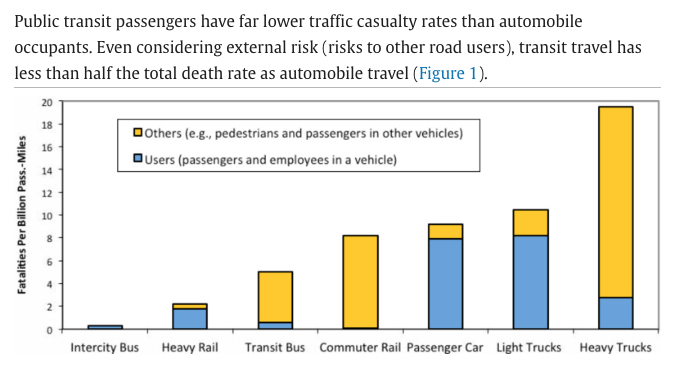
“Most transit trips include active transport (walking and/or cycling) links, and transit users tend to walk and bike more in total than motorists (Lachapelle et al. 2011). These modes have relatively high per-mile casualty rates, although this risk is largely offset by reduced risks to other travelers and improved public fitness and health, so per capita crashes tend to decline and overall health and longevity increase with more active travel in a community (Rojas-Rueda et al. 2011).” 
Transit is so safe that a 1% increase in transit mode share would result in a 2.75% reduction in road deaths. 

State lawmakers show similar characteristics of motonormativity. Until September 6, 2023, Californians could purchase EVs (electric cars) secure in the knowledge that they would receive guaranteed rebates of up to $7,500 for each EV, and that these would stack on top of Federal rebates of $7,500. The income cap was $200,000 for joint filers. California passed out over $1 Billion in EV rebates. 

Contrast that with the California eBike incentive, which has an income cap of $61,320 for a family of 2, and which exhausted the entire $10 Million allocated to eBikes within minutes. eBikes received only 1% as much money as EVs, despite global research showing that dual-mode households drove 19% less than before they obtained an eBike

 “Transportation is a climate and feminist issue. CA DMV data shows that women will spend twice as many years aged out of driving as men. Yet, our cities have not built infrastructure for people who don’t drive. 
… Car dependency is not just ruinously expensive, but it’s destroying the planet, and preventing nondrivers from fully participating in society. Women, as primary caregivers, are paying the time tax of chauffeuring people around. Protected bike lanes are mobility lanes, suitable for children on bicycles and seniors on mobility scooters alike.   
Local government decisions have kept us isolated and stressed.”

Wednesday, March 30, 2022

CA Car Rebates and Our Underfunded Active Transportation Program

There's been much hoopla about California's budget surplus and high gasoline prices. So why not use some of that surplus to alleviate pain at the pump? That may be good political messaging when the impetus is the much more mundane Gann Limit on CA public spending. The ghost of Howard Jarvis strikes again. Not content to limit just property taxes, they sponsored and got the electorate to approve caps on overall spending that limit public investment overall.

I don't want to belabor the stupidity of giving people who own cars $400 per car, up to $800 per person, while not similarly rewarding people who are either too poor to own cars and/or care enough about the common good to not own a private car in the first place.

In a world without all the stupid laws that we inherited, we could have fully funded our Active Transportation Program (ATP) to increase the proportion of trips accomplished by biking and walking.  The majority of ATP-funded projects are Safe Routes to Schools--to help children get safely to and from school. Basically, we need to protect kids outside of cars from the cars chauffeuring them around. 

Because of limited funding, ATP grants are extremely competitive

In 2014, cities and counties across the state requested about $1 billion in funding for pedestrian and bicycle safety projects, but there was only $368 million available, meaning about 37 percent of applicants were funded that cycle. Fast forward to Cycle 5 in 2020 when over $2.5 billion in funding requests were submitted for $554 million in available funding, a success rate of about 22 percent. In Los Angeles County, only 14 of 64 applications were awarded even partial funding, or 22 percent total – demoralizing, yet consistent with the statewide average.


The 2023-24 ATP budget is even grimmer. ATP has $147,670,000 to spend that is not already committed to other projects. That means, the 6-county SCAG region of 20 M people (including LA County, has only $31,242,000 or about $1.50/resident. 

In contrast, Governor Newsom's proposed 5-year infrastructure plan will devote $10 B to electric cars and $20 B for roads, roughly $5 B/year (pages 7-8).  This isn't even counting the $ spent on CHP and traffic enforcement. Due to the Gann limit, every $ spent in one place is a $ we can't spend somewhere else. This is extremely discouraging. 

In the mean time, we depend on volunteers and advocates such as Safe Routes Partnership to help communities hone their proposals to improve their odds of winning an ATP grant. "In ATP Cycle 5, four out of the five communities we worked with scored an 86/100 or above." In other words, communities can compete to get technical help to further compete to get funds to improve street safety for school children. 

My community finally won an ATP grant, but the funds allotted are well short of what we really need to remodel our streets.  We're likely to end up with some paint and street signs. Sigh. 

We have so much work to do. Spend some time exploring the California ATP Transportation Injury Mapping System.  (You need to register to create a free account, but it's worth it. UC Berkeley researchers built the system and don't do anything nefarious with your search terms.)

Here's a heat map of the 2017-2021 carnage. 


People who live in the neighborhoods with the larges blotches of red are least likely to own a car but most likely to be killed or maimed by one.  In Los Angeles County, over 5 years, 173 cyclists dead, 1323 pedestrians dead, thousands more injured and maimed. Their lives will forever be marked by pain and disability. (I'm not even counting the effect of air pollution in their neighborhoods.)


The Gann Limit requires CA to give out rebates. I wish that the rebates be used for restorative justice instead of rewarding people for owning cars. Who's with me?


Tuesday, March 22, 2022

World Water Day 2022: Groundwater

We've circled the sun one more time to another World Water Day. This year, the theme is Groundwater. 

I co-organize a monthly (Zoom) series for the League of Women Voters of Los Angeles County that grew out of a one-time water walking tour I led in the Beach Cities. We record and post all the Water and Infrastructure Group (WIG) lectures along with the slides. Occasionally, I add articles about what we learned or add further information on each month's subject. 


Mr. Matthew Hacker is a registered geologist in California and is currently a Senior Resource Specialist at the Metropolitan Water District of Southern California. He has more than 27 years of experience in water resources planning and local resource development in the areas of groundwater, stormwater, and water recycling. Currently, he is striving to create a more resilient water future for Southern California through innovative new projects such as Metropolitan’s groundbreaking Regional Recycled Water Program. 
His prepared talk is under an hour, half the video is Q and A. 

One fascinating thing I learned is that Metropolitan stores imported river water in the vast LA coastal aquifer. That water we pump out, treat, and deliver to our homes, may have originated in Northern California or Colorado. 

You can learn more about that by watching the Who Fills Your Taps? Video or reading the Who Fills Your Taps? Slide Deck. This is a marathon one that is better ingested in two bites. WIG co-organizer, Kathy Kunysz, is a scientist & planner who has had a long & varied career in water. She knows so much, it's an honor and an education to co-host this series with her. 

Friday, April 02, 2021

Batteries don't grow on trees

This video came across my Twitter timeline and I retweeted it. Rice geophysics professor Cin-Ty Lee explains why nickel and cobalt laterites are found in the areas where biodiversity is greatest. It's pretty heartbreaking.


I knew that batteries were very toxic, and that the Cobalt used in them came from DRC*, often using slave or child labor, but I had believed the stories that alternate sources of Cobalt had been found and that would be a nonissue as soon as the alternate sources came online. 

Professor Lee's video made me realize that the most economically viable Cobalt deposits are all in the tropics: Congo, Papua New Guinea and Queensland, Australia.  You reach the deposits either by strip mining in tropical highlands, or mining the oceans.


If you are in the "green-industrial complex" and need to calculate your client's carbon footprint, you end up having to sum the carbon from battery production with the savings that the battery enables.  If battery production includes the carbon released from strip mining tropical rainforests to mine the ore, the potential carbon savings plummets.

I found an open access journal about the Life cycle assessment of cobalt extraction process that gave a picture of the tradeoffs.  Eutrophication means adding nitrogen and silt to waterways from the strip mining.

Highlights

  • The life cycle assessment of the cobalt extraction route is carried out.
  • Blasting and electricity consumption in cobalt mining is damaging to the environment.
  • Eutrophication and global warming are the most affected impact categories.
  • Carbon dioxide and nitrogen dioxide emission are highest from cobalt mining.
  • Alternative energy sources for electricity generation would enhance sustainability.
One way to avoid destroying tropical rainforests to mine ore is to source your ore from the ocean floor.  I found other articles such as, Deep-ocean polymetallic nodules as a resource for critical materials, that show the potential of deep ocean mining metals used in batteries.  You may not release carbon by cutting down tropical rainforests, but you will make the fishing and tourism industries and coral reef ecologists very angry.  You'll also destroy ocean ecology.  Pesky tradeoffs!

Right now, we're in the battery build up phase.  Eventually, we'll have enough that we can keep recycling them, much as we do for lead-acid batteries.  This will end the destruction caused by mining, but cause other problems.

I did a little research to wrap my head around how much we are talking about.

Lithium-metal batteries are about 10-20% cobalt chemistry, but that includes water, so it's about 1-2% Cobalt by weight.

Teslas have 1060-1200 pounds of batteries or about 55-85 kWh (kiloWatt hours)
The new eHummer has 200 kWh
My Ebike has 0.5 kWh
My Escooter has 0.3 kWh**

Electric cars have 100-500x the batteries and toxicity of Ebikes/Etrikes/Escooters. They are also very very spatially inefficient with road space and urban space (parking).  For rural areas where space is not a problem and distances are large, they make sense.  For the 90+% of Californians and Angelenos living in urban spaces, they are a last solution, not a first solution.

I Ebike about 50 miles on the charge used to move a Tesla X just 1 mile.  Do we really need to move a 4000# car with an additional 1000# of batteries to move one person plus groceries?  I can carry 5 days worth of groceries for 3 on my Ebike without a backpack.  I could probably carry 7 days worth with a backpack, but why bother?

This is why I don't support strongly support electric cars, trucks and buses alone.

We have to get out of single occupancy cars as much as possible, especially in the urbanized areas.

We need to decarbonize transportation using every tool, starting with right-sizing the vehicles for the task.  

We need to use road space more efficiently, which means remodeling our urban environments to make better use of transit and active modes (walking/cycling). 

There is no time to waste.  

We need to do it all at once.

Further reading:


* Just because you rebrand a county from Congo to the Democratic Republic of Congo, doesn't automatically make it so. I refuse to use the Newspeak name.


** A research paper showed the CO2 per passenger-mile for a bunch of different transport modes and the statistic that caught all the media editors' clickbait attention was that shared electric scooters are inefficient.  They are inefficient due to their short lifespans (people trash them) and miles driven in cars by the people who hunt them down, recharge them and restock them.  


A subsequent study showed that privately-owned Escooters are almost as efficient as Ebikes, which are almost as efficient as regular bikes-the most efficient mode of travel ever invented.


Monday, March 29, 2021

Plastic

I vent sometimes on Twitter. Earlier this month, I ran a Twitter poll and learned how hard it is to write an unambiguous multiple choice question.


Is plastic petroleum?

Of the 164 votes, 

  • 72.6% chose "Yes, duh"
  • 3% chose "No"
  • 4.3% chose "Don't know"
  • 20.1% chose "Not enough info to answer"
It's a good thing that I don't have to come up with a grading rubric for this question because you can make a valid argument that any of the choices are correct. 

I started to write an explanation for the answer, but it became quite a long thread.  Since it took so much research and time, it deserves to be put up on the blog.

Until 2 years ago, I didn’t know that materials scientists consider plastic a property instead of a material. You can make plastic from all sorts of polymers that are soft when warm and rigid when cooled. Eg potato starch plastic. 2/ 

Most plastics used in the world are made from fossil hydrocarbons, typically ethane. It used to be made mainly from petroleum distillates but is now often made from fossil gas aka natural gas. 3/ 

Worldwide, plastics use is increasing alarmingly. We should question whether we really need to consume so much. But, in the US, our car dependence is a much, much bigger problem. Landfilled plastics are sequestered. Gas tank hydrocarbons get burned and add CO2 to the atmosphere 4/ 

4/ Quote Tweeted this AirQ thread about how CO2 is lower on weekends because people drive less.


I’m not a big plastic user and live in a community that supports reduce, reuse, recycling. Angelenos produce much less garbage than US avg. Many areas, including mine, haul away yard and kitchen waste for industrial composting. Our recyclables are collected, sorted and recycled 5/ 

The rest of our trash is incinerated at SERRF on Terminal Island, Long Beach. It generates electricity for SERRF and feeds the grid. The ports of LA/LB use a lot of electricity 24/7 so this is synergistic. My city diverts 74% of waste (typical for LA County) and burns the remaining 26% 6/ 

(Our regional solid waste stream is also smaller than the US avg due to state/local government policy choices. Our family also made lifestyle adjustments to reduce it even further. The main driver is that government policies support solid waste reduction.)

I’m still using a roll of Saran Wrap purchased 10 years ago. I used Parafilm in lab when I needed it. I have zero guilt about using plastic when I need it. Right now, my trash is full of takeout containers from local restaurants that need our support during the pandemic 7/ 

Try to reduce single-use plastics in your day to day life as much as you can. Carry that refillable water bottle daily, but keep a case of water bottles in your earthquake kit. The American Chemical Society devoted a special issue to plastics recycling 8/ 

In short, mechanical plastics recycling chops up the long-chain polymers and weakens plastic. So, the current methods of plastics recycling, where new and old plastics are mixed together, is not closed loop or sustainable. Eventually, the plastic will be too weak to do its job of holding stuff. You don't want a container that breaks unpredictably.
THE DYSFUNCTION OF PLASTICS RECYCLING Plastics recycling, as it exists today, is a mess. In 2015, the US recycled only 9.1% of the 31 million t of plastics that consumers threw out, according to the Environmental Protection Agency. The vast majority ended up in either landfills or incinerators. In contrast, two-thirds of paper, a third of metals, and a quarter of glass were recycled that year. In the European Union, about 14.8% of the roughly 27 million t of plastic waste was recycled in 2016, according to the European Commission.
But, there's active research into using enzymes to break down plastic back to its pre-polymerized raw feedstock shape. About 40% of it will remain, but it can be turned into low-sulfur diesel fuel--not a bad fuel for long distance trucking or ocean-going cargo ships which operate away from urban areas. 

One of my husband’s former classmates at MIT is working on enzymatic fuel production from plastics and agricultural waste. I am optimistic about the technology, though it is still too expensive. 9/ 

Driving an ICE car is single use petroleum. Using plastic, even if it is incinerated after 1 use, gets 2 uses out of the material. If it is landfilled, it is at least sequestered vs burned and released into the atmosphere 10/

Gasoline accounts for 45% of US petroleum use while all chemical feedstocks (paint, solvents, cleaners, pharmaceuticals, plastics) account for 1.5% https://eia.gov/energyexplained/oil-and-petroleum-products/use-of-oil.php 11/


In summary, that smarty pants state senator is operating on old information. Plastics are made from a variety of sources & petroleum is one of the top 2. Plastics in waterways is a problem, but tire particles are the overwhelmingly major source 12/ 

[oops, I skipped 13/]

EVs, because of their weight, increases tire wear, exacerbating water and air pollution https://greencarreports.com/news/1127424_study-particulate-emissions-from-tire-wear-is-higher-than-from-tailpipes 14/ 

I wrote a detailed blog post about this 15/ Leaf blowers, street sweeping, car tires, fish and you

“Non-exhaust emissions...are currently believed to constitute the majority of primary particulate matter from road transport: 60% of PM2.5 and 73% of PM10.” https://tiretechnologyinternational.com/news/regulations/pollution-from-tire-wear-1000-times-worse-than-exhaust-emissions.html 16/

Under-inflated tires are a huge contributor to tire particles. Remember the Ford Explorer rollover scandal? SUVs are top heavy. To reduce rollover risk, they use special tires that don’t burst when inflated much lower than passenger car tires 17/ 

SUVs and pickups need larger tires, often at lower pressures, so they don’t roll over. Want to know why our regional PM 2.5 just keeps increasing? The answer is almost always cars, especially SUVs. Electric SUVs are greenwash. Electric bikes/trikes in every garage instead 18/fin

I'm not the only one who sees EV-only approaches without remaking our streets to help us move out of cars as greenwash. 

Tackling the climate and air pollution crises requires curbing all motorised transport, particularly private cars, as quickly as possible. Focusing solely on electric vehicles is slowing down the race to zero emissions. 
Only getting out of cars will solve the urban particulate air pollution, road congestion and parking/land use problems. I said URBAN. Rural areas have different problems and different solutions. But, since California is the most urbanized of all US states and Los Angeles is among the most urbanized of all CA and US counties, this is what we need to do right here, right now, where I live. 

10 Million people live in Los Angeles County, 5.6x as many people as Idaho. So I don't want to hear any critiques along the lines of this will not work in Boise or on my Montana ranch. The Netherlands has a bike culture with just 511 people per square kilometer vs 905 for Los Angeles County. 

Sure, NL is flat and LA is surrounded by steep mountains. But that also means we live more densely because most of us live in the flatter broad valleys and coastal plains. Ebikes flatten the hills anyway.  It sure does rain a lot more in NL, though.

Followup 10/1/21 
The US Department of Energy, who runs the National Renewable Energy Laboratory, started a new program to fund research in chemical recycling of plastics.

Wednesday, October 28, 2020

Proposition 19 and Wildfire Danger

Proposition 19 is such a dangerous scam.  Why are realtors so eager to pass this convoluted proposition that they spent over $63 Million (as of 10/28/2020) to pass it?  Because they will make a lot of money.

Proposition 13 has been amended over the years to give ever bigger loopholes to exploit.  First was the inheritance tax break for heirs

One effect of Proposition 13 and the inheritance tax break has been to create generational inequities between those who have owned homes and those who haven’t. The laws place no limits on how many descendants can take advantage of the benefit, so future generations of Californians whose ancestors purchased houses decades ago will continue to pay property taxes based on values established in the 1970s.
Then came the portability for seniors to make a one-time move within the same county to homes of equal or lesser value.  This was supposed to help people prepare for aging at home.  E.g. help seniors move to a home without stairs or in a less auto-dependent location when they stop driving.  

Some counties extended portability between reciprocating counties, ostensibly so that seniors could move closer to family for help with care.
Propositions 60/90 amended section 2 of Article XIIIA of the California Constitution to allow a person who is over age 55 to sell his or her principal place of residence and transfer its base year value to a replacement dwelling of equal or lesser value that is purchased or newly constructed within two years of the sale. These propositions are implemented by Revenue and Taxation Code section 69.5. 
Proposition 60 allows for the transfers of a base year value within the same county (intracounty). Proposition 90 allows for the transfers of a base year value from one county to another county in California (intercounty) if the county has authorized such a transfer by an ordinance. 
As of November 7, 2018, the following ten counties in California have an ordinance enabling the intercounty base year value transfer:
Alameda, Los Angeles, Orange, Riverside, San Bernardino, San Diego, San Mateo, Santa Clara, Tuolomne, Ventura are among the 9 most urbanized counties in California and are home to 75% of Californians.  75% of Californian seniors already have one-time Proposition 13 intercounty portability and all have one-time intracounty portability.

Proposition 13 property tax assessments are already transferable between 10 counties including 9 of the most urbanized ones. 75% of CA's population already have one-time Prop 13 portability at age 55.

Once, there was momentum and counties were willing to extend intercounty portability.  But, counties discovered that this bled their coffers.  Seniors use a lot of public services, especially when their health fails or when they lose driving privileges.  Accepting people who will consume ever larger portions of scarce public dollars while paying lower taxes is a suckers game.  Prop 13 portability stalled.

Existing law allows tax assessment portability only to homes of lesser or equal value. This was marketed as a way for house-rich, cash-poor empty nesters to free up some of their equity for living expenses.  It's bad policy to give things away to all seniors, instead of just targeting low-income people specifically, but this is existing policy.

It's a misnomer to call it a giveaway to all seniors.  About 6 million seniors live in California.  Over 1 million are renters.  Senior renters are the ones most in need.  About half have trouble paying for basic necessities.

Giving money to seniors who were lucky/white enough to purchase homes in the 1970s or earlier is not going to help the seniors in most financial distress.  It's going to take money away from governments, that they could have used to help the real seniors in need.

Prop 19 would allow portability of low Prop 13 assessments to more expensive homes.  If seniors are able to purchase a more expensive home, do they need the subsidy from everyone else?

Business interests have exploited the CA initiative process to do an end run around government and elected officials when they can't get what they want.  They spend a lot of time and money crafting initiatives that sound good, while having stealth effects that they obfuscate with convoluted language.

Proposition 19 is marketed as a way to close the inheritance loophole, which will raise tens of millions per year, but it will create liabilities many times larger.

For instance, the inheritance loophole will still be valid as long as the heirs live in the home as a primary residence at the time of the transfer.  Be prepared for people to move into mom and pop's place for just long enough to get the lower tax assessment, and then transfer the low tax assessment to another home later.

Existing law, Prop 60/90, allows one-time property tax assessment transfers.  Proposition 19 expands that to THREE transfers.  Why settle for one real estate commission when you can get three?  Seniors are going to need it if they move to a rural area and then find themselves unable to drive dark rural roads.  They will need to move back to an urban area that is more friendly to those that can't drive.

[A UC Berkeley geography professor found that seniors who move to rural areas create many low-wage jobs, first in food-retail, then in home healthcare aides. Providing for seniors and the low-wage workers they depend upon is bankrupting rural counties.  That's why counties now refuse to opt-in to Prop 13 portability.]

So why does Prop 19 have these Rube Goldberg rules that tighten the inheritance loophole and redirect the money to fire fighting?  Because the 48 CA counties not participating in Prop 13 portability are mostly rural firetraps.

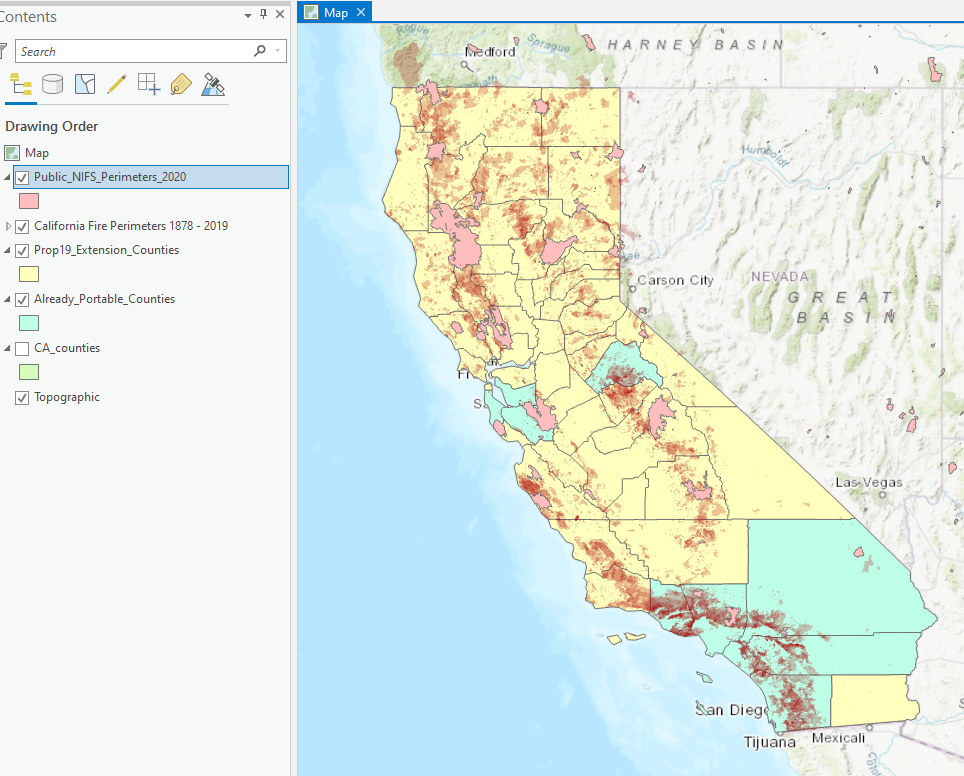
On the map below, the 10 counties with existing Prop 13 portability are aqua.  The 48 counties that Prop 19 would extend portability to are yellow.

Historical fire data for 1878-2019 is shown in brown.

Fire perimeters for the 2020 fire season is shown in pink.

Although there are many fires in the Southern California aqua counties, they are mostly contained in the rural, mountainous parts of the county.  Urban dwellers in the denser parts of those counties subsidize the few that live in harms way.  That is not true in most of the yellow counties.

Realtors know that Prop 19 would incentivize seniors to move to Paradise and other fire traps.  That's why they added the sop to fire fighters.  But, it would raise only tens of millions per year in fire fighting funds.  California spends a half to a full BILLION on fire suppression annually. That's not counting money spent by the Feds for fire suppression on Federal lands. 

[The Feds own 47.7% of California's land, including 57% of California's forest lands.]


People (and their cars) start fires.  Put more people out in fire country, and they will start more fires.  

Most importantly, prescribed burns to reduce fuels are difficult to do in areas that already have homes and people living and driving in them.  Ironically, prescribed fires aren't permitted if the PM2.5 particulate air pollution is already high and people live in the area.  

People driving cars shed PM2.5 (yes, even electric cars) so they add to the PM2.5 load while simultaneously reducing the allowable load.  It's so circular.  But, once people live in a fire-prone area, it gets harder to do the things you need to keep them safe.

The housing estates will further fragment wildlife habitat. 

Seniors will be socially isolated--especially when they stop driving.

Proposition 19 is just insane social, fiscal, ecological and fire policy.


Monday, March 09, 2020

Trustworthy Coronavirus News Sources

There is so much information and misinformation out there about, it's dispiriting.

My go-to source of reliable information is Pulitzer Prize winning science writer, Laurie Garrett, who has written extensively about pandemics and disease for decades.  Follow her on Twitter @Laurie_Garrett for the latest reliable news.

She uses the #COVID19 hashtag.  This time of year, I usually have a persistent scratchy throat from the tree pollen.   I don't follow that hashtag, because I don't want to obsess.  YMMV

I've been following the news of tests. I'm a physical scientist, but have worked in an analytical chemistry lab in college. I know that reliable testing for pathogens is very difficult, but don't understand the details. I found a couple of articles that helped me understand what is happening on the testing front.

How SARS-CoV-2 Tests Work and What’s Next in COVID-19 Diagnostics in New Scientist, by Bianca Nogrady

We Need a Cheap Way to Diagnose Coronavirus, in Harvard Business Review, by Devabhaktuni Srikrishna , Ranu S. Dhillon and David Beier.

Infectious disease docter, Dr. Krutika Kuppalli is also a good follow on Twitter, @KrutikaKuppalli.

The first article mentioned work on developing antibody tests.  Dr Kuppalli tweeted some preliminary antibody (IgG/IgM) test news out of China.

I live in the South Bay part of Los Angeles, which is bracketed by LAX international airport to the north and LA Harbor to the south.  So many airline employees live in my community, we are taking the prudent course and staying home as much as practical.  This will slow, but not prevent the spread.  That helps both you and your community weather the crisis.

Screen shot from Esther Kim's tweet

BTW, the "news" that Coronavirus does not spread in warm weather is totally false. It has spread plenty in warm places.

In times like these, I am livid that not all workers get paid sick leave and that we do not have universal and affordable access to health care.  Fight on, but maybe from home?  ;-)

Monday, November 04, 2019

Fashionopolis

I read an Advance Reader Copy (ARC) of Fashionopolis: The Price of Fast Fashion and the Future of Clothes by Dana Thomas. If I were a better advance reader, I would time this to come out the week of publication, around September 3, 2019.  But, I wrote it in July, when I read the book, and then set it aside due to anger.  In November, I decided to finish it up and post my thoughts.

This is not an expose about huge Fast Fashion chains that serve the mass market.  Lucy Siegle of the Guardian does an excellent job covering that beat.

Ms Thomas covers the business of fashion and she has fantastic industry access.  I read and blogged about her earlier book, Deluxe, which covers the luxury end of the market. This time, she writes about the Price of Furious Fashion.  Her publisher categorizes the book under: Business, Design, Technology.

It's a good survey of the history of fashion production and the current toll that it takes.  However, the book shines when Thomas takes deep dives with makers that show how to make clothing with smaller environmental footprints.

For instance, I have made my skepticism about organic cotton known.  But, I learned that naturally-colored Foxfibre is also naturally insect-resistant.  The Tannins that give the cotton color, are bitter; insects don't like to eat them.

I don't like the reductive way that Thomas segments the market into organic and "all the rest."  She covers the business of fashion, but she's not a scientist nor was there any evidence in the book that she spent time interviewing scientists.

For instance, Stella McCartney's Environmental Profit and Loss (EP&L) showed that virgin cashmere had roughly one hundred times the environmental impact of virgin wool (page 167).  Therefore, Stella McCartney does not use virgin cashmere in her collections.

How do you put a number on the destruction of an irreplaceable ecosystem I wrote about in The planetary cost of cashmere? Of the extinction of snow leopards in More bad news about cashmere.

McCartney hired a sustainability and ethical trade chief, Claire Bergkamp.  Bergkamp, in turn, hired the accounting firm, PriceWaterhouseCoopers, to audit her business (EP&L.) Accountants do what they do-- place numerical values on stuff.  At the end of the day, the numbers contain the biases of the makers of the model.

The numbers are maddeningly opaque and McCartney, Bergkamp and Thomas felt no need to look under the hood to find how those numbers are derived.  To a scientist, that's very disappointing.

On page 169, we learn that McCartney's EP&L determines that regenerated or 'reclaimed' cashmere is 92% less damaging to the environment than virgin cashmere.  She calls it postmanufacturing waste.  (I call it preconsumer waste and use it for more than half my sewing.)

This allows Bergkamp to throw around numbers like "though cashmere only made up 0.13% of [Stella McCartney's] overall raw material usage in 2015, it accounted for 25% of the company's total environmental impact; after adopting the use of regenerated cashmere in 2016, the impact dropped to 2 percent."

"Luxury fashion should use organic cotton--I don't think there is any excuse not to," said Bergkamp.

You get the idea.  Thomas takes so many claims at face value, particularly regarding natural vs. synthetic dyes and vegan vs. animal materials.

The book is a good survey on what people are trying, particularly at the luxury end of the market. Don't believe any of the scientific claims.  There is no guarantee that nonfiction books were fact-checked.  How do you fact-check a closely-held proprietary EP&L system anyway?

Saturday, May 25, 2019

Housing dysfunction

So California SB50 is dead.  (Text of SB-50 Planning and zoning: housing development: incentives)

Housing is a third rail for California politicians and we have the dysfunctional housing market to prove it.

The issue is so divisive, that Russian disinformation campaigns are being developed to divide and paralyze us.  See this thread:


Don't be a hot head.  Think rationally.

Where are all the workers going to live?  Elsewhere is not an acceptable answer.

Workers of all income levels should be able to live close to their jobs.

This saves workers time that they can spend on themselves and their families.

This fosters resilience in the face of disasters.  If awful things happen, they can still get to their jobs or home to their families.

This reduces air pollution caused by commuters.

This reduces traffic congestion caused by commuters.

This reduces the urban heat island effect because cars and road surfaces are a major contributor to localized heating.

When people use active transportation (walking and bicycling), their health improves.  This saves our whole society health care costs.

If parents work near their children's schools, they can be more involved, which improves educational outcomes for all.

I can go on and on.

WE NEED TO BUILD MORE HOUSING NEAR EXISTING JOB CENTERS.

It is not fair or just to keep cramming more apartments in already-dense minority neighborhoods while other areas near jobs are zoned only for single family homes.

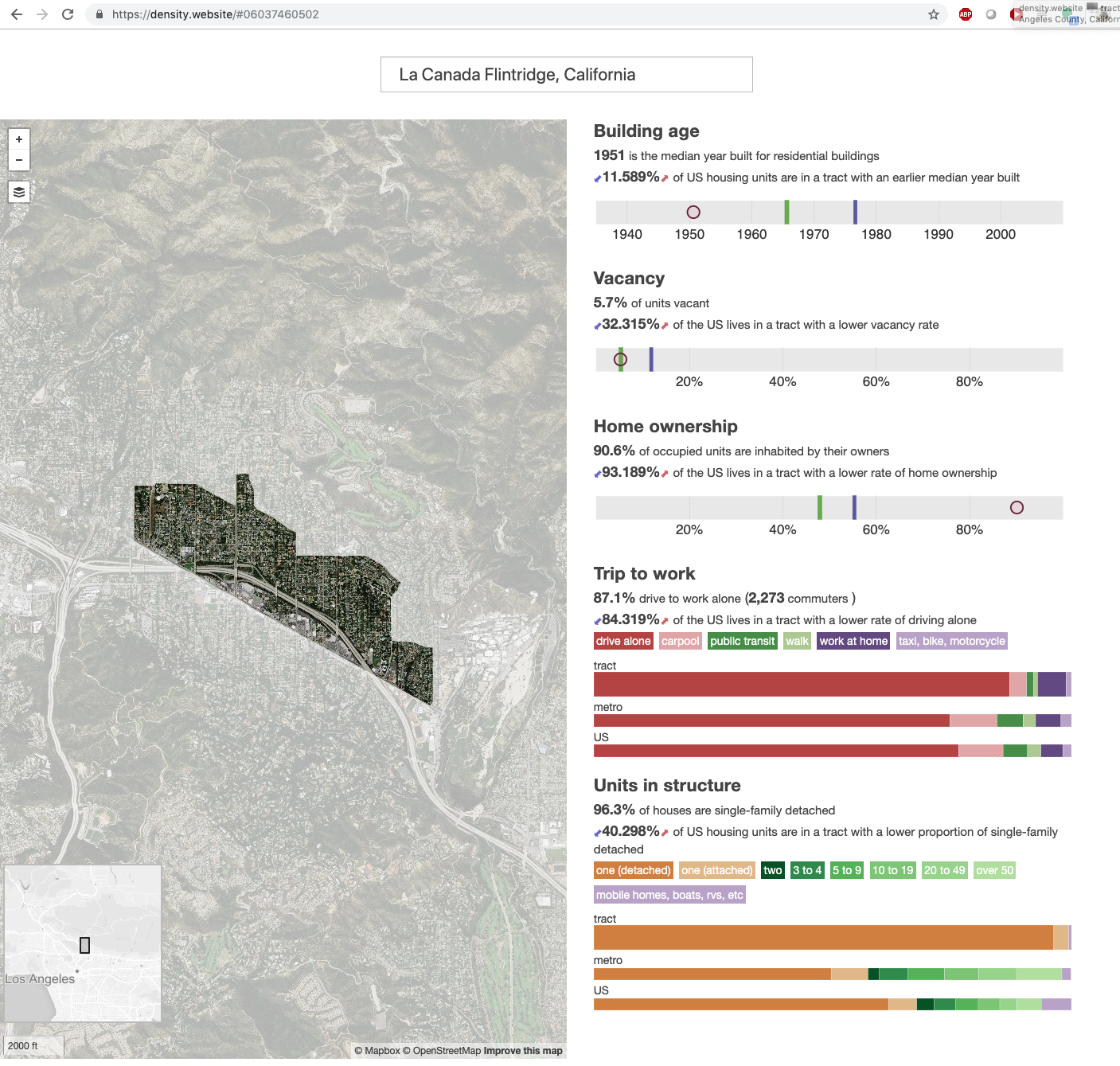
BTW, SB50 was killed by CA State Senator Anthony Portantino, a Democrat from La Canada Flintridge and chairman of the Senate Appropriations Committee.

You may know La Canada Flintridge (LCF) as the home of Jet Propulsion Laboratory, but did you know that it is so expensive, that practically none of the scientists and engineers that work there can afford to live there?

Did you know that Senator Portantino's constituents emit about twice as much CO2 as residents in the dense core of Los Angeles?  Check out the CoolClimate Maps for the US and zoom in for Los Angeles.


A main reason why they are so wasteful is because of the low density and high cost creates a mismatch between jobs and housing.  Thus, everyone has to drive long distances into and out of LCF.  The Density Map makes this nauseatingly clear.


Now that I got this off my chest, I am off to bed. 

Play with the Density Map.  It's a fantastically information-rich data visualizer.

The CoolClimate Maps are also cool, but their maps have more modeling assumptions.  Those are just best-guess averages based upon average consumption based on geographical data and income.  They are generally true, but not gospel.

Play with them in conjunction with the Racial Dot Map of the US.

If you are not mad after you explore the data in these three maps, I don't know how to get through to you.

Tuesday, January 29, 2019

The View from Flyover Country

This is a review that I posted to Goodreads* in 2018.

I've been telling so many people to read this book, follow Sarah Kendzior on Twitter @sarahkendzior and to listen to her podcast (with Andrea Chalupa,) Gaslit Nation.

This is a compilation of her essays, originally published in newspapers between 2012-2014, organized roughly by theme. This can appear repetitive on the surface, but pay close attention to the dates and the world events she cites.

You can pick up and start reading anywhere.

I highly recommend "The Political Consequences of Academic Paywalls" on pages 136-141. Dr Kendzior received her PhD studying authoritarian regimes in Central Asia. The for-profit journal business model is an inconvenience for physical scientists like myself. But having access to her published research, "Inventing Akromiya: The Role of Uzbek Propagandists in the Andijon Massacre," meant life and death for Uzbeks applying for political asylum.

Russian-backed propagandists honed their skills in Uzbekistan, and then trained their sights on the US. A decade after inventing Akromiya, they invented Antifa.

She is a uniquely qualified voice to explain the larger pattern that we see in current US politics.

Never stop looking critically.

Never stop complaining.

It matters.
* I joined the readers' community before Amazon bought Goodreads and log all my reading and thoughts about the books there. You can see the books I am currently reading on the right and click to see what I'm reading, what I've read, or what I'd like to read. Like fabric, I'm adding more books I want to read than I can read them. ;-)

This book reminds me of the Flyover Country app. Set your route and download geophysical data along your route before you leave the house. If you are sitting in a window seat, the GPS reception on your phone (set in airplane mode) will be able to give you real-time information about features below.  It also works on road trips and when hiking.  It even works in remote areas without cell phone access.


This app has a great backstory. Some geologists at the University of Minnesota came up with the idea and decided to apply for a small grant from a National Science Foundation program. They got approval in 15 minutes instead of the more normal 15 months.
Flyover Country® is a National Science Foundation funded offline mobile app for geoscience outreach and data discovery. Learn about the world along the path of your flight, hike, or road trip with inflight maps and GPS tracking. Offline maps with interactive points of interest and geologic data reveal the locations of landscape features, fossils digs, cities, and more that are visible from your airplane window seat, vehicle, or hiking trail vista.

Tuesday, October 24, 2017

'Free college for all' or 'Free college for most'?

'Free college for most' doesn't sound as catchy as 'Free college for all!'

In a perfect world, the government would have enough money for all. But, in the current political climate, I'd settle for directing the money to the the most financially needy. I want government to give away subsidies to people in need or to change people's behavior. Giving money away to people who have enough and were already going to buy a product (college education) does neither.

New York may make waves for offering tuition-free college, but there is still the pesky problem of books and living expenses.  Meanwhile, California has been quietly charging tuition, but rebating it back to low and middle-income families.  In fact, most families will pay less under the CA system because CA offers more aid for living expenses.

Consider the University of California budget for 2018-2019 that was recently adopted.  It includes a small increase in tuition, but the bulk of UC costs is not tuition.  Living costs and books dwarf tuition two to one.

By charging tuition, and then redirecting those dollars to financial aid for needy students, many students and their families pay negative tuition.  That is, their financial aid is greater than the amount of tuition.

The median family income for CA families with children under 18 in 2010-2014 is $61,991. 


Under the new UC budget, tuition is ~$13,000/year and the students and parents would be expected to contribute ~$15,000.  (Undergraduate students can take out subsidized loans of up to $7,500/year or roughly half of the family contribution.)

If students start at a community college (CC) and live at home for the first 2-3 years, they can reduce the cost even further.  About half of CA CC students received full tuition waivers.  They only had to cover books and transportation costs, and those were subsidized for the neediest students.

Starting next year, the first year of California community college would be tuition-free for everyone.

One third of all UC graduates were CC transfer students.  They typically move away and live on campus at an UC for only the last 4-5 semesters.

CA has effectively had free college for most, if they can get over the hurdle of being prepared to take advantage of it.

This is where I think CA--our entire nation--could do better.  Notice that families with children under 18 have a lower income than families without children?  Not only are children expensive, but they impair their care-givers' ability to work for cash income.  This is why we need cash transfers from the unencumbered to the people who work hard to raise the next generation of citizens/tax-payers.

Look at the incomes for families with children under 18 by CA state assembly districts.

Consider the median family incomes in South LA, district 59.  Imagine raising kids on $26,341/year. Note that families with children are poorer in district 59 than those without.

That is one quarter the income of families in the South Bay region, district 66. Although families in this area with kids enjoy higher incomes than families without kids, the income difference is slight compared to the cost of childcare and other child-related expenses.  I want to be clear that, given the high cost of living in LA, $100,000/year is not luxurious at all.


But you cannot compare two-parent families earning $100k/yr with one parent families earning $25k/yr.  Every family in the latter group that manages to raise their children to be college-ready has achieved something heroic and earns my enthusiastic support.


Sunday, July 30, 2017

The end of tapwater

Trevi Fountain photo courtesy of Wikimedia Commons

Italy has neglected infrastructure so badly that Rome, their capital city, will begin rolling water shutoffs
.
One-third of the city’s residents are set to have their water supply cut off for eight hours every day, possibly beginning as early as Friday; different neighborhoods will take turns in sharing the burden. It’s an unprecedented move for a major Italian city, said Giampaolo Attanasio, a public infrastructure expert at the advisory firm Ernst & Young. But it may soon be routine.

"Rome could be just the beginning. If the situation doesn’t improve, other large cities will have to ration water as well," Attanasio said in a telephone interview. "Small towns already have."
The math is damning.
as much as one-fourth of water pipes in Italy are more than 50 years old, and that it will take 250 years to replace the whole system at current rates.
This means that the pace of water pipe replacement has slowed in recent years. Otherwise, the % of older pipes would be higher.

Moreover, they lose 44% of their water through leaks in the pipes!

Climate change compounds the problem.  With higher temperatures come higher evaporation rates.  This means less water will flow from the mountains to the cities below, even if rainfall stays the same.

Rainfall patterns do not remain the same with climate change.  Storm tracks change with the weather, but the climactic average of storm tracks vary much less.  Those average storm tracks are being disrupted around the globe as the jet stream becomes more wavy.

In Spring 2017, Italy received 50% of the rainfall that they received over the 1971-2000 reference period.  At the same time, it was the second hottest Spring since 1800--1.9 C warmer than the 1971-2000 average.

Austerity measures compounded the body blow dealt by climate change and normal variation.

Lack of public funds meant reliance on so-called 'public-private partnerships' with for profit companies who cut maintenance to increase profits.

There is no time to lose.  The longer we wait to slow global warming, the worse these problems will become.

We should be spending more on infrastructure to build for climate resilience rather than less.

Will it be expensive?  Yes.

But the alternative, doing nothing, is even more expensive.

Thursday, July 27, 2017

Water views

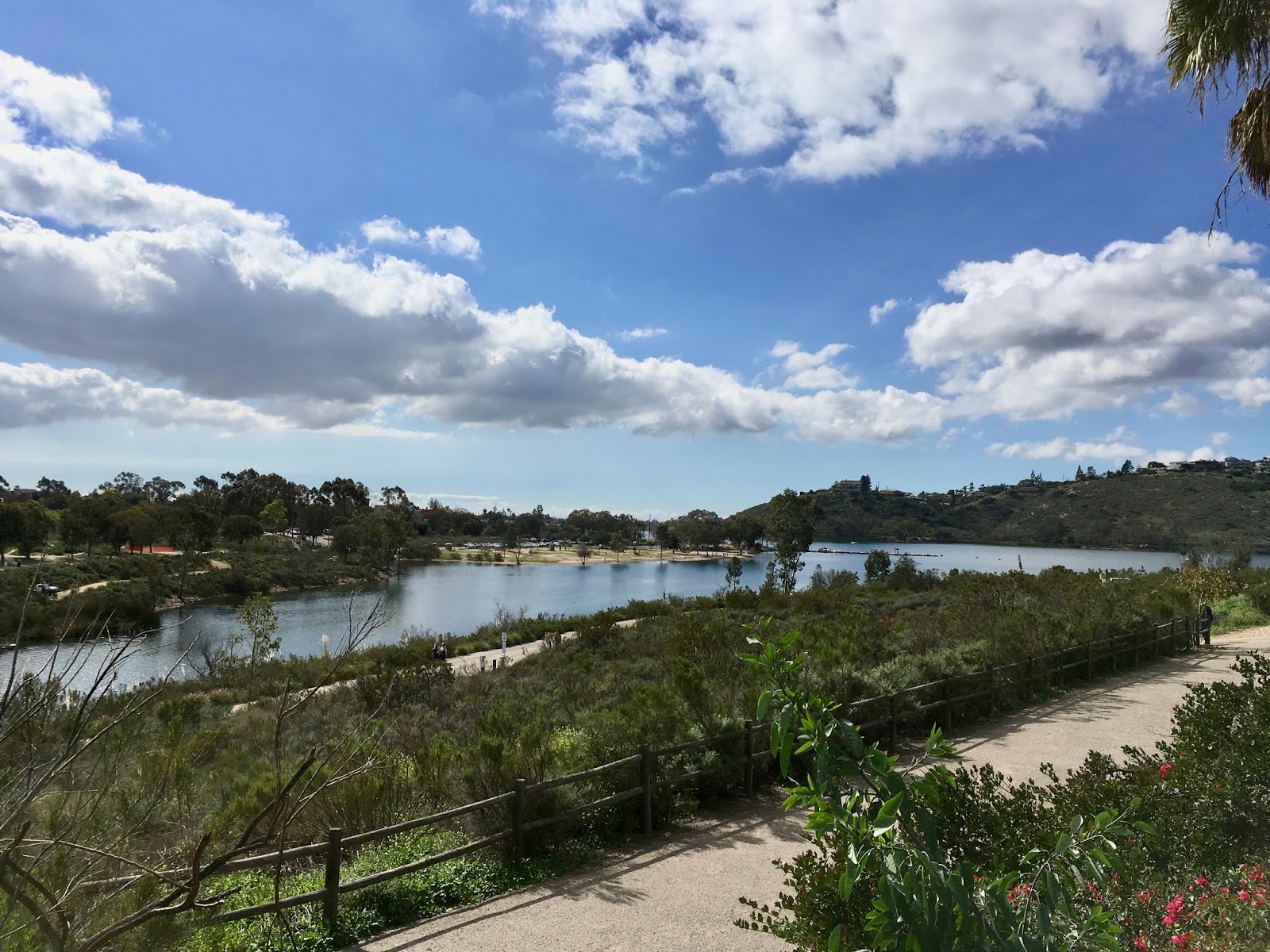
When I was visiting family in San Diego last winter, we went for daily walks around this reservoir. I overheard some other walkers discuss why this reservoir was so low, if they had been getting so much rain lately. It took a great deal of effort for me not to run up to them and explain at that time. ;-)

Most of the water in the reservoirs near where people live in coastal California is imported!  They are really just decorative water storage tanks.

You can see more land along the shores of Lake Murray in this photo than you do during dryer times precisely because people in the reservoir's service area need to use less piped-in water during rainy periods.

Moreover, they want to leave some room in the reservoir to catch the runoff from the storms in the local area.  Local rain augments the imported water supply (and not the other way around.)

Remember during the drought and last winter when the newspapers showed this weekly reservoir status map?  You can download it from the CA Data Exchange.  Click on Selected Reservoirs Daily Graphs PDF.

This well-designed graphic shows the relative sizes of reservoirs. The scale breaks down for the smallest reservoirs in the southern end of CA but you get the overall idea.

It doesn't matter if some area gets 200% of normal precipitation if that normal is 3". It's not as significant as another place getting 120% of normal (PON) when their normal is 65".

Check out the wide normal rainfall variation at the California-Nevada River Forecast Center.

It also matters where that rain falls.  Is it over a wide area?  Did it fall in a drainage basin connected to dry areas by our plumbing (rivers and aqueducts)?

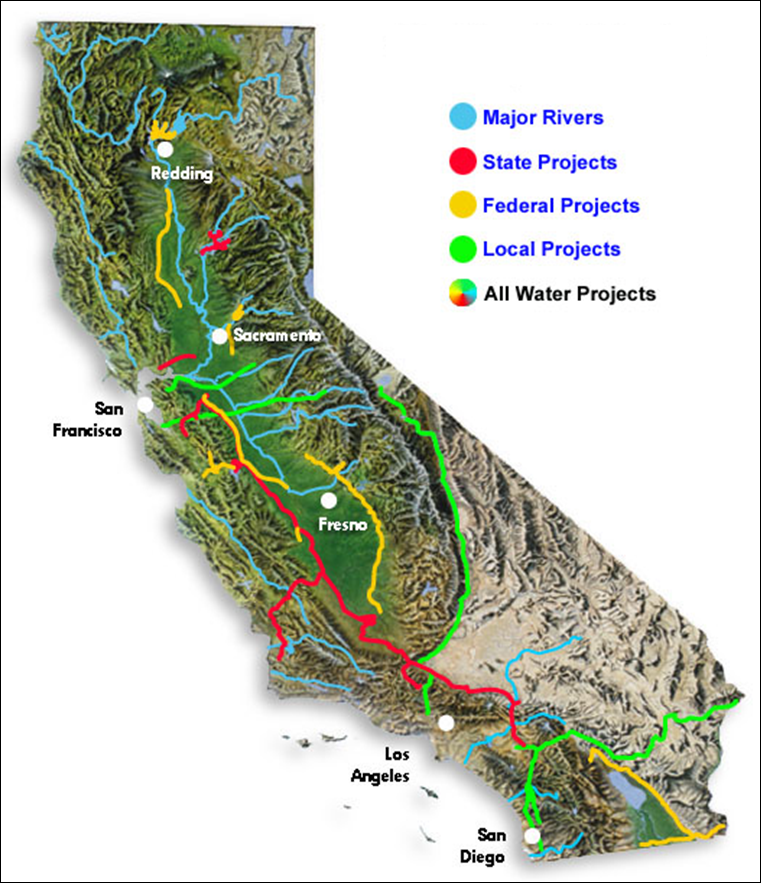
The plumbing that brings water from where it falls to where it is used is a complex system of aqueducts, ditches, rivers and pumps.  About 20-25% of the electricity consumed in California is used to move water around.  (Water is heavy.)


Read the in-depth, California's Water Supply, A 700 Mile Journey to learn more about the CA aqueduct. I'll write about the Colorado River later.

Los Angeles is a semi-arid place surrounded by tall mountain ranges and the ocean.  Bringing enough water to it is a challenge.  That is why it had to become a leader in water recycling.  There is really no choice.

The takeaway is that your water travels farther than you think.  It isn't just the total distance, but the number of (vertical) lifts required to get it to you.  Lifting water uphill is energy intensive and we can not cut our carbon footprint without lowering our water footprint.

Sunday, June 12, 2016

I left my heart in LA

I've written before about my melancholy when I leave LA to return to Boulder. The last trip was extended because of a family crisis. In between care-taking and medical appointments, Bad Dad and I managed to sneak in cultural breaks. 

For us, LA is all about the food, the culture and the beach. (I don't mean to discount rocket science even though that's what brought us to LA initially, but we're talking about the things that we love outside of work.)

It's nice to read that even the NY Times agrees with us:
No city in the country is more exciting than Los Angeles right now. Despite pop culture portrayals of Los Angeles as either comically superficial or darkly dystopian, the nation’s second largest metropolis is a vivid, soulful, eclectic city. It’s home to year-round blooms and captivating street murals, musical innovation and outsider art, deeply rooted communities and world-class food cooked by chefs from around the globe. The greatest challenge for visitors is not what to do, but which version of this vast city to embrace.

We went to LACMA to see Reigning Men and the Robert Mapplethorpe retrospective.
Look at that metallic embroidery.

Those short britches may require a bit of calf enhancement.
Cultural institutions of LA collaborate. For instance, LACMA and the Getty share a huge body of photography. The Getty Center is also showing Robert Mapplethorpe photographs as well as the work of some of his contemporaries and the collection of his first major collector/patron.

Getty Center hallway.
Meanwhile, the Japanese American National Museum is showing Making Waves: Japanese American Photographs 1920-1940. That show is incredible and not to be missed. Although most of the photographs made by these artists were lost or destroyed, what remains shows that, had they not been incarcerated (and racism), they would have been as famous as Ansel Adams and Edward Weston.


LACMA extends the argument further, with their own exhibition of Japanese Prints and Photographs: Paths Through Modernity.

I cannot stress this enough.  When you visit LA, skip the Tourist Traps and theme parks and head to the cultural institutions and the ethnic enclaves.  You will be met with friendly courtesy, fantastic food and insight into how diverse people and cultures live peacefully and cooperatively side by side.
Fried chicken, waffles and collard greens in Inglewood.
Downtown LA (DTLA) is hopping these days.  Stores are open (and busy!) on weekends.
The detailing on the old buildings is amazing.

Clifton's Cafeteria is open after their extensive remodel.  Prices and food quality are up.
The LA food scene uses traditional techniques with new ingredients and ideas.  For instance, dim sum places offer more and more vegetarian options.  Ocean Seafood will serve you seafood that looks back at you.  (Baby octopuses, anyone?)  But, even vegetarians can be challenged with tofu (stuffed with tofu instead of the traditional pork) that dares you to eat it.
Even the tofu dim sum at Ocean Seafood is served with faces intact.
When you come visit, pack for our mild and foggy summers.  You don't need a down jacket (that's San Francisco), but bring a light jacket for cool mornings and evenings.
June gloom extended all the way to the San Gabriel Mountains the day I left.