Showing posts with label Gardening. Show all posts

Thursday, December 08, 2022

Urban trees and the zombie carbon sequestration myth

Last summer, my city passed a tree protection ordinance that fines people for removing trees--even those on private property in side or back yards (where they don't shade public sidewalks or road asphalt). It was sent for legal review and will come back on December 20, 2022 for final passage. 

I'm not a lawyer, but I will say as a scientist that it is claptrap. 

So much nonsense was spewed that would fly under the radar of people not in the trenches of housing policy. I suspect that using the need for street trees to push through a more expansive policy is designed to make infill housing (eg ADUs*enabled by SB 9) harder or more prohibitively expensive to build. 

But, I want to push back on the pernicious myth that carbon sequestration through urban trees is better than building infill housing. 

Let's do the math!

A mature urban tree can absorb about 20 kg of CO2 per year. MIT Climate Issues rounded that to about 50 pounds. (Click through to read how they debunk some of the 'nature-based solutions' talking points.)

The EPA, US Environmental Protection Agency, reports that the Greenhouse Gas Emissions from a Typical Passenger Vehicle is 8,887 grams CO2/gallon or 404 grams CO2/mile using the US passenger car fleet average. 

The largest employers in my city are Northrop Grumman (next to a light rail station) and our local school district (dispersed around the city, not served well by transit).  Since school teachers cannot afford the median house price of $1,587,500 

or even the median condo price of $1,007,000

teachers drive in from elsewhere. The only places in LA County actively building new apartments and condos in substantial numbers is Downtown LA (DTLA) or Old Town Pasadena. 

If they want to buy an older single family home, like this one that sold yesterday in Whittier for $630,000, they also face a long commute. 

The Whittier house is 27-29 miles to Redondo Union High School depending on the route. Old Town Pasadena is 30 miles each way. 

A round-trip commute for just one of the hundreds of teachers in our city that cannot afford to live here is about 60 miles/school day. 

60 mi/day * 404 g/mi = 24,240 g/day = 24.24 kg/day

It would take a mature tree more than a year to sequester the carbon emissions of just one day's commute for a teacher commuting in from where they can find housing that they can afford.  

I looked up more data. 

California requires 180 school days/year. There are a few additional teacher prep and in-service education days, but let's use the lower 180 number. 

I looked up the RBUSD budget and see that there are 463.80 Full-Time Equivalent (FTE) teachers in the district. 

24.24 kg/day * 180 days * 463.8 teachers = 2,023,652 kg/year 

That would require 100,000 trees just for in-bound commuting teachers

That's just a few hundred of the 25,000+ jobs in Redondo Beach according to the research arm of Southern California Association of Governments (our regional housing and transportation governing body). 


I can't ensure that all infill homes will go to teachers in the community. 

I do know that teachers have to live somewhere, so they need homes. It would be great if they could live close enough to participate outside of school in the communities where they teach, and if they didn't need to drive a car to work.

The benefits of workforce housing:

  • Planet (fewer climate-wrecking CO2 emission)
  • Community (the teacher can be more present)
  • Public health (fewer car miles = less air/water pollution)
  • Teacher health (long driving commutes have well-documented detrimental health impacts)

Now substitute teacher for any other job in our city. This includes store clerks and caregivers to the elderly or young children that make just above minimum wage. They take care of us. We need to take care of them. We won't be able to build enough ADUs to fill the need. But, we can build enough apartments and condos, in a thoughtful way, to reduce the need for climate-destroying and space-gobbling automobiles. 

Asides: 

ADU = Accessory Dwelling Units or Granny Flats or In-Laws' units. ADUs generate a little extra density in single-family neighborhoods, create homes without generating much external impact. In fact, when used to house caregivers or those needing care, or local essential workers, they reduce car traffic or Vehicle Miles Traveled (VMT) overall.

Keeping low-density existing homes is NOT better than replacing them with higher density housing, even accounting for embodied carbon. But, I'll cover that myth in another post. 

I hear lots of chatter about preserving or increasing urban tree canopy in order to combat the urban heat island effect. That's a good idea. I'm all for trees. In fact, we bid aggressively on both our home purchases because they had more trees compared to other homes in our budget/area. More on that later. 

Redondo Beach has no native trees. It was a coastal prairie according to UCLA's Urban Wildlands Group (Dept of Geography). I'm stuck wondering what proponents are calling "Heritage Trees". 


Saturday, October 17, 2020

Leaf Blowers: Window on Governance

I wanted to do a quick post about something that seems like a small tweak and highly local, but that is much more complicated and far-reaching.  It gives another data point for "all politics is local" and "think globally, act locally."

With great fanfare, Redondo Beach voted to ban motorized leaf blowers on July 10, 2018 on environmental grounds.  The announcement did not explain the environmental grounds or clearly define what they mean by motorized.  

The notices went out to residents, but not the gardeners.  Renters, about half the RB population, don't hire gardeners. I don't know if property managers that hire gardeners were notified. The gardeners seemed to be unaware of the rule.

When I told gardeners about the rule, they ignored me or told me either that they were unaware of the ban, or that their electric leaf blowers were exempt.

The health hazards of gas-powered leaf blowers are well known.  They are deafeningly loud and expose the users to dangerous levels of carcinogens from fuel and combustion by-products.  The California Air Resources Board has a website explaining the pollution caused by Small Off-Road Engines (SORE).

BTW, the smog pollution includes NO2, which is known to be a very potent and persistent greenhouse gas.


1 hour of lawn mower use produces as much smog as driving LA to Vegas.  1 hour of leaf blower use = driving 1100 miles from LA to Denver.

The numbers are staggering. 1 hour of leaf blower use produces as much smog as a RT to visit my mom in SF and continuing on to northern NorCal to visit my SIL. 2 hours = a RT to Boulder to visit friends. 

Newer cars are much cleaner than older cars.  Our hybrid is cleaner than average so the equivalent SORE use time may be much lower.  In 2020, SORE smog emissions will roughly equal total car smog emissions in CA. SORE emissions will dominate as older, more polluting cars are retired. 

Lawn Equipment roughly equal total car smog emissions in CA and will dominate as the old cars are retired. 

The case against gas-powered leaf blowers is easy and well-known.  What about the much quieter electric-powered leaf blowers?  Are they a harmless alternative?

They don't produce the smog, but they are just as effective at kicking up clouds of dust.  Gardeners wear particle masks when they use leaf blowers to protect themselves, but the rest of us choke in it.

What's in that dust?
  • Pollen: terrible for allergy sufferers
  • Mold: terrible for people with allergies and compromised immune systems*
  • Road Dust: toxic, carcinogenic, causes lung & heart disease and dementia, makes Covid-19 deadlier
Let's normalize using a rake with a broom and dust pan.  It doesn't kick up as much dust or throw it up as high.  Reject that ultra-manicured yard look.

* My stepmother died of pneumonia after her last round of chemotherapy.  She was given a strong cocktail of antibiotics and anti-fungals via IV, but they couldn't save her.  An autopsy showed that she died of fungal pneumonia.  Mold spores got into her lungs and took advantage of her weakened state.  I think of her every time I hear or see a leaf blower.


What about governance?

Leaf blowers are another reason I lost faith in my local government.  I thought that you pass a law, and people obey the law.  If they don't, you call the cops or some other watchdog responsible for enforcing the law.

I called the non-emergency police hotline.  They took the report, but did nothing.  I asked my council member.  They said that the police were not happy about working without a contract. Hopefully, they would do more enforcement of laws after contract negotiations were successful.  

[The city was also spinning up another number and email address where we could report leaf blower violations as a workaround for the non responsive police department.  I emailed that office time-stamped photos of leaf blower use on my block, but never got any responses from them either.]

WHUT? Local teachers were working YEARS without a contract, yet they were still doing their jobs. From the Beach Reporter
In the 14 months since Redondo Beach enacted a ban on leaf blowers, the city has received more than 1,700 complaints and issued just three citations. ... On Tuesday, the Redondo Beach City Council received its answer when it learned that out of more than 1,375 leaf blower complaints to city code enforcement just two citations were issued. Police issued one citation out of 339 complaints. Numerous courtesy notices were also issued.
Up to that point, I had very few interactions with the RB police. Now, with all the BLM and Defund the Police talk, I've been thinking about what functions are appropriate for the police and which would be more effectively dealt with by others. 

Have you looked at your city's budget? I mean really looked at both the discretionary budget and the zombie costs of pensions? Do you know about the VERY generous police pensions relative to all other types of government jobs? They literally have a gun pointed at our heads during contract negotiations. 

Anyway, this has changed the way I see the police and city budgets. It's also changed the way I see local political races and endorsements from police (and fire) unions.  The saga with the RB firemans' union going after the elected officials that refused to merge with the county fire department (and their platinum-plated pension program) was eye-opening.


Even after cutting $150 M, LAPD still gets more than half the city's unrestricted funds.  If you count pension contributions, and they have the most generous pensions, police departments get the lions share of most city budgets.  

The cities work for the police departments, not the other way around.

Moreover, these employees often don't live in the cities where they serve.  They take that money and spend it elsewhere.  It's not an exaggeration to call it colonialism.

It started with my allergies and leaf blowers.  But it made this suburban mom question who really works for whom.  My local police union** taught me a lesson, and it wasn't the one they intended.  When the Defund the Police movement arrived, I was ready to listen.  

**The police union and the police chief are not equivalent. They don't have the same priorities.

Monday, October 01, 2018

Even El Ninos aren't what they used to be

Remember how things were bigger when we were younger?  How the El Niños of our youth just seemed to produce more rain in California?  How come so many El Niños of late have been La Nadas for rain?

It turns out that, like many things, the El Niños index has changed.  The NOAA Climate.gov El Niño blog explains Why are there so many ENSO indexes, instead of just one?

If you want to go deeper, read NCAR's Climate Data Guide entry about NINO SST INDICES (NINO 1+2, 3, 3.4, 4; ONI AND TNI).

The short answer is that the original El Niño index was based on the eastern Pacific areas where the effect was first noticed and named.  You may have grown up hearing TV weathercasters talking about El Niño index 2 or 3 (depending on your age.)  Today, they are probably talking about El Niño index 3.4.
Boxes denote various regions used to calculate El Niño indices.  The eastern Pacific ones (1-3) are closer to California and have a bigger impact on our rainfall patterns.  The western Pacific El Niño index is a better predictor of monsoon patterns in Asia.  El Niño index 3.4 gives the best overall diagnostic for global weather changes.
Each El Niño index is useful for someone. If you are interested in the global scale impact, the El Niño index 3.4 is the best compromise. This is the area used in official NOAA use. (However, they calculate and report all of them.)
It looks like we could have a mild El Niño in California this season. I'm cautiously optimistic for a wetter than normal winter. That may just be wishful thinking on the part of this gardener as El Niño 3 is meandering up and down in recent months.  My poor shrubs could use a good soaking to dilute the salts that have been building up from irrigation with hard water instead of rainfall.

Keep in mind that these indices are based on deviation from a departure from a 30-year mean.  The entire planet, including the oceans, has warmed in recent decades.  The temperature and pressure gradients (contrast between different areas) determine storm tracks.  But, the warmer oceans and air masses mean that storms contain more water, about 7% more water on average.

Storms are also sticking around longer due to changes in the jet stream (probably related to the melting polar ice.)  Some models suggest storms will generate 50% more rainfall in places where they land!  So, for those of us in California, rainfall will be more rare but more intense.  We need to re-engineer our cities for the new reality.  That's going to take money and cooperation because it is in everyone's best interest.  Are you with me?

Friday, August 19, 2016

The perennial dilemma

Air is a common resource. Each of us suffers from degradation of the air quality, but we have no little control over what others do to the air that we personally breathe.

When people think of the Boulder, they don't often think of air pollution. But, the elevation and topography (mountains to the west and northwest and the Louisville Rise to the east and southeast), and the automobile traffic in this small town, mean that the nose-level pollution in central Boulder is usually higher than the western coastal neighborhoods of Los Angeles. (My doctors had recommended in the 1990s that I move away from Boulder for my health and suggested coastal LA as a good alternative.)

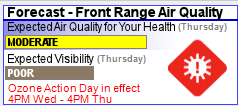
You can't see ozone, but it is created by a combination of automobile exhaust and sunlight, specifically UV radiation.  At high altitudes, we have plenty of UV (and cosmic ray) radiation.

Ozone is a lung irritant.

We can't control sunshine, so the only way to keep the ozone from reaching dangerously high levels is to refrain from driving.  That means you AND me.

But, sensitive people are cautioned from strenuous outdoor exercise during high ozone days.

What does an asthmatic do when an Ozone Action Day is called?  Ride my bike and possibly have an asthma attack?  Drive solo and pollute the air even more?

The combination of pollen and ozone is particularly irritating.  People with pollen allergies can be affected by lower levels of pollen when ozone is present.  The only time I ever ended up in a clinic gasping for breath was when I went for an after work run (in grad school in the 1990s) up Boulder canyon during a day with both high ragweed pollen and high ozone.  I now get allergy shots and that has helped somewhat.  But, I still avoid outdoor exercise when pollens are especially high.

Fortunately, my bike and I can pick up a shuttle bus to work 2 blocks from my condo and be whisked up to the main entrance of Mesa Lab.

So many of my coworkers did the same, we filled up both the front and rear bike racks of the van.

Some even took the RTD bus to meet the shuttle.

The best part of leaving the driving to someone else is that my hands are free to take pictures like this.
The ride home is an 800 foot elevation drop, so it is not the strenuous type of exercise that would be dangerous for me.

Links:


Sunday, May 15, 2016

The river that binds us

I'm swamped with both family work and market work that demand much of my time and attention.  The story about how I named my blog explains why.

As I sat on an airplane, leaving the family that needs me, to the job that also needs me, I pondered the irony that a woman so concerned with climate change is sitting on an airplane, spewing CO2 into the stratosphere.

A window seat in an airplane between LAX and DEN is also a good time to reflect about the water cycle.

Our familial home is down there, as is DD's school and DH's lab.
Remember when our elementary school teachers told us that, if we could pour a cup of water on top of the Continental Divide, half could end up in the Atlantic Ocean and half would end up in the Pacific Ocean?

It turns out, that it is not quite so simple.

The Colorado River, originating west of the Continental Divide, used to drain into the Pacific Ocean. But it hasn't for decades, because all of the water was used and reused until it peters out in the inland deserts of California (to grow alfalfa to grow cows to feed people.)

Colorado Snowpack
The water evaporates off the ocean and eventually falls down as condensed water or ice in the mountains.  Imagine the amount of energy it takes to lift up that large a mass and move it that great a distance!

Somewhere over the Four Corners area.  Not sure if this is the Colorado River or a tributary.  
The melted snow seeps into the soil and seeps into rivulets, creeks, small tributary rivers and then eventually into the mighty* Colorado River.  More than half of Colorado River water flow begins as groundwater.

Beginning in 1957, with the opening of the Colorado-Big Thompson Project, trans-basin water diversions were moving water from the western side of the Continental Divide to the eastern side. Without this water, the massive population growth of the Colorado Front Range wouldn't have been possible.

Trans-basin water diversion map.
Want to learn more about Northern (Colorado) Water, the public agency that brings this water to millions?  Of course you do!

Visit the Northern Water Annual open house and conservation gardens fair next Saturday, May 21, 2016.   Walk this scale model of the Colorado-Big Thompson and Windy Gap projects that deliver *half* of the water used by the Northern Colorado member communities (including Boulder.)  It's awe-inspiring to think about the amount of work that it takes to bring this volume and mass of water across the harsh alpine environment.

My favorite part is this landscape sculpture, which allows me to walk the journey of my Colorado tap water from mountain-top through tunnels, pipelines, and reservoirs.  It makes the monumental intimate.

Landscape art that makes this huge engineering and social project intimate.
Read Your Colorado Water Blog write-up about this event for more details.  I went last year with some gardening enthusiast friends.  I geeked out over the water engineering while they geeked out over the gardening booths.

Many, many Front Range nurseries set up booths at the fair to sell Colorado native plants that are rarely sold at commercial nurseries.  It's one-stop shopping for people who grow native and low-water gardens.  Plants, education, ideas and support from Colorado Extension master gardeners.

Whether I am in Boulder, Colorado, or in Los Angeles, the two parts of my life depend on the mighty* Colorado River.

* Anything that can carve the Grand Canyon and all the minor canyons you see here deserves the adjective mighty.  Anything that can bind my torn heart also deserves the adjective mighty.

Monday, March 14, 2016

Smell-O-Vision

I wish one could smell the lemon flowers through the screen.

The camellias (in our LA yard) enjoyed their baths this winter. I wish there were more coming, but the Madden-Julian Oscillation makes that unlikely.

On the upside, I traveled eastward with the MJO back to Boulder.

That's one dramatic front, n'est pas?

Wednesday, January 06, 2016

After the rain 2

We're getting some much-needed rain.  Unfortunately, LA is (mostly) not built to make the most of the rain when it does come.  But, let's talk about what engineering for rain looks like.

First, read After the rain 1, which I wrote back in November 2010.

Remember this newly built and planted infiltration basin?
Freshly planted in November 2011
and the sign?
Is the sign accurate?
This is the way it looked today, after a downpour.  There is slight ponding.

Some ponding, but less than 12 inches deep.
Remember the notches in the parking lot to channel water from the asphalt to the infiltration basin?  Parking lots are notoriously dirty because cars are dirty for myriad reasons.  (A post about that to follow.)

Low point of lot.  Slight sheen on water indicates oil pollution.
A slight sheen on the standing water shows a light level of pollution.  The plants planted in the infiltration basin were selected for their ability to absorb the expected types of pollutants.

Plantings have filled in nicely.
Because LA depends so much on groundwater pumping, infiltration basins are the most efficient way to bank water for use in dryer times.  They take up less surface area, cost less, and look so much nicer than rain barrels.
The view from the uphill side shows more room to stow water while it seeps.
I hired a landscape designer to design a front yard with fruit trees and native flowering plants around the perimeter and a gravel infiltration area suitable for use as an outdoor lounge in the center.  But, my neighbor in our HOA objected to pulling out the grass; she says that she bought her house because the front yard looked so nice with the lawn.  Her vote counts as much as mine.  (Drat!)  So, my front yard is still half lawn.

This illustrates that hydrology is as much a social problem as an engineering problem.  Heck, I solved the engineering problem.  I just can't solve the social problem on my own.

I can console myself with the thought that the west side of my house does drain into a gravel infiltration area and my backyard (south side) also does a reasonable job of rain capture.

Wednesday, August 06, 2014

Whirlwind Saturday

Bad Dad flew to Colorado last weekend and I can't believe we packed so much into 2 days. This is just some of what we did on Saturday.
We started out at the Research Aviation Facility Open House.  The NASA P-3 was airborne, but we saw NSF/NCAR's Gulf Stream 5
and the huge C-130 nicknamed "Snowflake".
They were in the middle of FRAPPE, the Front Range Air Pollution and Photochemistry Experiment campaign, and trying to make up for schedule slips during the 3 days of steady rain earlier in the week.  My interior photos were kind of dark and blurry, so go to the the FRAPPE website to see better photos of these airborne laboratories.

After that, we were famished.  RAF is near many Vietnamese grocery stores and restaurants.  Yelp pointed us to Pho Bay, where I enjoyed gumbo.  I'd read about Vietnamese Cajun.  Sadly, I forgot to take photos.

After nourishment, we headed over to Denver Art Museum and saw a fantastic collection of 20th Century Japanese prints.  I need to go back and spend more time in that gallery.

Of course, we had to swing by the quilt gallery and see the rotating display of selections from the DAM's extensive permanent collection of quilts.
We then tried to go to the Denver Botanic Gardens, but the parking lots were at capacity and the garden looked jammed.  It was also hot, so we cooled our heels at nearby Tattered Cover Bookstore, where I purchased the August issue of Burda (the UK, not American edition).

5-9 PM, the botanic garden offers 2 for 1 admission to DAM members (our LACMA reciprocal membership qualified us for the discount).

I love walking through gardens in the evening and enjoying the sights, sounds and smells. Look at the contrast in textures and scale in this gate
and in these flowers gone to seed.
The Chihuly sculptures added to the ambiance. Does this orange column remind you of desert dodder?


Saturday, August 03, 2013

Huntington Summer Evenings


One of my favorite summer delights is the Huntington Library and Gardens Summer Evenings.  Gardens open for members only 5:30 to 8:00.  Bring your own picnic or order one of theirs.  Lay your blanket out on the great lawn to enjoy a free concert.  The kids dance spontaneously on the lawn, the paths, and any open spot.  Cuteness overload.

Alternatively, find a quiet corner elsewhere and enjoy the balmy, but comfortable temperatures of summertime in Pasadena.  We like to hike over to the Chinese gardens and sit on the deck overlooking the water.

We can usually find an open table.  Sometimes, groups have to share tables (and exchange home-made picnic fare).  It's all fun and friendly.

Kids run around the lake.  Koi cruise up, hoping for some food.  Dusk at the lake with the mountains in the background is magical.  Iris and I bring sketchbooks and watercolor pencils and attempt to capture the scenery.

Just bring the bug repellant and you will have a great time.

The remaining Summer Evenings for 2013 are Aug 4 and Aug 19.  Reserve your parking pass ASAP.

Membership levels begin at $120/year.  It's worth it if, like me, you enjoy watching gardens change with the seasons.  I take out of town visitors there often and their jaws drop when they see and experience it.  The art collection is impressive.  We love the history of science hall.

Pennamite was awarded access to their research library and I might apply for access as well.  I am interested in studying their history of science materials with an eye to writing about them here.

Right now, they are featuring a show on textile arts from Californian collections!

All photos courtesy of http://www.huntington.org/.

Thursday, May 30, 2013

MMM ThemeFriday Red

A friend from Boulder visited this week and I gave him a BMGM best of LA tour. We rode our bikes along the beach, stuffed ourselves with fantastic food and then wrapped up the visit with a quick tour of my favorite artworks at LACMA.

The jacaranda trees are in full bloom, especially on La Brea south of Little Ethiopia.  (Think trees on both sides of the road arching to create purple tunnels--just dreamy.)  Unfortunately, I was too busy driving to take photos. We did manage to take one picture with a me-made in red and a jacaranda tree beginning to bloom.

I'm wearing Kwik Sew 2555 made from a refashioned t-shirt and contrast sleeves made of cotton/poly gingham.  I used the same pattern for Fashion Fail.  This time, I cut a size small.  (I cut a medium for the earlier version.)  For close-ups and details of the top, read Red Details.

Have you seen LA's favorite rock star, Levitated Mass?  From La Brea Boulevard, it really does look like it is floating a few inches above the ground.

In keeping with the red theme, I took a picture of my favorite section of Richard Serra's Band (aka Ribbon) sculpture in the permanent collection at LACMA.  Serra throws salt water on the steel to create the rust patterns.  Doesn't it remind you of Clifford Still?

Wednesday, May 01, 2013

Tailwind

I came home from PR Weekend San Francisco and realized that I didn't take any photos. Must have been all those fabric fumes. I did shop at Fabrix (twice!), Britex and Stone Mountain and Daughter. I had an enjoyable time at Lacis and will definitely go back when I need something special that only they stock. But for right now, my sewing room is overflowing and it is back to my regularly scheduled life.

I carpooled with Raye Ann and we talked about people who roll through stop signs. My husband, a white male, insists that it is OK to slowly roll through stop signs as long as you could stop in time if someone else is already at the intersection and has the right of way.

 I beg to differ. Some (if not most) don't have the reaction time or braking distance to stop in time. Plus, little kids and critters are down low, where you don't notice them until you are on top of them. So, no. It's not just the law; it's a good idea.

So how did a guy reach 40 with such a selective interpretation of the law? I call it driving while white. I have seen so many blacks and latinos (and some Asians) pulled over for driving like my husband. Yet, he's sure that the way he drives is fine because he's never been pulled over for his rolling "California stops".

When you come from a position of privilege, it's easy to think that everyone has it as easy.  You don't think you are lucky; you think that you are just good.

It's like having a tailwind through life.

When viewed on the global scale, I also live a privileged life.

For example, I read that if you asked people around the world where they would most like to visit (if money and visas were no object), San Francisco is at the top of the list and Santa Fe is not far behind.  In the month of April, I spent long weekends in both.

Here I am, taking a break from art gallery hopping with my husband on Sante Fe's Canyon Road while wearing Butterick 5816.
Food fetishism is another hallmark of privilege.  I enjoyed the most amazing BLT at Cafe Pasqual's in Santa Fe.  It shares a plate with cold beet soup and kale salad.  Yum.  We managed to eat three meals (2 lunches and one dinner) there in one weekend.
Shifting topics, I want to show you the kind of picture I can't take because I am an Asian woman.  This picture comes from Marcy Tilton's blog, but I'm not saying that she hasn't earned her success.  This is just a convenient example of a privilege that is denied me by racism.

Many blogs feature photos of store windows while on travel.  Marcy posted some lovely photos of Parisian store windows from her recent trip of digitally-printed flower images on clothing.
When I traveled in France and Italy, store personnel would literally run out of their stores and push my camera down whenever I tried to take a picture.  This happened even when I was merely trying to take a "cute kid street scene abroad" picture of my daughter.  The stores worried that I was going to rip off their designs and mass-produce it in factories in China.

The way the store personnel treated me was just plain racism.

If a knock-off manufacturer wanted to rip off the designs, they would send a well-dressed white person to take the pictures or to even go into the dressing rooms with the clothes for a more detailed look.  Actually, rather than to wait for the clothes to hit the stores, they would use runway pictures, which appear right after fashion shows.

Storefront photos abroad are conspicuously absent from my photo album.  Instead of flower images on clothing, I have flower images period.  BTW, the roses were in glorious full bloom at the South Coast Botanic Garden yesterday.
If you want to learn how to replicate those cute three-dimensional flower appliqués in Prada's Spring 2013 RTW collection, you need only purchase an used copy of Kumido Sudo's Fabled Flowers book, published in 1996.  Although I've only made one project from the book, it's chock-full of techniques to create all manner of three-dimensional flora embellishments in fabric.
People are always looking and appropriating, consciously or not. Those designers trying to prevent me from taking photos stole got their ideas from somewhere (and sometimes from Asian women!).  Trying to stop the flow of ideas harms society as a whole.