Showing posts sorted by relevance for query robots. Sort by date Show all posts

Sunday, December 18, 2011

Fight Back Against Content Theft

Many bloggers have been plagued by content theft, including myself. Plagiarism is an age old problem and will never be fully eradicated. But, there are a few ways you can reduce your chances of being ripped off.

I'm not an intellectual property expert, but my understanding is that your work is implicitly understood to be copyrighted UNLESS you specifically say that it is not. Just to make it abundantly clear, you can put a copyright notice on your blog to let people know that it is not OK to take any content from your blog. On blogger, put a footer that says something like this:
Copyright © 2011 YourBlogName/BusinessName All Rights Reserved.

[In dashboard, click on your blog, then on the design tab at the top. Then click on "Add a gadget" at the bottom of the template. Type your copyright text statement into the box.]

That cuts out the naive but honest actors. What about the dishonest ones?

Many websites had reposted part of What Do Automobiles and Spacecraft Have in Common?, a guest post I wrote for the James Fallows' blog at the Atlantic Monthly website. Only one had the chutzpah to repost it verbatim in it's entirety. Grrr. Very bad karma.

The upside is that I did a little research and learned some interesting lessons for this new post.

The overwhelming majority of blogs are known in the industry as "spam blogs" because they exist solely to serve up ads. To generate a large quantity of content as cheaply as possible, they resort to stealing it.

There are many companies that sell software to automate the process of "content scraping". (This cuts out the hard work of generating content and stealing it by hand!) There are a few legitimate reasons to scrape a website, e.g. to back it up. But I am just going to talk about the search and theft issue here.

This problem became particularly acute in Pakistan after news stories were published about a few spam bloggers (including a school boy) earning real $$$$ from the Google AdSense program. See this Express Tribune article from Pakistan that estimates that ~90% of Pakistani blogs were serving exclusively stolen content. (I've heard that is an underestimate.)

Note, the bloggers were not blocked from blogging and that their blogs continued to be included in search and referral. They were merely banned from participating in the Google AdSense advertising (for $) program. They could still earn money from other sources. Some articles in the media, including Global Voices, don't make that distinction clear. It's not censorship. It's just preventing people from profiting off theft on your ad network.

If you find your content someplace it doesn't belong, take these steps.

[This is not meant to be a complete list because I am not an expert. If you know more things to try, please teach us by leaving a comment.]

If you find a theft, don't link to it. You'll only drive up their importance ranking for search.

Instead, inform the search engines so that they can devalue the ranking for that webpage, and possibly for the entire site.

Google provides a Report Scraper Pages online document. Fill it out with the URL addresses of the original content that you wrote and the offending webpage and submit. (If you know a similar link for other search engines, please leave the link in a comment.)

It may take a while, but the scraper website will slowly disappear from the Google search engine. After several days, I noticed that the entire site that stole my content was excluded from the Google AdSense program and had slipped in the keyword search ranking.

Get the stolen content removed. You may want to give the search engine companies a few days to look at the offending website before you do this.

Do a domain trace on the URL address to find out who owns it and where it is hosted. You can use any one of the many whois lookups on the web.

For instance I did a trace at both Network Solutions and Whois.net and found out that the address was bought through a domain reseller rather than registered directly (a common obfuscation trick) and that the domain registration contact is hidden rather than public (there are sound security reasons to do this, sometimes).

Scroll down to see the name servers. That tells you the name of the ISP that is hosting the website. In my example, I saw:
Name Servers:
ns1.gothost.org
ns2.gothost.org
Write the ISP at abuse@hostingcompany.whatever. In my case, that would be abuse@gothost.org. Include in your message the page of the stolen content that they are hosting, the url of the original content, and request that they take down the stolen content.

I lucked out because gothost is an American company based in Florida and needs to comply with US laws. They took the content off their servers immediately. Abroad, you may be out of luck.

Robots are your friend.
Do you know what your robots.txt file says? I didn't even know what it was until a friend told me about it a month ago. Wikipedia has a synopsis.

Basically, it tells webcrawler robots where they can and can not access. This is purely advisory and nonbinding, but the major search engines all follow the instructions you set.

On blogger dashboard, select your blog, then click on the setting tab. Select yes for "Let search engines find your blog?"

If you do that, then your robots.txt file will look something like http://badmomgoodmom.blogspot.com/robots.txt
User-agent: Mediapartners-Google
Disallow:

User-agent: *
Disallow: /search
Allow: /

Sitemap: http://badmomgoodmom.blogspot.com/feeds/posts/default?orderby=updated
Note: robots.txt must always reside at the top-level root directory. If you put it anywhere else, it won't work.

Why do you want robots to "crawl" your content? Because that's how they index what your website is about and refer readers to you. It's also how they find high quality and original content.

If you don't allow search engines to "crawl" your data, the first time they see your content is AFTER it has been stolen and reposted elsewhere.

I know you are a good writer and you have tons of original content and creative ideas. Take credit for them. Make sure the search engines know where to find you.

How I became a victim.

I discovered What Do Automobiles and Spacecraft Have in Common? on a spam blog. Perusing it, it looked like the blog was set up to serve car ads for Google Adsense. 100% of their content was stolen. The "About Us" page said:
All content in this Site is gather from all over the internet. From All of the best resource of internet. That can be digitized – books, newspapers, magazines, newsletters, journals, research, music and film – is being digitized and distributed via the Internet. This Site aim to provide the world’s easiest-to-use, most flexible and most affordable solution for getting all this content online.
We always strive to bring you the best information available, in the internet, Our vision is to give readers information and provided, as fastest and fresh as it can. Finally we want to create a platform that is completely open so publishers and developers can shape it anyway they want to meet their own special needs.
Admin
So I am not sure if I should be offended or flattered to be considered among the "best resource of internet". ;-)

It looked like it was one of a family of websites--each organized around an advertising theme--that all link to each other. There was not one iota of original content, except possibly for the "About Us" info above. (Are they non-native English speakers? Or just pretending to be?)

I wrote some guest posts for theatlantic.com. They have a very restrictive http://www.theatlantic.com/robots.txt file.
User-agent: *
Disallow: /james-fallows/*/*
Disallow: /james-fallows/*/?cid=*
Disallow: /megan-mcardle/*/*
Disallow: /derek-thompson/*/*
Disallow: /marc-ambinder/*/*
Disallow: /ta-nehisi-coates/*/*
Disallow: /chris-good/*/*
Disallow: /alyssa-rosenberg/*/*
Disallow: /william-powers/*/*
Disallow: /jeffrey-goldberg/*/*
Disallow: /matthew-yglesias/*/*
Disallow: /bruce-falconer/*/*
Disallow: /daniel-indiviglio/*/*
Disallow: /derek-lowe/*/*
Disallow: /culture/category/*
Disallow: /special-report/archive/*
Disallow: /*/print/20*
Disallow: /*/this-week/*
Disallow: /*/last-week/*
Disallow: /*/thisweek/*
Disallow: /*/lastweek/*
Disallow: /*/magazinearticles/*
Disallow: /*/magazine-articles/*
Disallow: /*/blogarticles/*
Disallow: /*/blog-articles/*
Crawl-delay: 5
Allow: /
This is very unusual. Take a look at http://www.thedailybeast.com/robots.txt.
User-agent: *
Disallow: /search.html

Sitemap: http://www.thedailybeast.com/sitemap.xml
The Daily Beast makes everything visible to the search engines.

Now go peek at the robots.txt file of all your favorite news sites. I'll wait.

Inside Search, the official Google Search Blog, recently wrote about some search tweaks. If you were a web crawler, you'd know how much badly-written dreck there is out there on the internets. They program their web crawler robots to search for original content that can't be found elsewhere. I put significant effort into What Do Automobiles and Spacecraft Have in Common? and it's not a connection that I've seen pointed out in the popular press. Unfortunately, the first time the web search robots encountered it was on a spam blog. Don't let that happen to you.

Aside:
There are sound reasons to exclude some portions of your website to robots. I've seen this at the beginning of several robots.txt files. It looks like a template was passed around and I don't know the original source.
$Id: robots.txt,v 1.9.2.1 2008/12/10 20:12:19 goba Exp $
#
# robots.txt
#
# This file is to prevent the crawling and indexing of certain parts
# of your site by web crawlers and spiders run by sites like Yahoo!
# and Google. By telling these "robots" where not to go on your site,
# you save bandwidth and server resources.
#
# This file will be ignored unless it is at the root of your host:
# Used:    http://example.com/robots.txt
# Ignored: http://example.com/site/robots.txt
#
# For more information about the robots.txt standard, see:
# http://www.robotstxt.org/wc/robots.html
#
# For syntax checking, see:
# http://www.sxw.org.uk/computing/robots/check.html
If you are a scientific data center, serving terabytes of data to the public, you need to be careful about what you allow the robots to crawl. Otherwise, no science users can get through to download data to actually use. I asked around at AGU for best practices. Several people suggested blocking off most of the data areas but leaving a few selected examples of data that can be downloaded from the site open to the the robots.

Sunday, October 28, 2007

DARPA Grand Challenge Semi-finals

Guess what we did yesterday? We attended the DARPA Urban Challenge semi-finals. Of course, we went to cheer on our hometown robot, Golem 3. The finals take place over Iris' birthday weekend so we decided to attend the semi-finals instead.

That's the evil Discovery Channel crew interviewing the team. Well, the crew members might not be personally evil, but they are supposed to be making a documentary. They are not supposed to write dialog in order to fit their storyline and force the "cast members" to read it. From what I read, every "reality" show does that. So the crew is no more or less evil than any other crew. Enough said. Just don't believe the "personal drama and conflict" you see on their show.

This year, the robotic cars have to navigate around traffic, parked cars and buildings-all while obeying California vehicle codes. Do not make potshots about how we drive crazy and ignore traffic codes. I have heard them all. (My favorite is the joke about how the more massive vehicle has the right of way.)

During the semi-finals, the robots attempt to navigate 3 courses. Before each course, like the minute before the start, the teams are given a USB memory stick with "the mission". The mission includes everything the robots need to know about the course and route. That means they know their expected course, have a map of the area, and know where the stop signs are, even though the signs are not posted. The top scorers, up to 20 robots, advance to the finals.

If you had a bunch of robotic cars driving around, would you want to put them out in traffic with "civilians"? The smart people at DARPA bought 47 Ford Tauruses, stripped their interiors and put full NASCAR roll bars and protective devices inside. The cars are driven by professional off-road race drivers. Parked cars are junkers bought and placed around the course. I have never watched NASCAR, either in person or on TV. In case there is another person in the US who also has not, here are interior shots of the cars.

The cockpit.

The back showing the roll cage.


Course A sounds simple. The robot has to merge into traffic and drive around the course as many times as they can in 45 minutes.

This is easier said than done. They have to make a left turn at a T-intersection, without right of way and with traffic coming in both directions. Many robots just froze at the beginning. If they made it through the first part, successfully merging into traffic, then they were able to navigate the rest of the course (mostly) uneventfully. This robot made a right turn on their first try, then froze on its second attempt. This team decided to rewrite their software and try another day. (That's better than the Porsche Cayenne that ran into the concrete barrier full-speed. Or the huge OshKosh truck that couldn't negotiate the turn at all.)


In course B, the cars enter a course that is not viewable by the spectators or the participants. The cars go in, but (with two exceptions) they don't come out. No wonder it was nicknamed "the maze". Team Lux, below, got through 80% of the course before time ran out. I congratulated them on a good showing. They responded in typical German manner.

Here they enter "the maze".


The commentator said that the car is the baby of the woman in black. I told Iris it was the woman's brainchild. But a quick look at the Team Lux website says that she has no technical involvement. She is the marketing chick, a booth babe. Oh, well, I don't have to tell Iris that.

The Team Lux robot is really slick. Their lidar system is hidden integrated below the headlamps. Their lidar system is used in many of the other robots in the competition.

Golem 3 also has a lidar system, but externally mounted. It is a relatively small, light and maneuverable robot.

At the other extreme, you have the MIT robot. It is the most heavily instrumented robot in the competition and has the most computational power under its hood. There are 40 "cores" inside of that SUV. Can you imagine the kind of cooling system required for that? Note that the windows are closed and they are driving around in the desert.

Everyone likes the Cajunbots. I like any team that carries art around to a robot competition.

Iris was more impressed with having a wide open area to play with and a big stick.

We don't see much sky at our house. I miss big sky views.


We close with Golem 3 successfully navigating a 4-way stop sign in course C. That's the one where they circumnavigate a residential subdivision. It stops short of the sign and then proceeds to the sign. I think its lidar system sensed some dust kicked up by a gust of wind. Twice, I felt a gust of wind and saw dust swirl. Each time, Golem 3 stopped and proceeded until the dust ahead cleared. Golem 3 got stuck at the same place as the Ford/Delphi robot just before it. On the third lap, those sneaky DARPA folks put up cones near a curve in the road; the robots were supposed to know that they needed to make a U-turn and go around that section of the subdivision. Most robots failed at that point. After a restart, the Ford group was able to make the U-turn, but then ran into a barrier. Golem 3 just stopped, even after they restarted the computer. It will be a long night two weeks of coding for all the teams.


You can see more on my uploaded videos page.

Monday, August 06, 2012

Congrats and oops


My daughter and I watched this NASA video of the Mars rover landing last night.  The tension and the joy among the team were palpable.  Congrats!

We had to go back and watch this conceptual animation of the landing sequence so that she could follow along with the audio commentary calling out key milestones in the landing sequence.  It is truly worthy of Rube Goldberg.


It's pretty neat to think about how the robot I watched being assembled back in 2010 in the JPL clean room in Space Day is now on Mars.  Go see the photos in the post!

The dark cloud is how many of the JPL team will be laid off.

Tangential oops

I read some internet chattering about how Scripps Local News, a for profit company, had blocked NASA from showing the top video on Youtube.  Motherboard gives an excellent summary and analysis of the problem of fraudulent claims of ownership  on Youtube.  I was surprised that this also happened in April and that the process/software had not been changed to prevent this sort of thing from repeating.

And that, the miscreant, Scripps, is .still. able to claim ownership of NASA videos after they were caught last time.  It's a wonder that they are able to claim ownership of .any. videos after their repeated abuses of posting other people's content and claiming ownership.

Youtube has a massive problem of policing pirated content on their platform.  Remember the days of uploading your content to Google Video and waiting hours for a human to view and approve the content?  Youtube automates the review process and the turnaround time for videos to go live has gone down to just minutes.  However, robots are only as good as their algorithms and they make mistakes.

Here's a laymen's description of the system.  Data and software geeks may want to go to the source and read an IEEE paper written by Google engineers, Video2Text: Learning to Annotate Video Content.  Robots, metadata and supervised learning, oh, my!  While reading about their training methods and how they calculate correlation functions for video content with multiple time offsets, can you feel the heat coming off their servers?  That's a seriously hot process!

It ties in nicely to the Learning from Data course from Caltech.  Speaking of which, I should get back to the homework set for the class due tomorrow.  The Stanford/Coursera online AI class is a stroll in the park compared to the Caltech class, but I'm learning much more from the latter.

For more background, read Fight Back Against Content Theft.  Google search algorithms give a weighting to content "freshness" and "originality".  Scripps' robot software beat out NASA to appear as if they were the originator of the content.

Inside Search, the official Google Search Blog, recently wrote about some search tweaks. If you were a web crawler, you'd know how much badly-written dreck there is out there on the internets. They program their web crawler robots to search for original content that can't be found elsewhere. I put significant effort into What Do Automobiles and Spacecraft Have in Common? and it's not a connection that I've seen pointed out in the popular press. Unfortunately, the first time the web search robots encountered it was on a spam blog. Don't let that happen to you.

Thursday, March 12, 2009

The Robotic Baby

Before you learn how to drive, you learn how to be a baby. Actually, babies are born knowing how to learn. I forgot how complicated it was to be a baby.
Free live streaming by Ustream

Watch and listen to Lisa Meeden from Swarthmore College as she speaks about Creating Curious Robots. The talk is streamed at http://www.ustream.tv/channel/umbc-ebiquity-meeting.
Abstract: Applying machine learning to a robotics problem typically requires substantial human oversight to design the learning system, tune the parameters, define the task, determine the input and output representations, and create the training data set. In contrast, biological organisms are able to learn autonomously from unlabeled data in an open-ended fashion. Developmental robotics is an emerging field that strives to build better robots by applying insights from biological developmental processes. In this talk I will review several recent approaches from developmental robotics that use prediction to generate teaching signals. This results in a task-independent kind of learning in which the robot focuses on novel stimuli.
The streaming video site is blocked at work; I was told to watch it at home. If you watch the UMBC ebiquity weekly talks in real time (7-8 AM in LA), you can type questions in for the speaker. I like attending seminars in my jammies.

The part around minute 7, when she explains why we ignore the most familiar, was particularly worth noting.

The UMBC ebiquity blog is also worth reading if you are interested in the technological stuff "under the hood" that is shaping the way humans interact with computers.

The most recent talks are listed first at http://www.ustream.tv/channel/umbc-ebiquity-meeting. The talk before Lisa Meedan's may appear more arcane, but skip to minute 46 for a worthwhile discussion of net-neutrality and bandwidth throttling.

Saturday, June 24, 2017

Fauxtomation

This new word hit the zeitgeist on June 19, 2017 thanks to @astradisastra.


The next day, Mel Healy wrote a smart essay about Fauxtomation and the Mechanical Turk.
For all their tech, many leading tech firms nowadays may be rather more “hi-Turk”, relying on cheap labour to do the day-to-day maintenance and moderation of their social media. Like the Mechanical Turk’s operator these people are largely hidden away inside big boxes, only this time the boxes are on the opposite side of the planet, in India or the Philippines. Vast armies of invisible workers in underdeveloped countries.

Each box is decidedly unglamorous compared with the shiny new HQs and campuses of Silicon Valley in California or Google Docks in Dublin. You won’t find any fancy games rooms and lavish staff restaurants, or “micro kitchens”, chillout zones, fitness centres, swimming pools, wellness areas, tech stops or phone booths.
June 23, 2017, Shira Ovide wrote about the army of workers needed to bring you Amazon's one-click convenience.

Fauxtomation is the word that crystalizes why I feel so angry about gushing articles like this about places like Eatsa, a restaurant that supposedly serves vegetarian food made by robots.
Customers tap their meal selections on an iPad or their smartphone and pay electronically. No cash is taken here. Then when the order is ready, hands slide the meal into a “cubby,” which lights up with the customer’s name. The plan is for it to be ready in less than minutes from the time the order is placed.
Silicon Valley reinvented the automat. But--most insidiously--this time, they are selling a guilt-free low-cost experience by pretending that a low-paid human did not make the food.
Eatsa is the brainchild of Scott Drummond, a techie focused on data-driven results. He says forgoing meat, along with staff, helps keep the cost of goods down.
Drummond is all about the data science and other buzz words/phrases such as “enhanced predictive and personal health engagement.” But can robots prepare these meals? If so, what a breakthrough in robotics!
How the kitchen will hold up remains to be seen. For now, at least, it relies on human components: about five employees involved in prepping, assembling, and expediting behind the store’s façade.
The dirty secret finally comes out, there are people hiding in the mechanical Turks. Even then, he obfuscates further by invoking the glamour of warfare and robotics.
But for now, Eatsa still needs a few good chefs, with some special skills. “They can’t be afraid of technology,” say Drummond. “Our first general manager used to be a military robotics specialist.”
You betcha that a robotics expert is not the guy making your $7 lunch in San Francisco.

Wonkblog explains the crisis in restaurant staffing, particularly in high cost areas such as SF-SV.

And don't even get me started on Blue Apron's unsafe working conditions necessary to bring us cheap, home-cooked meals.  Food, like clothing, is not going to be cheap and fast unless we sacrifice some people.  Are we willing to confront those choices head-on?


Addendum:
The Washington Post reports that shipping costs account take up 30% of the price of Blue Apron meals.  It's a big driver in why BA squeezes their kitchen staff to work at unsafe speeds or to work off the clock without pay.


Sunday, June 12, 2011

Speaking of keeping notes

UMBC eBiquity managed to combine two things near and dear to my heart, robots and construction notes! Moreover, the robots crawled under the Great Pyramids of Giza to discover the red writing, which were later deciphered to be builders' measurement notes. Add in the great pyramids and a mystery solved, it's really a trifecta.

Robot discovers construction notes.

Friday, October 03, 2014

Slice of sky

One of the things I like about my apartment is the amount of sky I can see, considering the local population density.  If I get home before sunset, I can often watch the storms roll through.
After the rain, I saw broken clouds and blue sky.
The admin assistant for the group says that it takes about a year for new employees to learn the job. My boss joked that he threw 8000 things at me in my first two weeks. Not all of the things I need to learn are purely technical.

Last week, I asked him who I should contact to do a task that requires superuser permission on the network computer for me.  He replied that I should do it myself; I have superuser privileges.  Gulp.  I had been entrusted with superuser privileges on #29 of the world's fastest supercomputers and no one thought it was worth mentioning to me?  Fortunately, I didn't break it.  ;-)

I take that back.  I may or may not have been responsible for the tape drive crash slowdown last week.  I was trying to fix the metadata on some data that had been sprayed across thousands of different tapes over the last 15 years.  I envisioned making the IBM 3495-style yellow tape robots play Twister.
But I learned that the new-fangled tape robots I am using don't have the long articulated arms of earlier generations.

Am I the only curmudgeon, or do you also miss the quirkiness of old technologies? The IBM Selectric let us type faster, but did you miss watching the key arms along their trajectory?

Thursday, August 25, 2016

Feeling Patriotic

Another in the long list of reasons why I love this country...
Anyone can ftp into this NOAA server to download weather and climate data for free! Check out how easy it is to anonymously ftp into the data server.  Use "anonymous" as your username and an email address as your password*.
Grace> ftp nomads.ncdc.noaa.gov
Trying 2610:20:8040:2::166...
Connected to nomads.ncdc.noaa.gov.
220 2610:20:8040:2::166 FTP server ready
Name (nomads.ncdc.noaa.gov:Grace): anonymous
331 Anonymous login ok, send your complete email address as your password
Password:
230-************************************************************
** WARNING ** YOU HAVE ACCESSED A US GOVERNMENT COMPUTER.**
** WARNING ** UNAUTHORIZED USE IS PUNISHABLE BY FINES OR **
** WARNING ** IMPRISONMENT UNDER PUBLIC LAW 99-474. **
** WARNING ** INDIVIDUALS USING THIS COMPUTER SYSTEM ARE **
** WARNING ** SUBJECT TO HAVING THEIR ACTIVITIES ON THIS **
** WARNING ** SYSTEM MONITORED AND RECORDED BY SYSTEM **
** WARNING ** PERSONNEL IN ACCORDANCE WITH ESTABLISHED **
** WARNING ** SECURITY PRACTICES. **
************************************************************
230 Anonymous access granted, restrictions apply
Remote system type is UNIX.
Using binary mode to transfer files.
And look at the available data:
ftp> ls
229 Entering Extended Passive Mode (|||62934|)
150 Opening ASCII mode data connection for file list
drwxrwxr-x 20 3682 nomads-prod 4096 Feb 16 2016 12
drwxrwxr-x 14 3682 3682 4096 Aug 16 11:43 32
drwxrwxr-x 23 3682 nomads-prod 4096 Sep 12 2012 33
drwxr-xr-x 3 root root 4096 Mar 30 2015 CFSR
drwxr-xr-x 2 root root 4096 Mar 30 2015 CFSRR
lrwxrwxrwx 1 root root 7 Aug 26 2013 GDAS -> 12/GDAS
lrwxrwxrwx 1 root root 7 Jun 6 2013 GENS -> 32/gens
drwxr-xr-x 2 root root 4096 Jun 6 2013 GFS
drwxrwxr-x 11 3682 3682 32768 May 8 2015 model
drwxr-xr-x 2 root root 4096 Jun 6 2013 NAM
lrwxrwxrwx 1 root root 7 Jun 6 2013 NARR -> 12/narr
lrwxrwxrwx 1 root root 10 Jun 6 2013 NARR_monthly -> 12/narrmon
lrwxrwxrwx 1 root root 7 Dec 18 2012 NDFD -> 33/ndfd
lrwxrwxrwx 1 root root 8 Aug 23 2013 NDGD -> 33/ndgd/
lrwxrwxrwx 1 root root 3 Sep 23 2013 RAP -> RUC
lrwxrwxrwx 1 root root 15 May 6 2015 reanalysis-2 -> 12/reanalysis-2
-rw-r--r-- 1 root root 26 Oct 13 2010 robots.txt
drwxr-xr-x 2 root root 4096 Dec 16 2015 RUC
drwxr-xr-x 2 root root 4096 Jun 6 2013 SST
-rw-r--r-- 1 root root 610 Mar 23 2011 welcome.msg
226 Transfer complete
Now what do you want to see?
ftp>
This is where all the weather apps and websites get their data. They just package it up and add advertising or charge you. You can do this yourself with a computer by getting the data from NOAA and the easy-to-use Panoply software from NASA for free.

* You don't have to use your email address, but it is standard courtesy in anonymous ftp to use your email address as a password so that they can log where users are coming from. For instance, if you are a teacher or student, use your school email address so they can log you as an education user. This is how we discover needs and allocate funding.

Tuesday, February 08, 2011

Comments wanted

Iris tells me how disappointed she is that her appeal for game ideas did not generate a single comment. When I first saw that post, I didn't think anyone would answer her. After all, why would anyone give away their ideas for free?

I thought that her appeal was not specific enough and that the post did not show much legwork on her part. That isn't to say she hasn't done the legwork. I find drawings of characters and story threads all over the house. She just hadn't demonstrated that she had put work into the project.

Do you want to see some of the mythology-inspired characters she has drawn? Leave her a comment and let her know!

I just learned today that HuffPo's 6,000 bloggers work for free. How much of that $315 Million will Arianna share with her serfs?

If that is how I feel about free labor, why do I work as a volunteer CSA coordinator? (So that the program doesn't disappear and I can continue to enjoy my veggies.)

Why did I volunteer to help Iris' middle school robotics team? (So they can have a better chance against teams that have a lower than 38:1 student teacher ratio.)

Why did I agree to work as an unpaid guest-blogger the week of March 7 for James Fallows while he is on book leave? (Because I look forward to reading his book when he is finished and also because I am a long-time subscriber to the Atlantic--a for-profit enterprise that runs in the red as often as it runs in the black.)

Posting may be light as I try to bank up blog posts for my stint at http://www.theatlantic.com/james-fallows/. It should be an interesting week with a science and technology theme.

I am also furiously reading up about how to build and program Lego NXT robots. The programming API is built on LabVIEW, so I am hoping it will make intuitive sense to me.

Northrop Grumman sponsored two FLL teams (of 10) for the school and provided several NXT kits. In December 2010, the two teams competed in the qualifying round in Manhattan Beach. Iris was one of 3 kids moved from team A to team B to rebalance them a bit. Her original team did great and advanced to the next round. Her new team fell just short, and placed as an alternate.

For the Spring Showdown Robotics Tournament at Legoland, the school came up with the money to send an all-girl robotics team! Iris and three other girls were selected. They are working assidiuously with the aid of one of the girls' fathers. He's in PDR* and he still finds time to volunteer so I have no excuse not to shuffle my work schedule so I can help, too.

I wonder if the girls want to tie-dye their old team shirts pink?

*PDR is preliminary design review. All satellite programs go through thorough design reviews at various stages or milestones. Engineers and managers for both the contractor and the buyer work very long hours leading up to and during the design review process. PDR is the last chance to catch gotchas before proceeding to build the satellite.

Saturday, October 04, 2014

I beg to differ

I've been thinking meta lately and coming up with more questions than answers. But, one of the things I am sure about is that there is something wrong with our socially constructed way of valuing art and artists and also science and scientists.

I'm halfway through Van Gogh on Demand, by Winnie Won Yin Wong, a book that explores the plight of many varieties of Chinese artists on different social and economic levels.  I highly recommend the book, based on what I have read so far.  If you can't find it, you can read the PhD thesis on which the book is based for free.

I'm doing major housekeeping on two major data sets.  This weekend, I'm babysitting supercomputer batch jobs that should (hopefully) run for several weeks.  While keeping an eye on things from home, I came across this Is Computer Coding an Art? via How Creative is Coding? This paragraph quoting, Vikram Chandra, stopped me cold:
But the virtues of what might be called “beautiful code” are different than those of beautiful art. “Beautiful code,” he writes, quoting Yukihirio “Maz” Matsumodo (the creator of the Ruby programming language), “is really meant to help the programmer be happy and productive.” It serves a purpose. Art, by its very nature, serves no purpose. Code is practical and logical. Art is about affect, associations, and emotional responses—part of what Chandra calls dhvani. The term, developed by Anandavardhana, a ninth-century Indian literary theorist, derives from a word meaning “to reverberate.” Dhvani is resonance or “that which is not spoken,” as Chandra says. Code is explicit. Art can be irrational and leave some of the most important things unsaid.
I'm especially repelled by "Art, by its very nature, serves no purpose."

Regular readers of this blog know me as a connoisseur of practical art and craft who enjoys amateur dabbling in same.  One friend calls my experimentation and documentation of remaking castoffs into new clothing a piece of performance art.  I take that as high praise.

Back to the point...

I am biased.  I think we should expand the definition of art to those fields and materials practiced primarily by women that produce beautiful as well as useful artifacts.

But, even if art objects serve no materially practical purpose, they .can. serve a purpose.  Does it illuminate some aspect of the world that was there, but not appreciated?  Do the viewers come away with more understanding of the world or a better grasp of what they don't know?  To repeat a cliche, art applies a mirror to society or a window into the human condition or insert your favorite phrase.

(Ok, I am not sure if making a balloon rabbit in polished metal is really art but I'll let other people go there.)

On the flip side, software aka code is not purely an abstraction.  It can control physical objects, such as how a satellite operates or, as I encountered this week, the behavior of tape robots.  One of these days, I want to attend Solid, a conference that explores this theme between software and tangible things.

Coding can create aesthetically-pleasing artifacts such as this 500 mb wind visualization made with help from NCEP and earth.nullschool.net.


This computational artifact of 500 millibar wind fields* helps explain weather (especially rainfall) patterns. Like (some) art, it is both pretty to look at, and provides insight.

Coders and artists both belong to the super set of makers.  That's all I know for certain.

Related:
Mommy Art (and Science)

* Sea level is roughly 1000 millibars.  500 mb is the half-height of the atmosphere, if you were to look at just one level, 500 mb is a good place to start.  The geopotential height of the 500 mb isobaric surface is an especially useful diagnostic tool to locate dry and wet areas; globally, proportional differences in the geopotential height are largest here.

Do you like the way I snuck in "computational artifact" several times?  That's a term I picked up after reading the new College Board and National Science Foundation Draft Curriculum Framework for the new AP Computer Science Principles class.

Sunday, April 24, 2011

Robot Sumo

I accompanied Iris' robotics class to the First Lego League Spring Showdown 2011 at Legoland in March. Her school sent four teams, one comprised of all girls.

Part of the competition involves running an obstacle course aka mission on the main stage. The first mission is announced two months in advance so that the kids can program the robots and practice at home. The cameras trained on the tables are used to project the action on the large screens behind them. I wonder if it makes the kids feel like rock stars?

Later, the kids are given an hour to program an "on the spot" mission. That tests the kids' abilities to think algorithmically and execute their vision quickly. It also helps judges determine if the kids or their team mentors did the programming for the pre-announced mission.

In order to leave the kids alone, the coaches were all pulled into another room for the coaches' challenge: robot sumo. Iris wasn't around to help me program the Bot, but the other members of my team were very capable.

We agreed that our bot should be small, with a low center of gravity. We wanted a scooper in the front that would slide under the other bots and then tap repeatedly.

The kit has 3 motors. The first motor went on the sensor, which looked for the nearest object (hopefully, the combatant bot). The second motor moves the bot toward the object at full speed, which we hope will slide the scoop underneath the other bot. The third motor does the tapping.
We won the first match because the algorithm of our first competitor (not shown) moved their bot out of the ring with no interference from ours.

Our second competitor looked so large and formidable next to our little bot. But, he first two matches against this bot were a draw.
The way the two bots were designed, it would always be a draw if they both started in opposite ends of the oval from a dead stop. In order to introduce a little bit of variability into the initial conditions (encourage the butterfly effect), the judges had the competitors run to the table and drop the bots quickly.

Here's what happened next. Our bot is the one that started on the left.


See another time when parents were separated from children in Lego class--to the benefit of all.

Friday, February 20, 2015

Burda 7184

I made a muslin to test out a new-to-me silhouette.  I wasn't sure if this would overwhelm my 5'5" body or if this proportion would work with my figure.

The muslin of Burda 7184 turned out so well, it made it into my regular wardrobe.

(I tidied up my office last week.)  I just love the undulating stripes.

I made the shorter View A, but trimmed the front 4" so that the back dips slightly relative the front.

[I M Pei is so clever.  That cutout to my right is not a mirror.  It's a window into the office that is a mirror image to mine.  The building is loosely modeled after Anasazi architecture.  The bottom part of the window to the outside tilts open.  On summer afternoons, the shape of the wall underneath the window directs a stream of air right into the window--just as they do in Anasazi cliff dwellings.

Architecture fans and people curious about climate and weather science can tour the building.  Plan your visit.  Sorry, we no longer work behind glass windows for public viewing, but you can see where the supercomputer operators used to work.  They have been replaced by tape robots.]

A dummy view to show off the gigantic pockets.

I didn't like the in-seam pockets in the pattern.  Instead, I taped a piece scratch paper to figure out the size, shape and placement I prefer.

The pattern envelope drawings do not show the two-piece sleeve with a seam down the top.  If I had known that, I might have shied away from the pattern.  I'm glad I didn't.  I cut single-layer, but made no attempt to match the seam at the top.  After all, I thought I was making a muslin.

The pattern had one match point, at the underarm seams. I matched the stripes there, and paid attention to the grain lines. All the rest of the stripes automagically lined up.  I am very impressed with the engineering that went into this pattern draft!

I've used this poly Ponte knit (purchased cheaply by the pound at SAS Fabrics) before, and was disappointed in the lack of stretch and breathability.  However, the beach is very humid; the mountains are very dry. What is too clammy to wear at the beach is perfectly comfortable in Colorado. Yeah!

The ponte doesn't curl or ravel so I sewed it using a narrow zig-zag on my main sewing machine, and then pressed the seams flat.  This was a super-quick and relaxing sew. I thought I didn't need another one, but I have a suitable piece of magenta ponte in my stash.

My Burda 7184 PatternReview

Wednesday, November 14, 2007

What is Lego class?

Ann asked why Iris needs to attend a class to put together Legos. That's a good question. I thought I would show you some samples of stuff she puts together in her weekly class at Mr. B's Bricks.

Last Spring, she did the simple machines series of experiments using an older version of the Mindstorms set. The Lego didactic materials are very impressive. The kids are given a booklet that shows, step-by-step, how to put together a project. At some steps, there are little characters on the side (like in IKEA assembly instructions) jumping up and down (pay attention) or scratching their head (what is going on here?).

When she reaches those steps, the instructor walks over to discuss the things she is supposed to notice or try. (I imagine the teachers' manual goes into more detail than the student booklets.) Then, the kids are given a problem that is not shown in the students' booklet and left alone to work out a solution. Whenever my schedule allows it, I stay for class and work independent of Iris. Let's just say the puzzles are challenging. One time, I got a different solution than the 7 year old kid beside me--and it took me longer. Mr. B said that the boy came up with the most common solution and I came up with the second most common solution. (See what I mean about the teacher's manual?)

Anyway, the teachers are around and available, but do not interfere with the kids' exploration. They help only when asked or if the kids are ready for the 'challenge' problem/puzzle.

You can see some of the projects on my Google videos page. Look for the ones uploaded last spring.

In the current Fall session, she is using the MSM Motorized Simple Machines kit.


This is a pumpkin for Halloween and a project that teaches the relationship between gear ratios and torque. I have a longer video in which Iris explains how the gear ratios determine how hard it is to stop the turntable. Alas, it is over 100 Mb and I can't upload it. It is really cute.


Here is a partially built conveyor belt.

Eventually, the kids will graduate up to the Lego robotics kit. They will learn how to write computer programs that control the robots. The kids can also join a competitive Lego team. I wasn't aware before this that there was a competitive Lego league.

Most of the pupils at Mr. B's Bricks are boys. When I pick Iris up early from daycare on Fridays for Lego, one of Iris' (girl) school friends keeps saying how much she wants to go, too. I asked her dad if she could take the class the same time as Iris. I even offered to walk the girl to her house after class.

The father scoffed, "$100 to watch a kid play with Legos? What a ripoff!" ($100 for 8 semi-private 1-hour lessons with individually tailored curricula.) Then he got into his Lexus and drove off. I drive a Toyota (and Mark rides a bike), which is why we have money left over to pay Mr. B.

Friday, September 29, 2006

Congratulations

I would like to congratulate several of my coworkers and their friends, spouses and hangers on. They made the DARPA grand challenge for the nth year in a row. Way to go! Check out their team website and individual blogs here and here.

In related news, Beach Cities Robotics is having an open house between 2 and 5pm this Sunday, 1 Oct 2006. Let these national champions show you their stuff. Way to go, kids!

And why is their so much robot activity around here? Iris picked up on it right away. Satellites are the original transformer robots. They are packed into tin cans and shot up into space. Once in space, they transform themselves into satellites that must function autonomously part of the time.

Tuesday, August 18, 2009

Simplicity 5635 (Not)

Unbelievably, I finished Iris' Fall Wardrobe on August 8, 4 weeks before the start of school. OK, I cheated and bought some of the stuff. But I did make 2 dresses, 2 skirts and one pair of pants.

In July, Iris and I went through her closet and set aside everything that was too small for her to give to her younger cousin. She is pretty cooperative about this semi-annual ritual because she knows that the more she gives away, the more she will receive. ;-)

We started out by looking at the clothes I had stockpiled earlier from clearance sales and thrift stores. I decided what I could realistically make given our schedules. Then I went out to stimulate the economy on the first day of the Nordstrom Anniversary Sale. Can you believe that I came home with only one $15 item, a super-secret accessory for Iris? Everything I liked was sold out in the size and color I wanted.

We were both sad that she didn't have any sleeveless dresses in her current size. I piled a stack of fabrics next to the pattern envelope on the sewing table and told her to select two fabrics. I wasn't surprised that she gravitated to the black/white/yellow poplin. I had bought it last Spring with her in mind.

I showed the skirts in Blue and Black.

The black pants are not terribly exciting. You have seen the same pattern last summer. I was too lazy to trace the next larger size so I just laid last year's (too-small) pattern on the fabric and cut the fabric pieces 1/4" wider and 1" longer.

Simplicity 5635 is a princess-seamed sleeveless shift. That is not exactly Fall wardrobe gear in most parts of the country. However, the sea surface temperature (SST) peaks in the Autumn, producing our warmest days at the beach. So, even if I made the dress in the Spring, the Summer weather would have been too cold for her to wear it. (That's my story and I'm sticking to it.)

Here's the front.
Of course, she complained about the patch pocket instead of a side seam pocket.
The inside is fully lined in cotton voile. (BTW, Birgitte is right. Line with silk habotai; it is cost effective and easier to handle.) The voile distorted easily and was slithery to boot. I won't make that mistake again. I ordered more silk habotai PDQ.

I used techniques gleaned from Threads' A Shortcut to Great Linings and Fashion Incubator's Centered Zipper Tutorial.
Because I had stitched the facing & lining to the center back zipper all the way to the bottom, I could not manipulate the dress inside the shoulder and sew around the armhole. I used a technique that Burda and some of the Vogue designer patterns use. Summerset calls that "sewing gymnastics" and shows an easy way around that. Carolyn uses the same easy method and posted pictures in In and Out.

The dress probably could have been finished in half the time, but I wanted to exercise my topology muscles and learn new techniques.
Then I made another dress with fabric Iris and I selected during our trip to Hawaii.
This fabric did not need a lining. Iris is notoriously finicky about scratchy seams. I thought it would be safer to use French seams in the absence of a lining. Besides, the narrower seams make sewing curved pieces easier.
I think I finally got the hang of the Centered Zipper Construction. Thanks, Kathleen!
I inserted patch pockets on the inside of the side front panels. The side seams were finished with a mock flat-fell seam.
Not quite perfect, but she was thrilled that I listened to her.
I can't show you any pictures of the dresses on her because she packed them for her annual trip to visit her aunt in Washington state.
She also played Scuttle (the seagull) in The Little Mermaid last Friday. I finished sewing her costume Tuesday night. Then I boarded an airplane to Pittsburgh on Thursday. For various reasons, a telecon wouldn't have cut it. So I missed another performance.

But I did tour the Carnegie Mellon Robotics Lab and watched them test a pair of robotic boats on Panther Lake. It was really exciting when I put a boat controller (for manual overrides) down while I took a water break. They're robots, right? They should be autonomous.

No, the crash avoidance algorithm is not complete and I let that sucker roam around the pond with another boat that it couldn't "see" yet. Yipes! I bet they never invite me back.

Wednesday, May 10, 2023

Guidance for the Metro Active Transportation Corridor: Redondo Beach Blvd Survey from a Local

Urgent Action Alert 

Deadline Extended to May 30, 2023 May 15, 2023 so read on and fill out the survey now 

I need you to fill out a public input survey about a vital active transportation project for Redondo Beach and surrounding cities in the South Bay region of Los Angeles County. This is our chance to reverse some of the damage wrought by past auto-centric road design in North Redondo Beach and allow those who can ride a bike to make school and shopping trips with confidence that they can make it home alive and in one piece. 

There's also a Story Map about the Redondo Beach Blvd Active Transportation Corridor Project with more information. 

Short version if you are in a hurry:

The current street allocation with car parking on both sides and massive SUVs speeding down our streets is not safe or welcoming for cyclists. The proof is in the declining bicycle mode share. 

When filling out the survey, select the options that give a protected bike lane every time. Scroll down past the background info to see my recommendations and why. 

Paint is not protection. Never select an option with a paint-only bike lane in the door zone. If someone opens a door, a cyclist in the door zone will be knocked off their bike and suffer grievous injuries. If they swerve to avoid the door, or are knocked into the traffic lane, they could be killed. No one wants to be killed or have their child killed while riding to school. 

Two-way cycle tracks are a good option, particularly near schools. When kids are arriving or leaving school, there will be a lot of traffic congestion on all modes. But cars are particularly dangerous. The less car traffic they cross while leaving the congested area, the safer they will be. Keep them on the school side of the street, with wide lanes so that there is passing room in the bikeway (keep the kids out of the car traffic lane). 

Plastic poles are not physical protection, but likely the best we can get as a first step.  Plastic poles can be replaced with bollards or concrete barriers later if we allow enough buffer space to install the plastic poles in the first place. Do not let the perfect get in the way of actions we can do right now. 

You can skip the background (but I hope you read it when you have more time).  

Background: The Connection with Schools

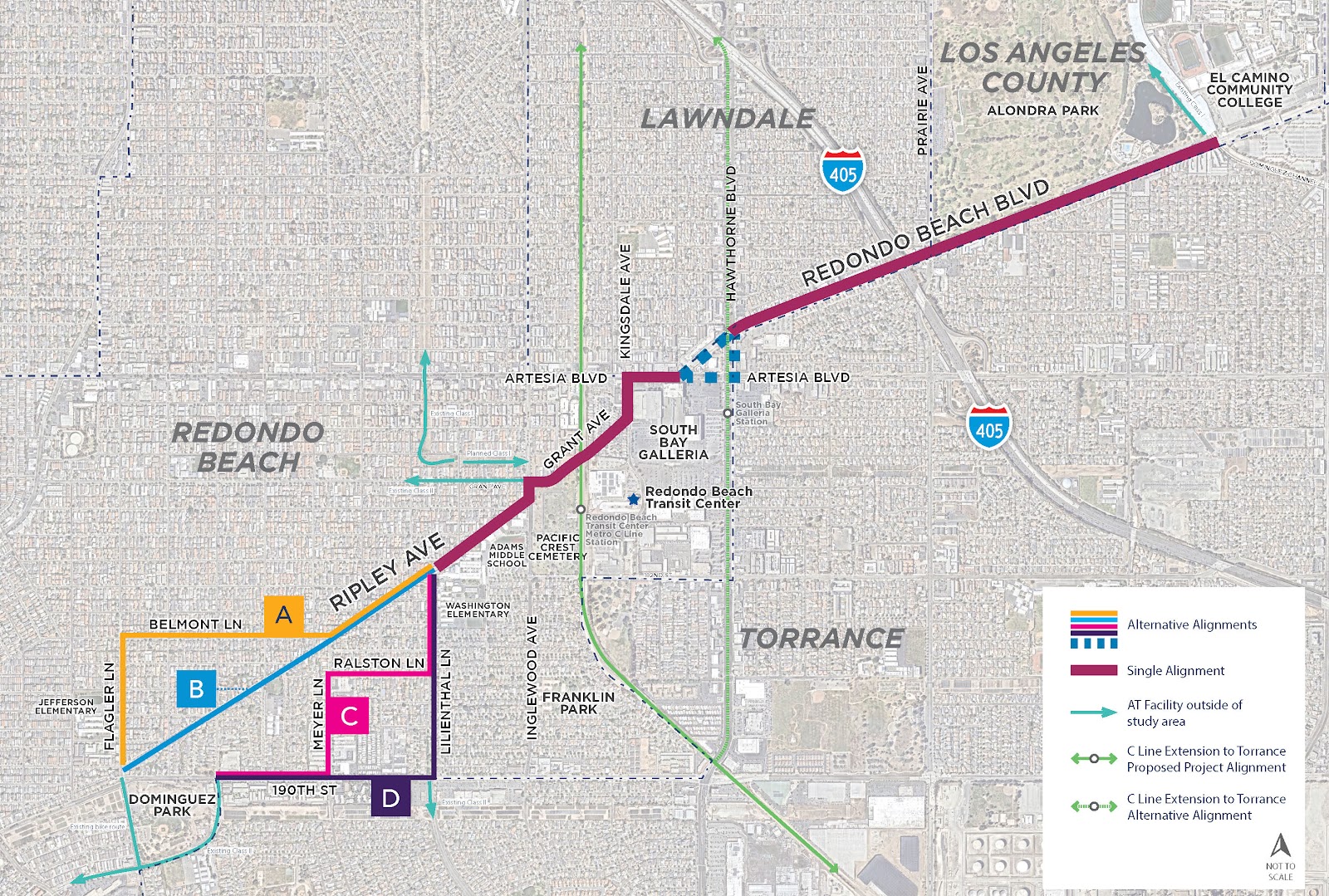
The project area below was originally going to be along the old freight route from Redondo King Harbor to the inland rail routes, but Ripley was found to be too steep (several areas with 15% grades) to be feasible for safe cycling. 


A Redondo Beach traffic study determined that 30% of the city's AM/PM peak traffic is the child school run. This travel corridor includes

  • Adams Middle School: 1066 students: 6-8 grades
  • Washington Elementary School: 801 students, K-5
  • Jefferson Elementary School: 509 students, K-5
That's almost 2400 K-12 students arriving and departing each day on this corridor. 

But that's not all, because all students in Redondo Beach Unified School District (RBUSD) attend Redondo Union High School (RUHS) in South Redondo Beach*. Jefferson ES students also attend Parras Middle School south of RUHS. 

Assuming 350/grade at Adams MS and 90/grade at Jefferson ES, 

350*4 + 90*7 = 2030 students cross 190th Street to attend school and return home each day. 

About half of all RBUSD students traverse this corridor every school day.

But that's not all; El Camino College (ECC, 22,000 students, many from the Beach Cities) is on the eastern end of this travel corridor. Some RUHS and MCHS students do concurrent enrollment and take classes at ECC while they are in HS. Due to many factors, including cost and lack of housing at UC campuses, a large number of students are enrolling in grades 13/14 at ECC before transferring to a 4-year college/university. 

When filling out the survey, think about what you would send your kid to school on. Think about what you would be comfortable riding on as you accompany your younger child to school or run your errands. I ride this area 1-2x/week to run errands in North RB or West Torrance. I want better infrastructure for my safety, too. 

Watch this video of the horrifying existing conditions as ridden by two fit MAMILs (Middle-Aged Men in Lycra). Would you ride these steep hills? Next to fast-moving busy traffic?


Here's another video of the area where Kyle, an area father, rides his kids to preschool. 


My opinionated guide for the survey choices and why they matter: 

Every cross-section shown is facing either Eastbound or Northbound.

Q1: For the westernmost portion of the corridor, which alignment(s) do you prefer? 


I picked D because that would give us a 2-way cycle track on Lilienthal and the longest length of protected bike lanes on 190th. 190th St is also the only way to avoid steep hills. 

The problem with B: The first video shows just how steep Ripley is. Notice that the lead cyclist on a light road bike has trouble getting up the hill (and the trailing cyclist with the camera is on an eBike). Going up a 15-16% grade is difficult, but going down them is downright dangerous. Do not send kids on this route. 

A and C are better, but still steep in some sections. Also, if those are the official routes, there will not be likely any road changes except Sharrows, which are shown to be more dangerous than not doing anything

Only Option D along 190th St will yield any road space allocation for cyclists. 

What is a Sharrow? 

Why are Sharrows so dangerous? 

Q2: The proposed street section for 190th St (Alignments C and D) is shown here. How satisfied are you with this proposal?


I picked Very Dissatisfied: These cross-sections are looking towards the east, with Torrance on the Right Hand Side (RHS) and Redondo Beach on the LHS. Cars are coming down the hill from Flagler and often speeding 50 eastbound mph. People drive with the sun in their eyes during the morning and evening commutes. Do you feel safe with just paint and plastic poles designed to bend when run over by vehicles?

I recognize that people living in the apartments in Torrance on the right need overflow parking, but let's swap the bike lane and parking lane. Install a parking-protected bike lane like this one in Long Beach on the Torrance side with breaks to preserve sight lines at each driveway or street crossing. 


On the RB side, I'd like to see real bollards or a curb. Imagine something like these without the parking lane. Images courtesy of National Association of City Transportation Officials (NACTO)


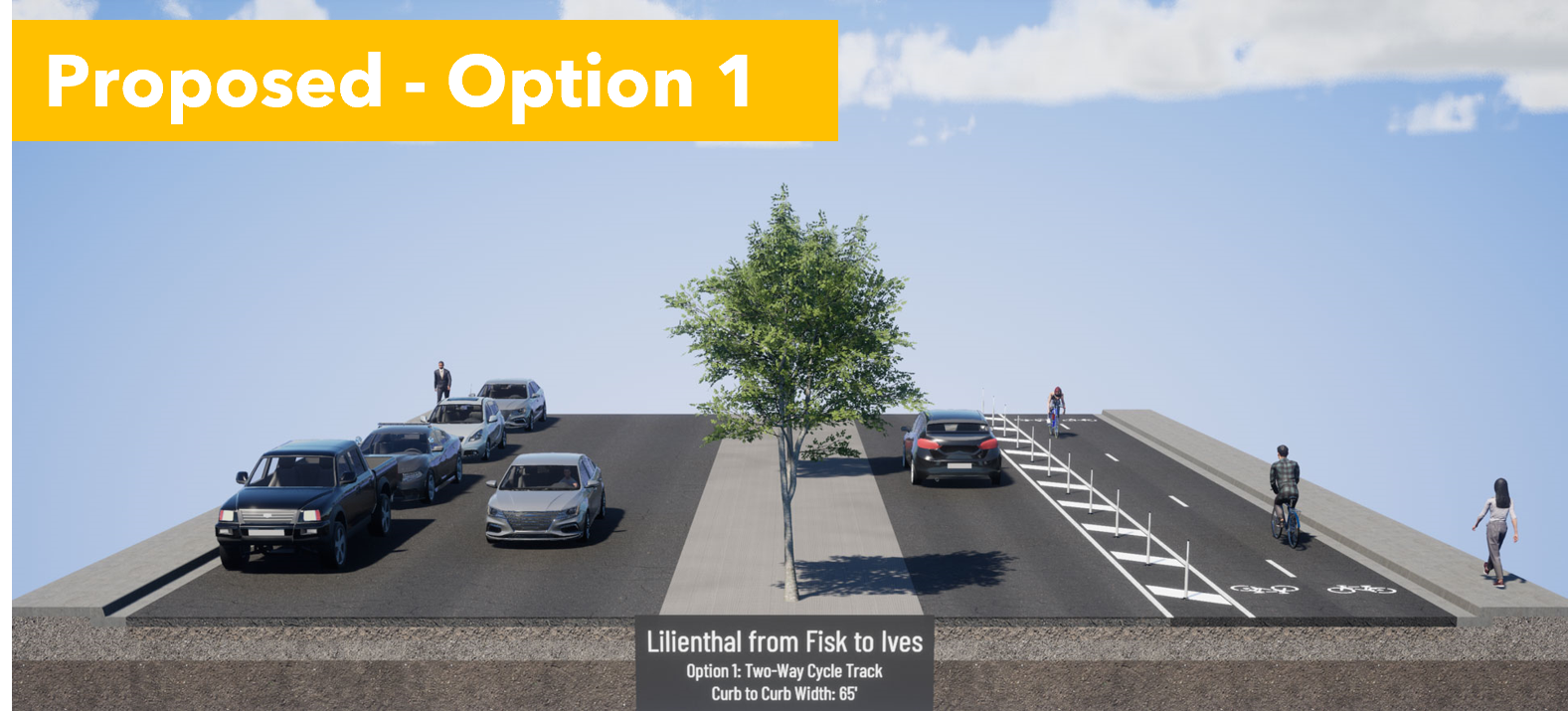
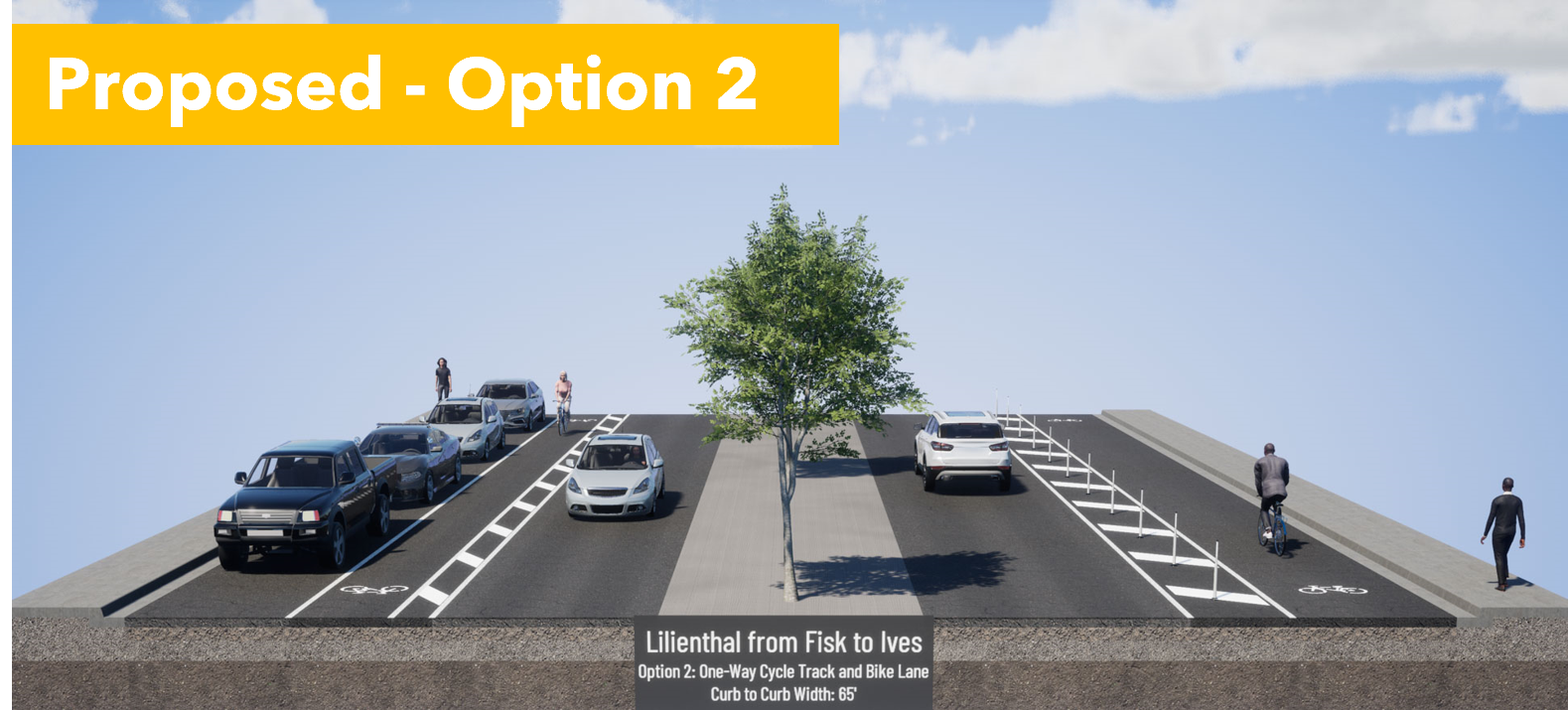
Q3: Select Option 1, the 2-way cycle track on the east side, next to Washington ES. 


Option 1 provides separation from cars, and is wide enough for passing, and allows parents to ride side by side with a child gaining confidence in their bike skills. In 2-way cycle tracks, people riding opposing car traffic are facing approaching cars, so they can see and react to dangerous drivers. It would be better to have solid protection here, but Option 1 gives us room to retrofit with more solid barriers later. 


Option 2 puts kids in the door zone on one side and makes them cross the street to get to school. It's a dangerous situation. 


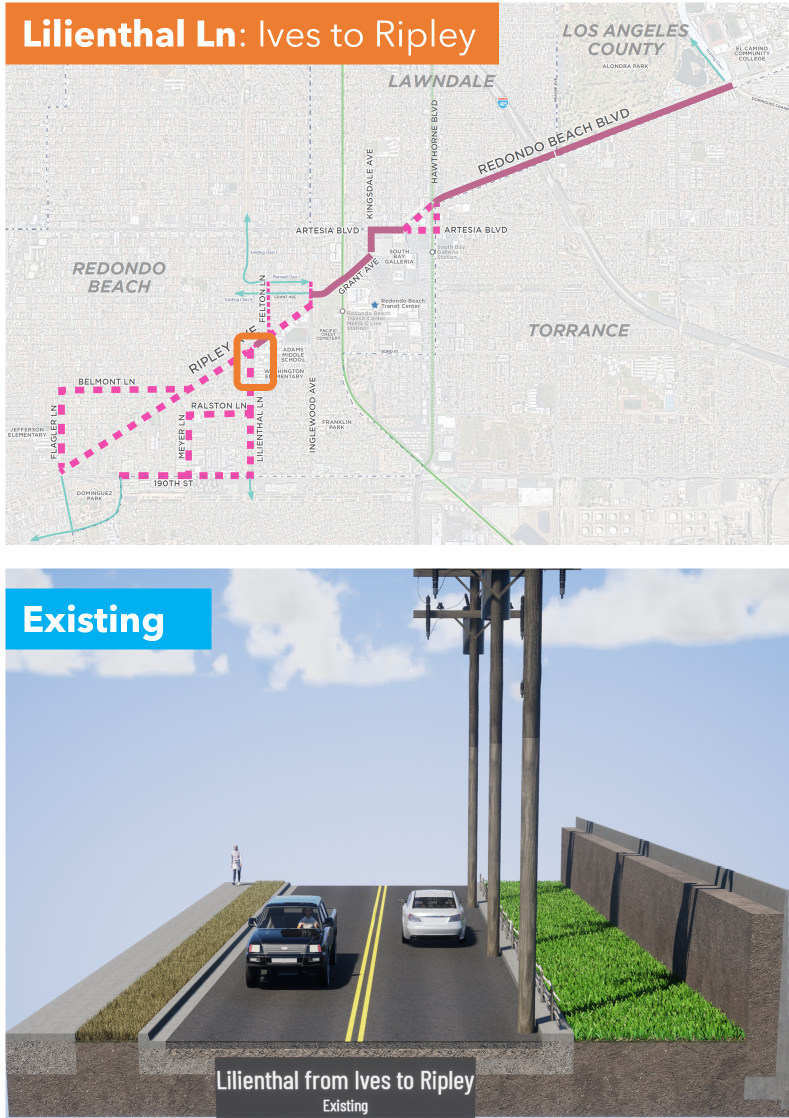
Q4: Select Option 1, the 2-way cycle track on the east side, next to Washington ES.  


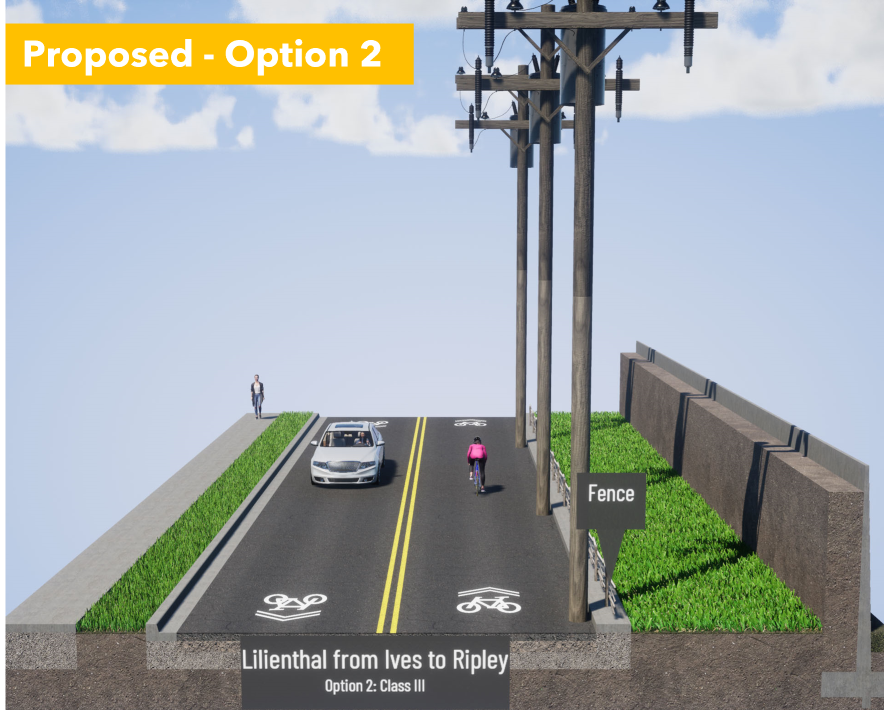
Don't be distracted by the stock visualization image with a tall solid wall. There is currently short solid wall on the parking lot side and a wood and rope fence on the road side. 


Option 1 gives a clear place for kids to ride that is physically separated from cars. The 2-way cycle track would replace the wide grassy area.


Option 2 is sharrows in a place where drivers are more focused on making a turn at Ripley than cyclists approaching from behind them. 

Motorists trying to make a right turn will pull over to the right, trapping cyclists behind them. Small children on bikes and tall, boxy hoods on todays trucks and SUVs mean that parents may not be aware of cyclists in front of them. This has led to an epidemic of frontover crashes where drivers run over people in front of them because they can't see them over their hoods. Or, they look at their screens and forget that there are children in front of them. 

Option 2, sharrows, is a safety disaster. 


Q5 on Ripley: Pick Option 1, the 2-way cycle track on the Adams MS side


Option 1 keeps the kids on the school side as long as possible. It also preserves the car unloading curb space that people are currently using. 


Option 2 puts kids in the door zone, at precisely the time that kids being driven to school are unloading. This is a safety disaster. 


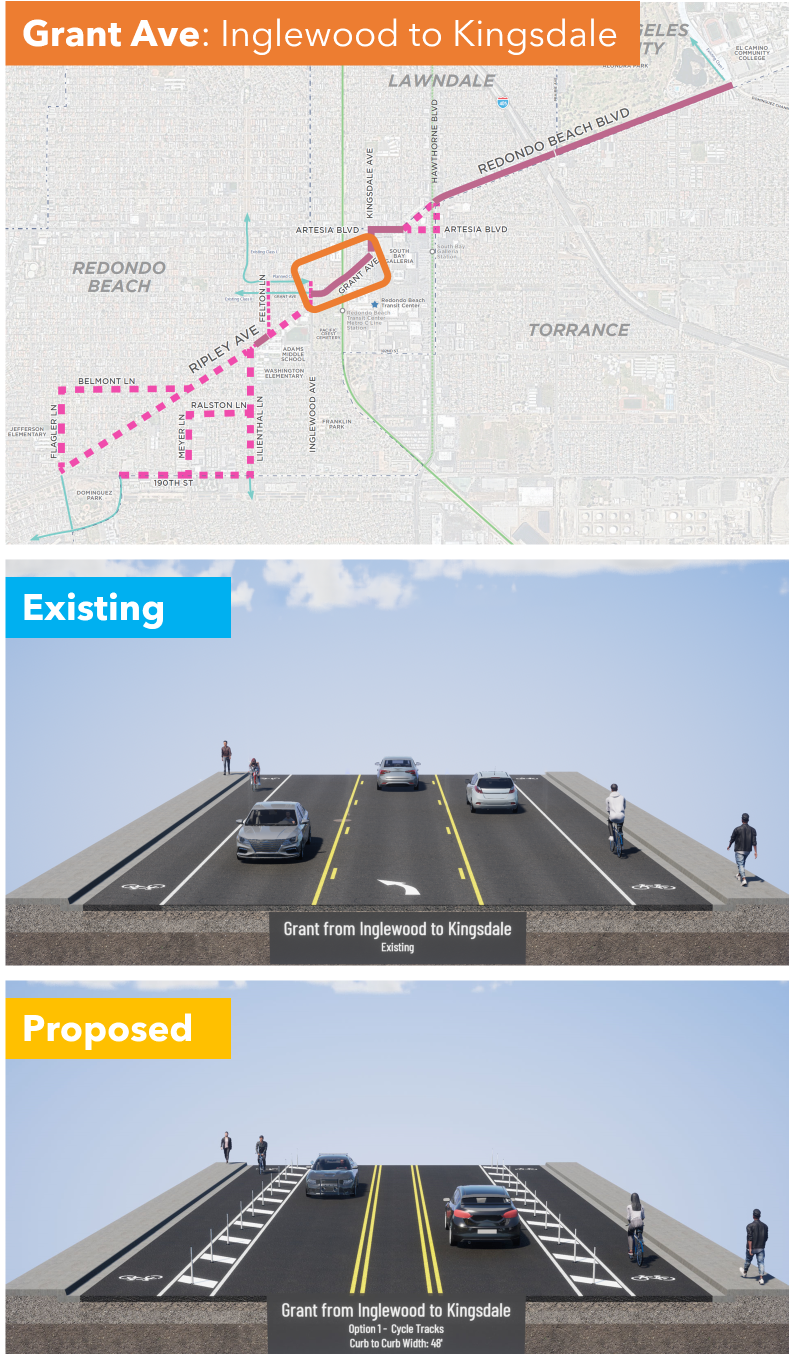
Q6: Grant Ave from Inglewood to Kingsdale; I am very dissatisfied but I selected other and explained why we need solid protection instead of plastic bendy poles


They are proposing paint, a buffered (space separation) and plastic bendy poles. 

This is better than existing conditions, but not safe. Cars pick up speed heading downhill and frequently misjudge the curve, so they end up sideswiping cyclists in the bike lane. We really need a concrete barrier on the downhill (right hand) side. 

I ride by bike to shop at the Galleria and this is the scariest part. I saw a guy almost get killed here. If we want more people to bike through this area, which connects to shopping, the South Bay Transit Center, and the 300 new homes under construction, then we deserve solid protection in this dangerous area. 

I gotta break for lunch but I'm going to hit Publish on this so you can get started. I'll finish after lunch. 

...

I'm back. Stay with me because we are on the home stretch, but the most dangerous one that crosses the 405 Freeway and has the most high-speed traffic. 

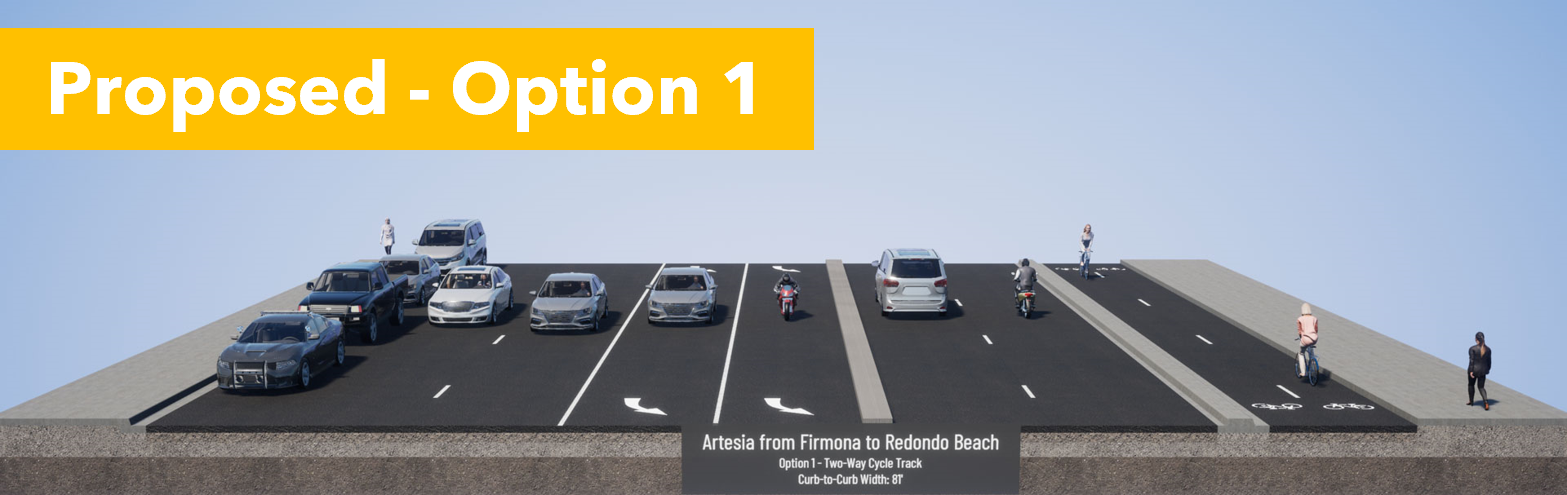
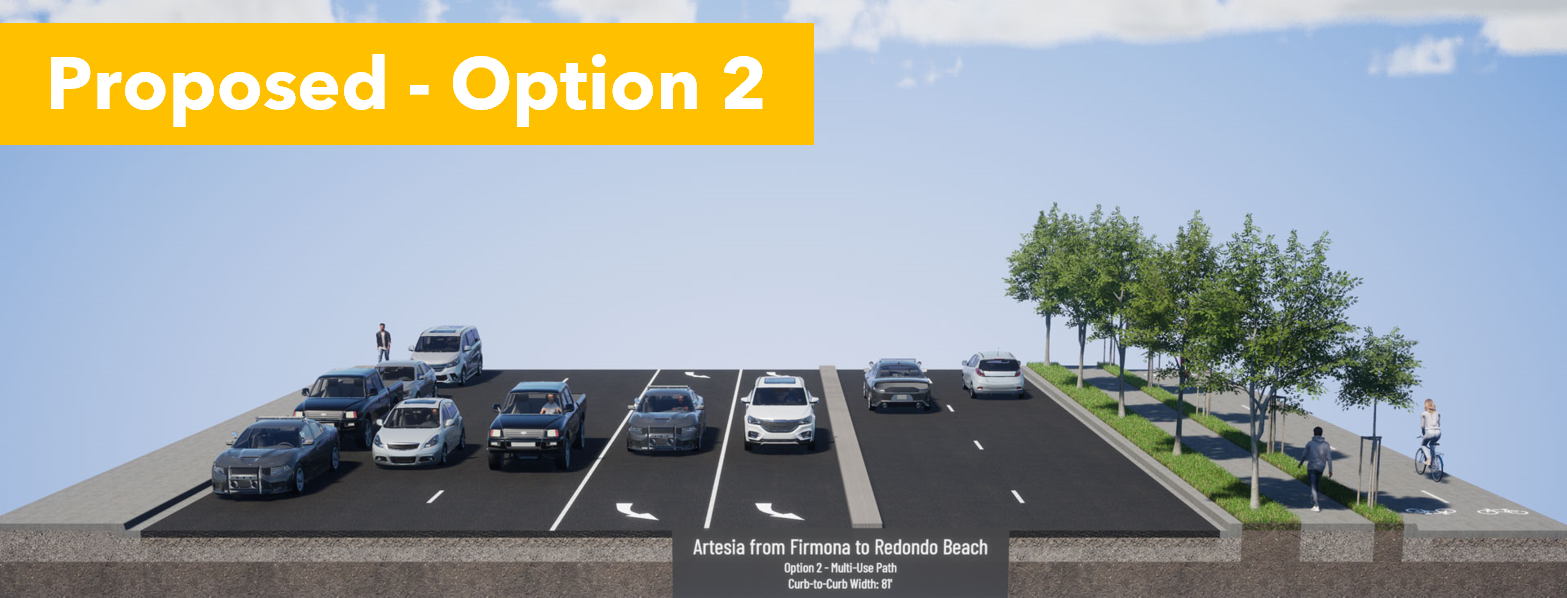
Q7: Artesia Blvd from Kingsdale Ave to Redondo Beach Blvd pick Option 2.  

Existing conditions are awful and you see very few cyclists brave enough to ride here. If they do, they are often on the sidewalk, conflicting with pedestrians. 

Option 1 puts cyclists next to vehicle lanes, but protected with a concrete curb. Pedestrians and cyclists would intuitively understand where they are supposed to be, as faster bike traffic is at the street level. However, this would interfere with bus stops. 


Option 2 puts pedestrians next to the vehicle lanes, but also next to the bus stop. Trees would provide shade. There could be some confusion with pedestrians wandering on the bike path, but that can be solved with good signage.


Our community has experience with pedestrian and bikeways next to each other in the North Redondo Beach Bikeway (NRBB). While there is some spillover, people have already learned where pedestrians and rollers have priority on the NRBB. Option 2 will work best for us and we already know how to use it. 

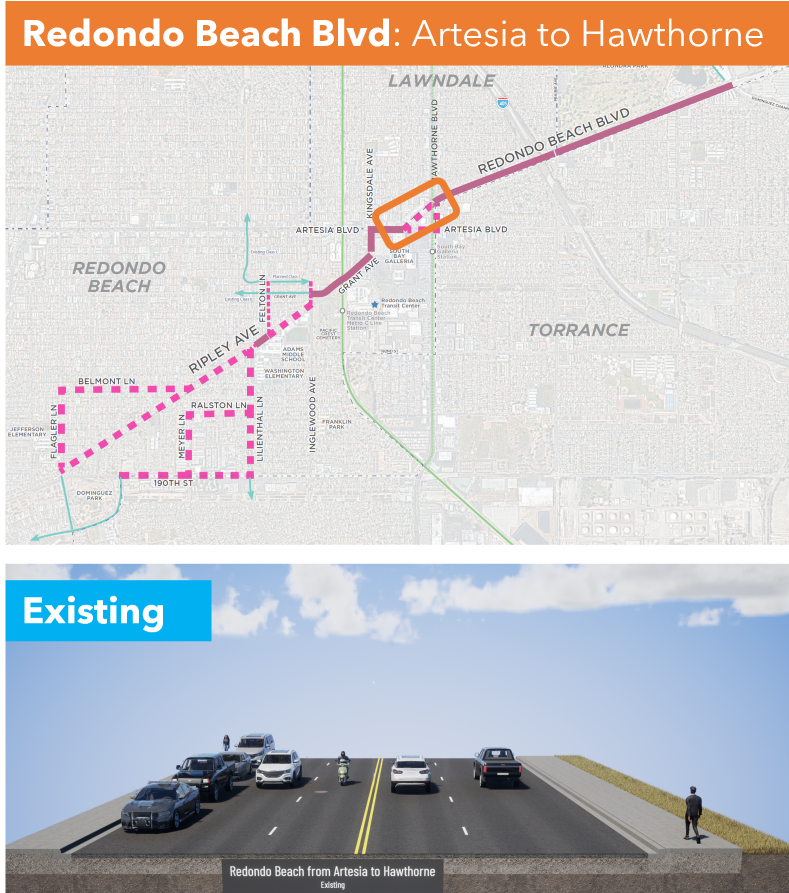
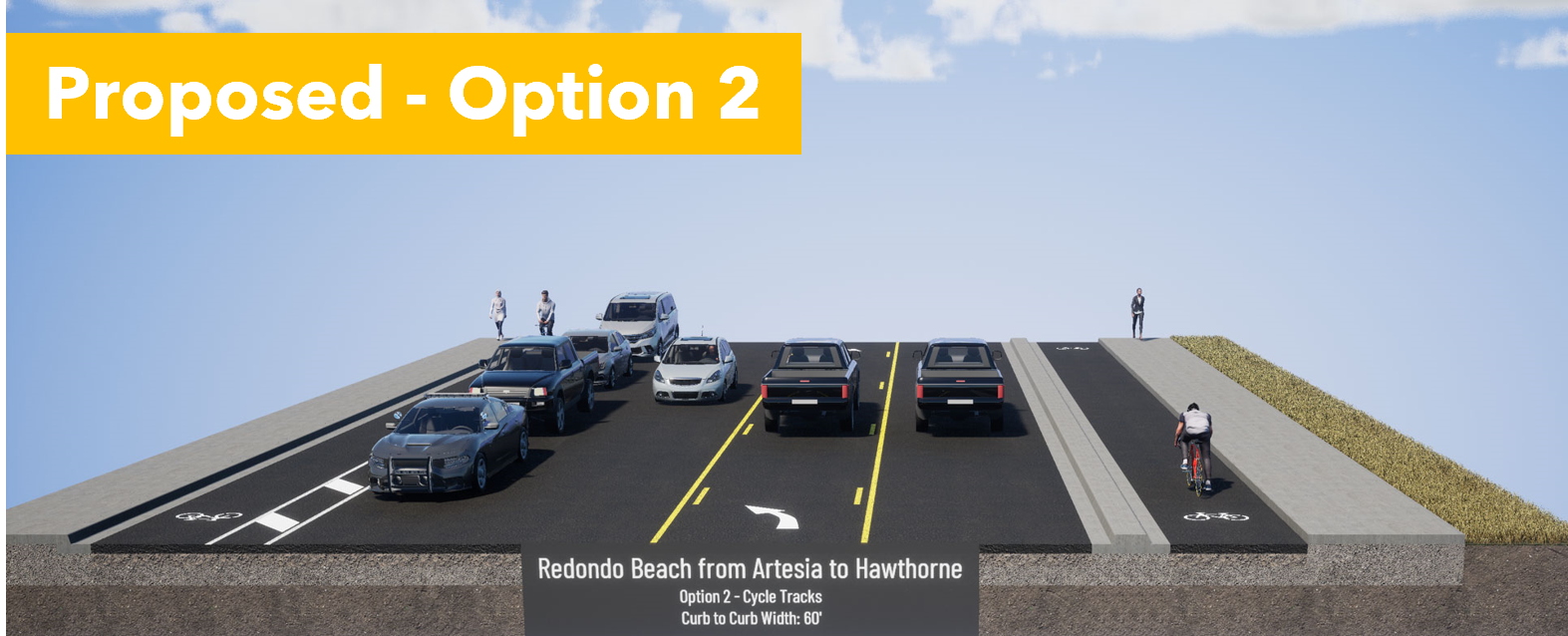
Q8: Redondo Beach Blvd from Artesia Blvd to Hawthorne Blvd. Is a tossup but both Options are so much better than the status quo.


Option 1 pits cyclists against pedestrians, but provides 2-way access to Walgreens and Starbucks. It's not terrible as long as cyclists slow down when passing pedestrians and motorists exiting the parking lots look both ways. 


Option 2 provides a clear separation between motorists, cyclists and pedestrians. Cyclists are curb-protected on the eastbound RB side, and parking-protected on the westbound Lawndale side. However, coming westbound from Walgreens/Starbucks, people will likely bike on the sidewalk until they meet the 2-way cycle track. 


Although you lose a traffic lane, it's not the cyclists' fault. One can just as easily blame the space allocated to free car storage (on-street parking) and a turn lane. Motorists are losing a travel lane to other motorists, not cyclists. Don't forget that. 

Option 1, the 2-way cycle track, provides a better alternative not suggested by Metro for the next section. 

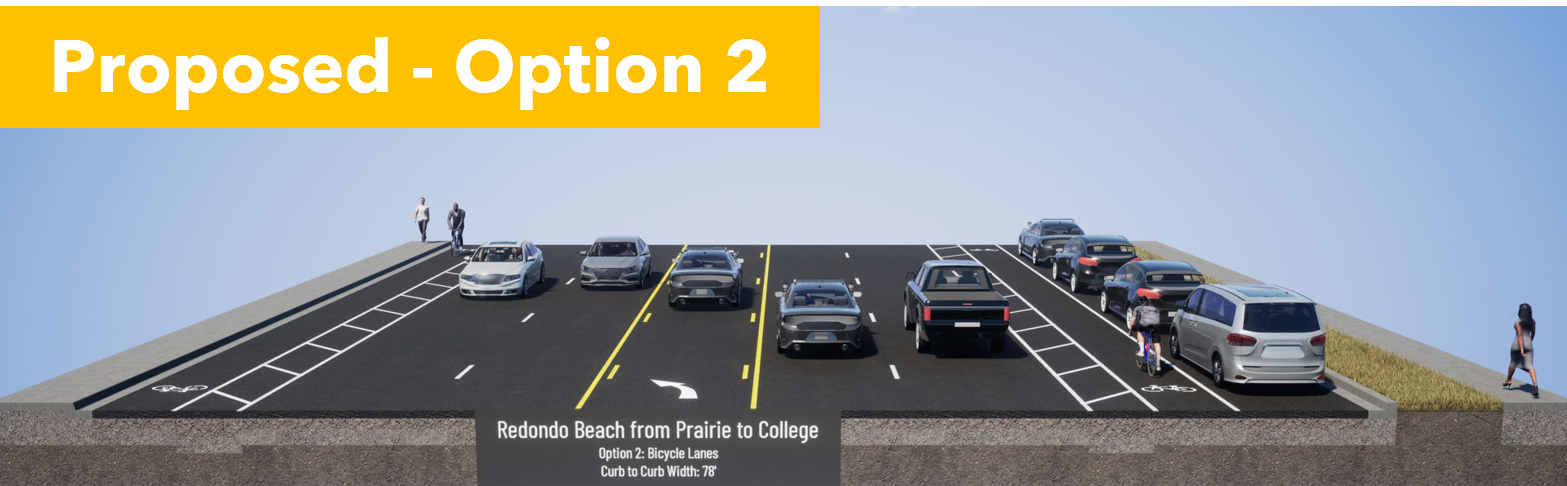
Q9: Redondo Beach Blvd from Hawthorne Blvd to Prairie Ave. I am Very Dissatisfied & propose a better solution. 


Although the status quo is very bad, we shouldn't rush into the proposed door zone bike lane next to high-speed traffic heading to the freeway onramps. It is extremely dangerous. This will greatly reduce the number of people brave enough to ride to Alondra Park and El Camino College. 

If there is enough room for on-street parking, then there is enough room for a parking-protected bike lane. That may require narrowing the car lanes a bit, but that would also inhibit speeding, making that stretch safer and quieter for all road users. 

The freeway onramp is on the north side of RB Blvd. A 2-way cycle track on the south side of RB Blvd would keep cyclists away from the crazy line of cars trying to merge onto the 405 on-ramp. Suggest that in Q11. 

Q10: Redondo Beach Blvd from Prairie Ave to Dominguez Channel. Pick Option 1, the 2-way cycle track on the North side, next to the park and El Camino College. 


Option 1 puts cyclists next to the park and ECC. Although it is shown with plastic bendy straws, it can easily be fitted with bollards or a concrete curb for better protection when cycling to and from evening classes at ECC. 


Option 2 puts cyclists in the door zone, where they can be knocked into fast-moving traffic and killed. Drunk or malicious drivers can also harm cyclists easily with only "paint as protection". 


Q11: Additional Comments: This is where we ask for a protected 2-way cycle track on on the south side of RB Blvd between Hawthorne and Prairie. 

What do you need to be comfortable bicycling this corridor? Tell them!

Keep in mind that younger Beach Cities kids will probably only ride the western side of this corridor, west of Inglewood or Kingsdale. But older teens and young adults may need to ride to ECC or to retail jobs between Kingsdale and Crenshaw. 

There are a lot of children and seniors in Lawndale and Torrance who would benefit from these bike facilities, whether they are riding a bike, trike or mobility scooter. 

We should make this corridor welcoming for ages 8-80. 

Think about who needs to travel through this corridor and at what times. What kind of cycling facilities do they need to get there comfortably and safely?  What about seniors in mobility scooters or electric wheelchairs? Would you like to see food delivery robots in the bike lane or more food delivery by privately-owned cars?

With better bike facilities, I may choose to bike to stores further east than I currently feel safe. Every trip I make by eBike instead of car, I am "sparing the air", not taking up road space in front of you, and not competing with you for parking. 

Another thing that excites me about this project is that it connects us to the Dominguez Channel. In a separate project, LA County Public Works will be extending the bike path along the channel southwards. It currently goes north to 120th St, past Amazon, Space-X, Lowe's and to the Metro Green/C Line. A southbound channel bike path would connect to the Harbor Gateway Transit Center, with very fast connections to the Silver/J Line to USC/Expo Park (15 min) and Downtown LA (20 min). Harbor Gateway TS is already linked up to CSU Dominguez Hills. This is a large step forward for a transportation transformation for the South Bay. 

Bike lanes benefit you even if you don't ride a bike, but your neighbors do. 

Bike lanes will save you time currently spent chauffeuring your kids short distances. 

Bike lanes will benefit your kids because students who get exercise before school do better. 

Bike lanes will benefit you when you age out of driving. 

Bike lanes may allow your family to shed one car, saving you over a million dollars per lifetime

Finally, I want to close with this terrific video of a #BikeBus led by Coach Sam Balto in Portland. 

https://twitter.com/CoachBalto/status/1656353963489501190?s=20

This bike corridor will touch the lives of half the students in RBUSD and can be transformative for the way our community gets around. If half of our households can shed just one car, we would be richer, our street parking and traffic congestion problems will evaporate, our air and water will be cleaner, and we will have done our part to slow climate change. Oh, we'll be fitter and happier, too. 

* A very few students living in North RB attend Mira Costa HS in Manhattan Beach, but only if MBUSD will take them.