Wednesday, October 18, 2023

The allies we have

I took down a tweet that was getting a lot of traction for reasons I want to explain here. This whole phenomenon and the complex politics around it, deserves more than microblogging. 
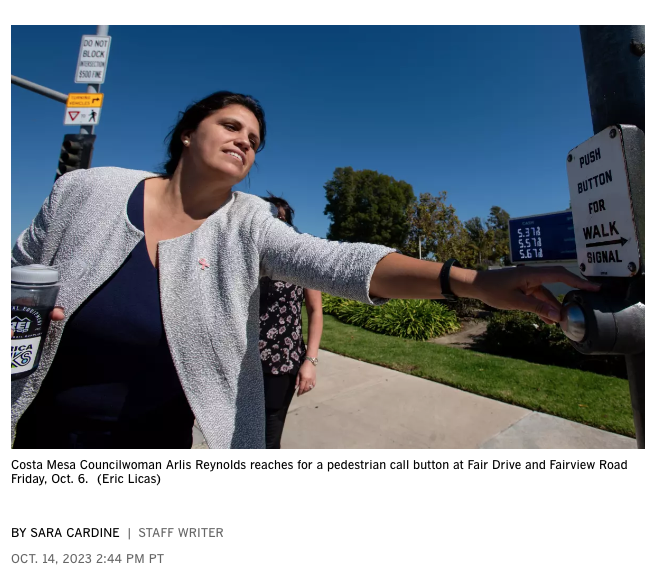
It all started when I linked to this article in the LA Times/Daily Pilot about local elected officials participating in the "Week Without Driving" challenge. Costa Mesa Councilwoman Arlis Reynold said, "I haven't been on a bus in, like, 30 years." 

On the fifth day of Reynolds’ week without driving, the councilwoman was joined by Mayor John Stephens, Thomas and transportation services manager Jennifer Rosales.
[snip]
Stephens, who’s lived in Costa Mesa for 30 years but cannot recall ever taking the bus, said he was stunned to learn how many denizens rely on the local transit system.
I tweeted at how awful it was that elected officials who vote on transit issues don't use it. 

That resonated with a lot of people, and got much attention, retweets. However, I also received comments that it hurts the cause to criticize elected officials who have been allies for safer streets and who agreed to do this experiment and invited the press along to write an article about it. 

They further pointed out that these particular officials don't vote on transit; decisions are made by the Orange County Transit Authority (whose board is made up of elected officials from cities or the county board of supervisors). 

These are valid points and I took down my critical tweet. 

However, I just want to point out that city officials are responsible for the lack of amenities at bus stops, e.g benches, shelters, trash cans, bike racks, way-finding. Bus stops are notoriously hostile places sitting right next to traffic on the busiest and most polluted stroads (street+road). 

Waiting for a bus is literally bad for your health due to air and noise pollution and exposure to car violence.  Drivers have rammed through bus stop benches on both Artesia and Aviation Boulevards near me with enough force to break concrete benches and even pushing one bench (with a woman sitting on it) through the glass windows of the store behind it. 

Cities will use eminent domain and spend $$$,$$$ to buy land to widen intersections for new turn lanes, but they won't do the same to buy a few square feet to move bus stop benches further from the street edge. They don't install plexiglass sound barriers to block wind and dampen noise. They won't install air filters like they do in Korea to protect bus riders from tire and asphalt particulates. 

In conclusion, I'm glad that these particular allies spent a week understanding the challenges of those traveling without cars.  I wish it was mandatory for all elected officials and candidates.  Actually, I wish it was required for everyone, including drivers. 

I am deeply saddened that people are so scared to lose the few allies that they have in Orange County, that they don't feel free to note that officials should have been riding the bus, walking and biking around their cities regularly all along. 

Read the whole article, Costa Mesa councilwoman walks the walk during ‘Week Without Driving’ challenge. In case you can't get past the paywall, the closing is good. 
“I was surprised that [buses] were pretty well packed with people,” he [Stephens] said Tuesday. “We don’t usually walk through the neighborhood like this when we don’t have campaign literature in our hands — whenever you do something like this you become more aware.”

Reynolds, who officially concluded her week without driving last Sunday, is already thinking of improvements for transit riders, first by evaluating all the city’s bus stops to ensure they meet the same standards and adding vital shade and seating where they are currently lacking. And that’s just the beginning.

“I’m interested in looking at broader routes. What I haven’t done is zoom out and see the whole network,” she said in a debriefing Tuesday. “I think there’s an assumption transit can never work in Orange County, but, actually, it could.

“I’m two days past the campaign, and I’m walking still.”
Earlier this year, I read Human Transit: How Clearer Thinking about Public Transit Can Enrich Our Communities and Our Lives by Jarrett Walker. I borrowed an electronic version from the public library and highly recommend it. Jarrett Walker's Human Transit Blog is also good for learning more. 


Wednesday, August 30, 2023

When too much water leads to water scarcity

 Like clockwork, every time we have a big rainstorm, I read news stories and hear people talk about all the "wasted" water running out to sea or out of the arid area. I understand the frustration, but want to highlight some of the complexities. 

For instance, Southern California received quite a bit of rainfall ~10 days ago as the remnants of Hurricane Hilary swept through. We received 2.5" according to my backyard rain gauge. I'll write more about that in a later post (already started drafting it). 

But, I thought it would be interesting to show what happened near Palm Springs, where Interstate 10 was washed out after the area received half of their annual average rainfall in 6 hours. Interstate 10 was shut down for miles due to flooding and mud

One of the surprising things to water neophytes is that less water is captured in torrential rainfall events than in more normal, smaller and slower rain events. 

This is why water professionals are so worried about climate change. Climate models forecast, and our recent experience verifies, that SoCal will get about the same average annual rainfall as in the past--but it will come in fewer and burstier storms like we experienced in August and January/February 2023. 

In arid climates, it makes more sense to store the water underground to minimize evaporative losses. Palm Springs exists due to a large aquifer and faults that allow the groundwater to seep to the surface. After unsustainable groundwater pumping, the Coachella Valley developed percolation ponds to spread imported river water to refill the aquifers. In this way, the aquifer has stabilized. 


This land works remarkably hard precisely because of it's geology. It has the surface to aquifer connection that allows it to function as a percolation pond. But it's also a transportation corridor because it has the surface water needed by overland travelers. 

Can you see the percolation ponds, wind turbines, solar farm, Interstate 10, and the railroad tracks in this aerial photo? That's five uses, not counting housing and related services. 


You can also see wind turbines in this photo from another percolation pond just to the south of this one. 


The transportation corridor is here because of water, but it's also at risk because of water. You can see the Site of the Original Palm Springs RR Depot in this aerial photo, along with Whitewater Canyon, which feeds the Whitewater River that eventually drains into the Salton Sea. 


It's more dramatic in the terrain contour map. 


The people are here because the water is here. 
The water is here because the mountains are here to squeeze the water out of the sky. 
The mountains are here because the faults are here. 
The water reaches the surface because the faults are here. 

It's all interconnected, but I'm digressing again. 

This is about why we couldn't capture most of the water from bursty rainstorms into the aquifer. 

Turbidity and Water

You know how lake beds have very fine soil impermeable (or only slightly permeable) to water? This allows them to hold the water. Watch Who Fills Your Taps as Kathy Kunysz explains how, when water comes pouring off the mountains, the larger gravel falls out first, and then the finer silt settles into clay layers (aquitards). If you don't keep the finer particles out of your spreading basin/percolation pond, they clog up and cease to function. 


If you don't have time to watch this 75 minute video, you can view the slides


In order to preserve the percolation pond, they had to redirect the muddy runoff AWAY from them, so they didn't capture most of the runoff. This happened in January 2023 and again in August 2023. 

If the rain comes too fast, and the water contains too many fine particles, then you can't capture it in percolation ponds. More and more of our rainfall is going to come from these bursty storms. 

The good news is that they water was diverted around the percolation ponds and sent downstream to feed the shrinking Salton Sea. If we preserve and restore coastal wetlands, that silty water can replenish the marshes, build up the coastline, and help protect us from sea level rise and storm surges. The bursty flows can scour out the waterways, remodeling/refreshing wildlife habitat. 

It's all good. 

Waste is in the eye of the beholder. If you look at it in terms of what's valuable to humans, you aren't seeing the whole picture. 

But, it also means we have to work harder and and spend more money to capture the same amount or less water, due to climate change. The people who told you that we couldn't do anything to stave off climate change because it was too expensive played the American public for chumps and we fell for it. 

Wednesday, August 23, 2023

The ghost of wells past

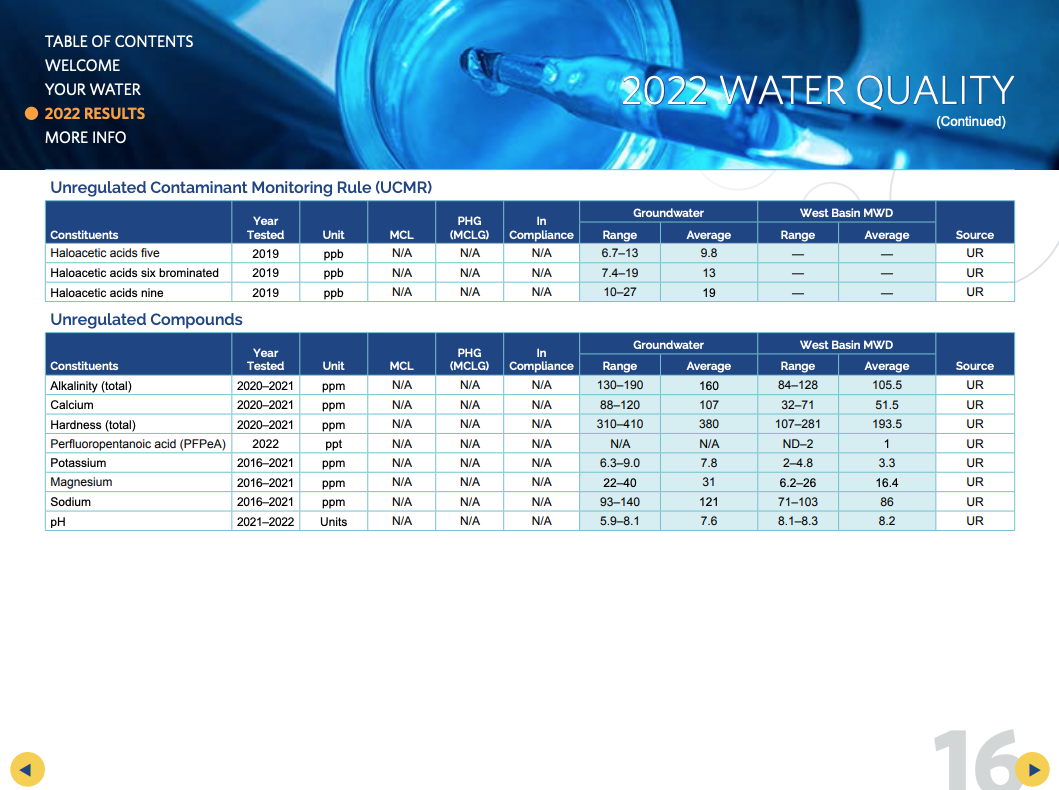
Remember when I wrote that I wasn't that worried about PFAS chemicals in my drinking water? I'm still not worried about it. But several things stood out when I looked at the 2022 Hermosa Redondo Water Quality Report


I expected to see small (but safe) amounts of Uranium from the imported drinking water purchased from Metropolitan Water District (via West Basin Municipal Water District). That's a blend of Colorado River and Sacramento-San Joaquin Delta water. For myriad reasons, water from the 4-corners states in the Colorado River Basin contains Uranium and Radium. 

But, why does my local groundwater contain more Uranium than the water imported from the states where we used to mine Uranium, and make and test bombs? I posted that question on the social media platform formerly called Twitter and had my answer in minutes. 

I found a map of active water wells from LA County Dept of Public Works. Unfortunately, I couldn't figure out how to download the map and combine it with other data so you'll just see a screenshot. Look at the 3 aqua balloon pins near the right of the map, just west of Inglewood Blvd. 


Now look at the map of Oil Wells (Inside LA County) from City of Los Angeles GeoHub


See the old oil wells that used to operate in the vicinity of the active water wells? 

EPA: Radioactive Waste Material From Oil and Gas Drilling

Rocks in and around certain oil- and gas-bearing formations may contain natural radioactivity. Drilling through these rocks or bringing them to the surface can generate waste materials that contain radioactivity.
I'm drinking a blend of local groundwater and imported river water with an average of 2.3 pCi/L and 1 pCi/L of Uranium respectively. 

The federal EPA Maximum Contaminant Load (MCL) for Uranium in drinking water is 20 pCi/L (one trillionth of a Curie per Liter; a Curie is a measurement of radioactivity). However, there are measurable increases in negative health outcomes for water above the EPA MCL Goal (MCLG) of 0.43 pCi/L. 

This is concerning but not panic inducing (at least for me.) Reverse Osmosis (RO) reduces contaminants in water, including Uranium and PFAS chemicals. RO also reduces the calcium salts responsible for Water Hardness. Anything above 300 ppm (parts per million) is considered hard water. Imported river water is semi-hard, at ~200 ppm, but the groundwater here is 380 ppm. 

I would be happy to pay for RO treatment of household water. The small extra expense would reduce wear and tear on my home's plumbing and my housecleaning time. It's a worthwhile tradeoff. 


[The EIR for West Basin's abandoned plans to build a desalination plant estimated that the RO-treated ocean water would have saved customers an average of $300/year in reduced plumbing and appliance replacement expenses. Coastal NIMBYs enjoying 100% imported river water blocked the plant despite support from inland communities using very hard groundwater like mine.]

Today's LATimes features an excellent profile about Adel Hagekhalil, general manager of Metropolitan Water District of Southern California. He talks about the existing three pipelines that bring water from the Delta, Owens Valley and the Colorado River. He advocated for developing our "Fourth Pipeline" of local water sources. 

I fully support that vision; it's an achievable goal. But let's not kid ourselves that it will be easier or cheaper. There are tradeoffs for everything, as I learned from the Water and Infrastructure Group lecture series I co-organize. Understanding Drinking Water Quality taught me the limits of conservation. Groundwater 101 and Measure W taught me the difficulty of developing *new* groundwater supplies. San Diego's Pure Water and LA County Sanitation Districts taught me the challenges of water recycling. 

I'm willing to pay a little bit more to stop dewatering faraway places, to honor our treaties with Tribes, for higher quality water, and for more reliable and secure water supplies. We have the technology to do all these things, but financing it is going to be the biggest hurdle. Middle and higher income users will be fine. 

But, I ask you to join me in overturning Proposition 218, which constrains our ability to buffer lower income people from the impact of higher utility bills. We need to figure out a way to spread the costs equitably, which includes overturning Prop 218 and securing State and Federal funds to help low-income users.