Speaking of the afterlife of shipping containers, the LA Times published a story about a house made up of recycled shipping containers going up in my neighborhood. Click here to read it. The Pirkl shipping container house is very close to my favorite jacaranda tree so I have many reasons to visit that street.
While I am proud to live in a diverse neighborhood that is open to new housing concepts, I do have reservations about the house. My first reaction when I walked by was, "It is so BIG." The house volume is huge; it might be even taller than the McMansion next door to it.
This was once a single story neighborhood. The newer houses are two or two and a half stories tall. The newest houses also have soaring ceilings of 9 to 20 feet. 8 foot ceilings are not good enough anymore.
Our city's building code constrains the square footage of living space and the peak height, but there is no limit on building volume. The new houses have so much bulk, they are houses on steroids. Suddenly, the neighbors' homes and yards are thrown into shadow by someone else's need for bragging rights to the most headroom. (Let's not discuss the height of SUVs.)
The media helps fuel this frenzy. I lost track of the number of times I have read stories in the LA Times magazine about homes built on tiny lots in Venice with 10, 12, 14 and 20 foot ceilings. If you do the math, a 3000 sf house with 12 foot ceilings has the same volume as a 4500 sf house with 8 foot ceilings.
Low ceilings in new construction signal considerate, good neighbors.
Addendum: I read in the article that the containers were imported from Florida. What's wrong with using some of the shipping containers sitting in our backyard? Or rather, the backyards of some of our poorer neighbors in Wilmington?
keywords: neighborhood, neighbors, architecture, shipping containers
Saturday, July 15, 2006

Sunday, July 09, 2006
Shipping Containers
In my little bubble world, I thought that shipping containers were something that merely clogged up the highways at inopportune times. I had never given any thought to what happens to all those shipping containers. I had assumed, that they were reused for shipping goods back and forth.
What happens, when the goods are shipped only one way? The shipping containers would be sent back empty for reuse. Surely they were too valuable to let pile up?
I was wrong. Read this article in the LATimes. The shipping containers are piled up in poor neighborhoods-sometimes stacked 7 high. The print version of the article has an accompanying graphic showing the number of incoming and outgoing shipping containers in Los Angeles and Long Beach harbors by year. (The graph is missing in from LATimes.com which is another good reason to subscribe to the hardcopy.) In essence, the graph shows the outgoing shipping containers remaining relatively constant, 2.4 million in 2005, while the incoming climbs relentlessly from 2.6 million in 1995 to 7.2 million in 2005.
earlier post: Goodie Bags and the Wealth of Nations
Saturday, July 08, 2006
Basalt Tank Derailment

I started the Basalt tank yesterday using stash yarns in Amish colors. I encountered several difficulties. These are the two hexagons I had intended to use for my center front and back.
I made the hexagons in the round. For the first hexagon, I used green yarn and the corrections posted by cmeknit but the hexagon puckered in the middle in an unattractive way. So I frogged it back to row 24 and made both garter stitch/eyelet sections the exact same way. I was happy with the result until I got to the inside stockinette section. The decreases were too frequent and caused puckering in the center.
I had previously made two other sweaters with equilateral triangles, but the decreases came at the rate of 6 stitches over 8 rows. Click here for a discussion about the correct decrease ratio for equilateral triangles. Click here for another discussion about the correct decrease ratio for right triangles.
Since I was knitting in the round, I placed paired decreases every 3rd row (6 decreases every 9 rows). The resultant green hexagon has a slight volcano which is barely noticeable. The hexagons in the photograph have not been blocked (just patted down a little bit for their photo op).
So, if I used 2 colors of the same yarn, Cascade Key Largo, then why do I have a small amount of the green yarn left over after completing the hexagon but ran out of the red yarn with 7 stitches remaining on each side?! If you read the label, they both are supposed to be 110 yards.
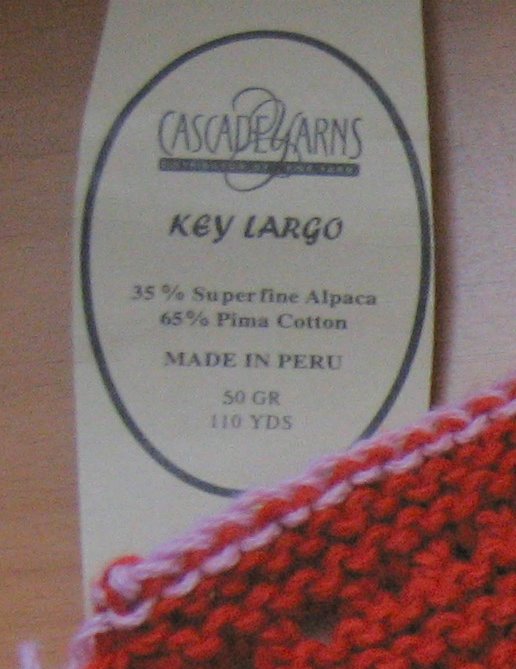
So I am at a crossroads. What should I do?
- Join a ball of dark berry colored yarn and pretend I planned a contrast section all along.
- Bind off and leave a peekaboo section in my midsection.
- Frog the whole thing and use it as a side 5/6 hexagon. (But this would put the red right next to the green and make a summer sweater look like Christmas.)
- Frog back to just after the second eyelet row and continue in stockinette until I run out of yarn. Stockinette would take less yarn than garter stitch and I might have enough yarn to knit the center completely in stockinette (or leave a smaller peekaboo section).
- Some other solution from the wisdom of the internet.
Addendum for knitting these hexagons in the round
 The pattern was probably written for knitting back and forth to avoid the jog at the end of the rounds. See the mismatch at the change of rounds when switching from garter to stockinette?
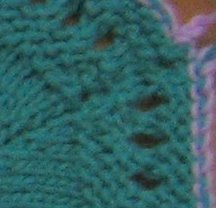 Here is what happens when I remembered to knit the first stitch of the round together with the stitch immediately underneath it. The garter purl ridge is lifted up just enough to meet the ridge at the end of the prior row. No jog!
Pay no attention to the pink yarn. I was trying to avoid lumpy seams by using this nifty trick in Lucy Neatby's latest newsletter for crocheting a provisional cast on.
Subscribe to:
Posts (Atom)